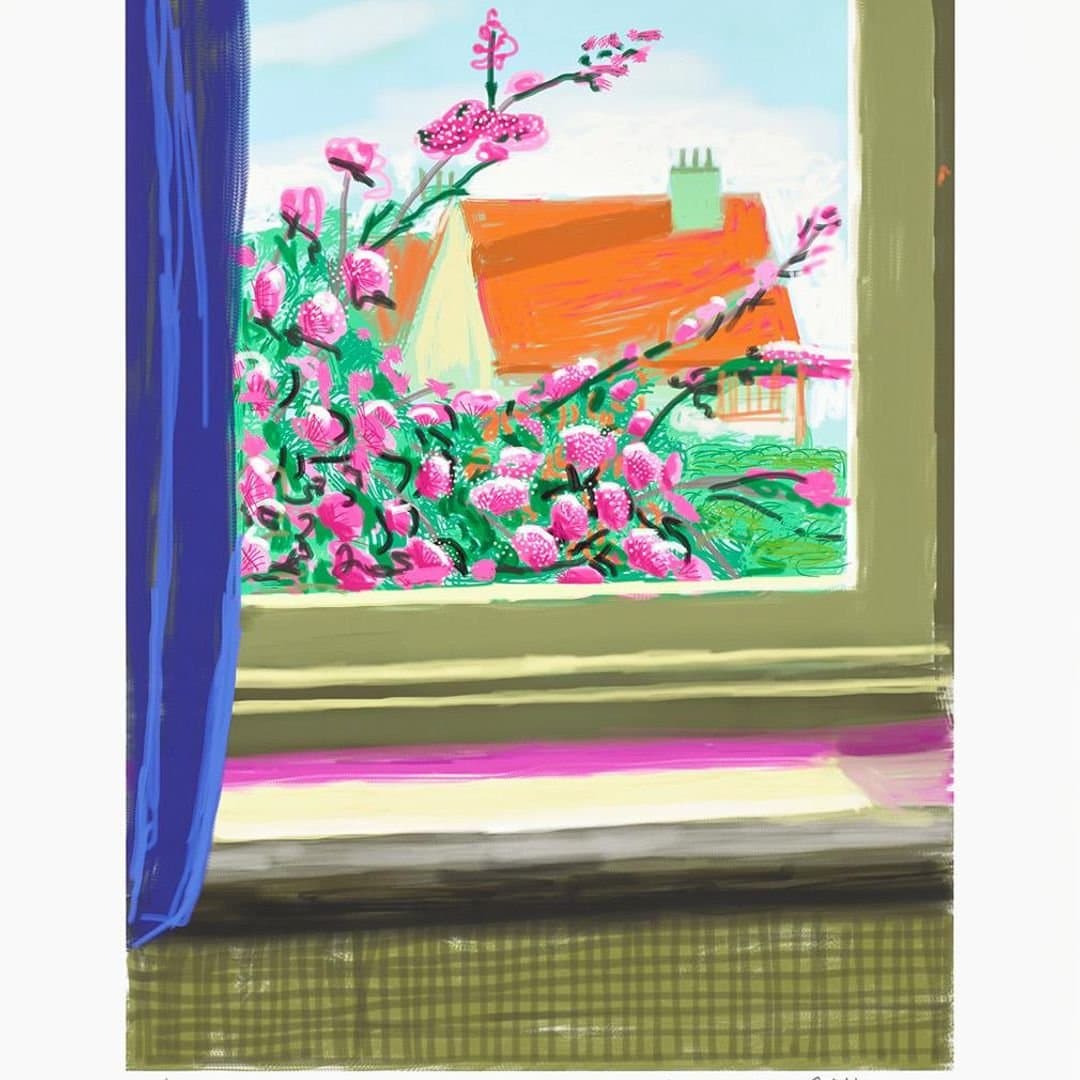
David Hockney
Untitled No. 778, My Window, 2011
Ipad drawing
Contemporary & Post-War


Sixty years of printmaking across more media than almost any of his contemporaries — which is exactly what makes his market hard to read.

Hockney has been making printed editions since the early 1960s, and the breadth is the defining fact of his market rather than a footnote to it. Etchings and lithographs from the sixties and seventies, screenprints, the photographic collages, and since 2009 the iPad drawings issued as inkjet editions. These are not one market with several corners. They are different markets, with different buyers, different condition risks and different price behaviour, and a valuation that treats them as interchangeable is not a valuation.
The question owners actually arrive with is narrower and more awkward: is what I own an edition at all? His images have been reproduced as exhibition and museum posters for six decades, in enormous numbers, and a good poster in a good frame looks very like the edition it was advertising. The answer is in the margins — a published edition is normally signed in pencil and carries a numbering or proof marking, and the sheet matches the edition's recorded size — and the margins are exactly what framing hides.
At the top of the market the figures are unambiguous. Portrait of an Artist (Pool with Two Figures) sold at Christie's in New York on 15 November 2018 for $90.3m, which was then the highest price paid at auction for a work by a living artist. The Splash followed at Sotheby's in London in February 2020 at £23.1m, and Nichols Canyon at Phillips in New York that December at $41.1m.
None of those were prints, and that is the point worth holding onto. Headline results for unique paintings tell you that the name carries weight; they tell you almost nothing about a sheet of paper. What decides a print's value is duller and more specific: which edition it belongs to, who published it, what medium it actually is, whether the inscriptions in the margin are consistent with the edition, and how the sheet has been kept. Light fading is the one that catches owners out, because it happens slowly on their own wall.
Results as reported at the time of sale, inclusive of buyer's premium. They are a record of what specific works achieved on specific days, not a guide to what any other work is worth.
We represent the seller rather than the auction house: comparing houses and sale dates, negotiating the seller's terms, and keeping the paperwork and remittance in your name. What sets the value of a David Hockney sets out what we look at first.
Whitebank Fine Art is a London art advisory and gallery. A photograph and a few details are enough to begin — a valuation carries no obligation to proceed.