
Art News ·
Bayeux Tapestry History: Controversies and the Artists It Inspired
By Rich
Few works of art have been argued over as long, or as passionately, as the Bayeux Tapestry. For more than 900 years this strip of cloth has been a sacred object, a war trophy, a propaganda tool and a diplomatic bargaining chip. It is also one of the greatest pieces of visual storytelling ever made, and contemporary artists are still borrowing from it today. This guide covers the history of the Bayeux Tapestry, the controversies that surround it, and the modern artists it has inspired. You'll find our artist guides to Grayson Perry and Andrew Crummy at the bottom of the page.
What is the Bayeux Tapestry?
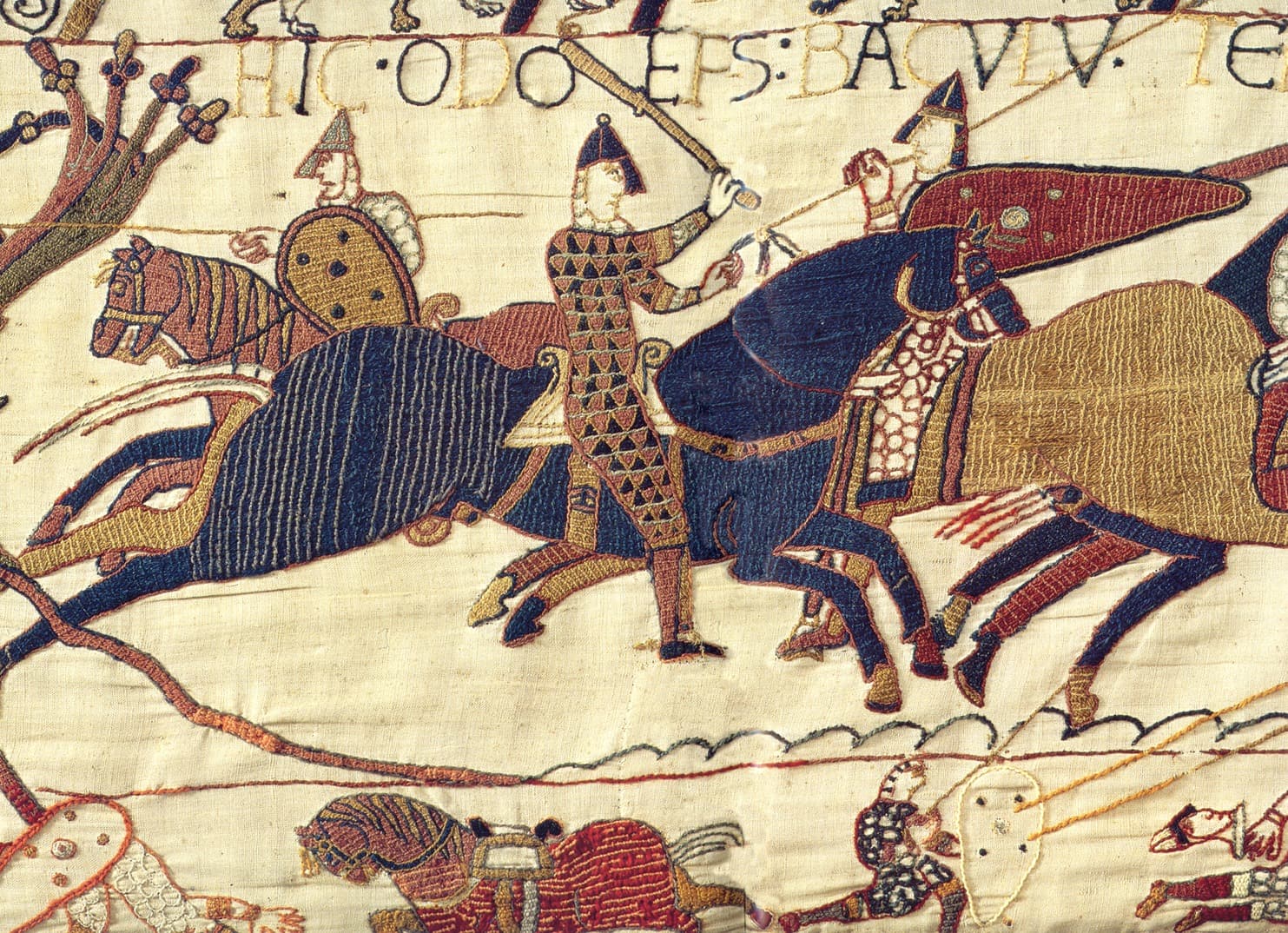
Start with the name, because it is wrong. The Bayeux Tapestry is not a tapestry at all. In a true tapestry the image is woven into the fabric on a loom. This is embroidery: wool yarn stitched onto linen, mostly in stem stitch and a technique called laid-and-couched work. It is roughly 70 metres long and about half a metre tall, made from nine linen panels joined together. Its makers used around ten colours of wool, dyed with plants such as woad, madder and weld. Across 58 scenes it tells the story of the Norman Conquest: Harold Godwinson's journey to Normandy, the oath he swears to Duke William over holy relics, the death of Edward the Confessor, Harold's coronation, the appearance of Halley's Comet, the building of William's invasion fleet and, finally, the Battle of Hastings on 14 October 1066. Decorative borders run above and below the main story, filled with animals, fables, farming scenes and the occasional piece of bawdy humour. The whole thing reads left to right like a strip cartoon, with Latin captions, and it moves with a pace and energy that still feels modern.
Who made the Bayeux Tapestry, and why?
The most widely accepted theory is that it was commissioned by Bishop Odo of Bayeux, William the Conqueror's half-brother, in the 1070s, perhaps for the consecration of Bayeux Cathedral in 1077. Odo appears prominently, and flatteringly, in several scenes, which is usually read as the patron's fingerprint. The needlework itself was almost certainly done in England, most likely in Canterbury. The spelling of names in the captions follows English rather than Norman forms, and the drawing style closely matches Anglo-Saxon manuscripts from Canterbury's monasteries. So the great monument to the Norman victory was probably stitched by the defeated English. It first appears in the written record in 1476, in an inventory of Bayeux Cathedral, which hung it in the nave each summer. That it survived centuries of damp, candle smoke and handling is remarkable. That it survived what came next is close to miraculous.
Revolution, Napoleon and the Nazis
In 1792, during the French Revolution, the tapestry was requisitioned to cover a military supply wagon. A local lawyer, Lambert Léonard-Leforestier, is said to have rescued it by swapping it for a tarpaulin. Two years later it narrowly escaped being cut up to decorate a float for a revolutionary festival. Napoleon saw its value immediately. In 1803 he had it exhibited in Paris while planning his own invasion of England: a centuries-old reminder that a cross-Channel invasion could succeed. The Nazis were even more interested. After occupying France, the SS research unit, the Ahnenerbe, sent a team to study and photograph it, keen to present the Normans as heroic Nordic conquerors. In 1944 it was moved to the Louvre, and in the final days before the liberation of Paris, Heinrich Himmler reportedly ordered it taken to Germany. The order was never carried out.
The biggest Bayeux Tapestry controversies
Norman or English? The tapestry has been claimed as a French national treasure and, in England, as proof of Anglo-Saxon craftsmanship. Both claims are, in a sense, true, and the tug-of-war over its identity has never entirely stopped. Propaganda or quiet protest? On the surface it is the victor's account: Harold swears an oath to support William, breaks it by taking the crown, and is punished. But Harold is shown remarkably sympathetically. He rescues soldiers from quicksand, he is brave and dignified, and the captions never quite call him a traitor. Some scholars believe the English embroiderers slipped a more ambivalent version of events past their Norman patron. Did Harold really die from an arrow in the eye? The famous story comes largely from the scene captioned Harold Rex interfectus est, "Harold the King is killed". But which figure is Harold: the one clutching an arrow near his face, the one cut down by a horseman, or both? Worse, the tapestry was heavily restored in the nineteenth century, and early drawings and old stitch holes suggest the "arrow" may originally have been something else. The unsolved mysteries. One scene shows a woman named Ælfgyva with a cleric touching her face, beside a naked figure in the border. Nobody knows who she is or what scandal is being hinted at. The ending is missing too: the tapestry breaks off after the battle, and its final scenes, probably William's coronation, are lost. The British Museum loan. The most recent row is diplomatic. In 2025 France and the UK agreed that the tapestry would travel to the British Museum, returning to England for the first time in over 900 years, with the Sutton Hoo treasures and Lewis Chessmen going to Normandy in return. It is now on display in London until 11 July 2027 (book tickets here). In France the reaction was fierce. Tens of thousands signed a petition against the move, and conservators warned that the fabric, marked by thousands of stains and many small tears, was too fragile to travel. It is the tapestry's oldest role, as a political object, playing out again.
Contemporary artists inspired by the Bayeux Tapestry
The tapestry's real legacy may be its format: a long, continuous, stitched narrative that anyone can walk along and read. Contemporary artists have seized on that. Grayson Perry is the most celebrated example. His Walthamstow Tapestry (2009), around 15 metres long and three metres high, is a deliberate modern answer to Bayeux. Instead of a king's road to battle it follows the journey from birth to death, crowded with the brand names and logos Perry sees as the new objects of faith. Like its medieval model it is a procession of figures, wry marginal detail and text. Perry returned to the medium with The Vanity of Small Differences (2012), helping bring textiles back into the fine art conversation in Britain. Andrew Crummy has taken the Bayeux idea further than anyone. He designed the Prestonpans Tapestry (2010) and the Great Tapestry of Scotland (2013), both longer than the original and stitched by hundreds of volunteers in a style that nods clearly to Bayeux. The format has inspired community epics too. The Overlord Embroidery (1968–74), designed by Sandra Lawrence to commemorate D-Day and now at The D-Day Story in Portsmouth, was conceived as a modern Bayeux, telling the story of an invasion in the other direction. On Alderney, embroiderer Kate Russell led a project to stitch the tapestry's missing ending, completed in 2013.
Why the Bayeux Tapestry still matters
More than 950 years on, the Bayeux Tapestry is a reminder that great art is rarely neutral. It was made to tell one side's story, stitched by the other side, and claimed by revolutionaries, emperors, dictators and diplomats ever since. For artists it offers something just as valuable: proof that thread, patience and a strong narrative can hold an audience for a thousand years.
Bayeux Tapestry FAQs
Is the Bayeux Tapestry really a tapestry?
No. It is an embroidery, with wool stitched onto linen, rather than a woven tapestry.
How long is the Bayeux Tapestry?
Roughly 70 metres long and about 50 centimetres tall.
Where is the Bayeux Tapestry now?
Its permanent home is the Bayeux Museum in Normandy, which is being redeveloped. While that work takes place, it is on show at the British Museum in London, in the Sainsbury Exhibitions Gallery (Room 30), from 10 September 2026 to 11 July 2027.
How do I get tickets to see the Bayeux Tapestry in London?
Book through the British Museum's Bayeux Tapestry tickets page. Tickets for 2026 have sold out, but tickets for January to March 2027 go on sale on 21 October 2026, and April to July 2027 dates are released in early 2027.
Who made the Bayeux Tapestry?
It was most likely commissioned by Bishop Odo of Bayeux and embroidered by English needleworkers, probably in Canterbury, in the 1070s.
Artist guides
Below are our guides to the two artists who have done most to carry the Bayeux Tapestry into the present: Grayson Perry and Andrew Crummy.
Artist guide: Grayson Perry
Sir Grayson Perry is one of Britain's best-loved contemporary artists and one of its most collected. Potter, printmaker, tapestry-maker, broadcaster and writer, he uses traditional crafts to hold up a mirror to modern Britain, with its class, taste, identity and consumerism.
Grayson Perry at a glance
- Born: 1960, Chelmsford, Essex
- Trained: Fine art at Portsmouth Polytechnic, graduating in 1982
- Media: Ceramics, tapestry, etching, woodcut, sculpture
- Major honours: Turner Prize (2003), CBE (2013), knighted (2023)
- Gallery: Victoria Miro, London
Career highlights
Perry won the Turner Prize in 2003 for his glazed ceramic vases, becoming the first ceramicist to take the prize. He accepted it dressed as his alter ego, Claire. His pots look classical at a distance, but up close they are covered in sharp, often uncomfortable images and text about childhood, gender and violence. He gave the BBC Reith Lectures in 2013, published as Playing to the Gallery, and curated The Tomb of the Unknown Craftsman (2011) at the British Museum. With FAT Architecture he created A House for Essex (2015), and during lockdown his Channel 4 series Grayson's Art Club brought art-making into millions of homes. Major exhibitions since include Smash Hits at the National Galleries of Scotland (2023) and Delusions of Grandeur at the Wallace Collection (2024).
The tapestries and the Bayeux connection
Perry's large woven tapestries are where the Bayeux influence is clearest. The Walthamstow Tapestry (2009), about 15 metres long, is a modern procession from birth to death that swaps saints and soldiers for brand names and logos, a Bayeux-style frieze about what we worship now. The Vanity of Small Differences (2012) is a set of six tapestries following a character's journey across the British class system, inspired by Hogarth's A Rake's Progress and made alongside the Channel 4 series All in the Best Possible Taste. He later told the life of a fictional Essex woman in the Julie Cope tapestries (2015). Like Bayeux, these works read as a story, packed with incidental detail that rewards a long look.
Collecting Grayson Perry prints and editions
Perry's pots and tapestries are museum-level purchases, but his prints are the most accessible way into his work. His large etchings and woodcuts, such as the imaginary maps Map of an Englishman (2004) and Map of Nowhere (2008), are among his most recognisable images. When buying, check:
- Edition details. Look for a signature and edition number, and confirm the edition size with the publisher's records.
- Publisher and provenance. Keep the original invoice or certificate from the publisher or gallery. Clear provenance supports value on resale.
- Condition. Large works on paper are vulnerable to light damage, creasing and handling marks at the edges. Ask for condition photographs without glass.
- Framing. UV-protective glazing and acid-free mounts protect both the print and its value.
Buying or selling Grayson Perry
Whitebank Fine Art has more than 15 years' experience in contemporary prints and editions. If you are looking to buy or thinking of selling a work by Grayson Perry, contact us for a confidential conversation.
Artist guide: Andrew Crummy
If Grayson Perry brought the spirit of the Bayeux Tapestry into the gallery, Andrew Crummy brought it back to the community. The Scottish artist and illustrator has designed some of the longest narrative embroideries made in modern times, each stitched by hundreds of volunteers.
Andrew Crummy at a glance
- Background: Grew up in Craigmillar, Edinburgh
- Media: Drawing, illustration, murals and designs for large community embroideries
- Best known for: The Prestonpans Tapestry (2010), the Great Tapestry of Scotland (2013), the Scottish Diaspora Tapestry (2014)
Art rooted in community
Crummy's approach grew out of the Craigmillar Festival Society, the community arts movement founded in Edinburgh by his mother, Helen Crummy. The idea that art should be made with people, not just for them, runs through all of his major projects. He draws the designs, and teams of volunteer embroiderers bring them to life in wool and linen, much as Anglo-Saxon needleworkers once did for Bayeux.
The Prestonpans Tapestry (2010)
Crummy's first great narrative embroidery tells the story of Bonnie Prince Charlie and the Jacobite victory at the Battle of Prestonpans in 1745. At more than 100 metres, it is longer than the Bayeux Tapestry, and it borrows its model's structure: a continuous story, bold outlines, text woven into the scene and lively borders.
The Great Tapestry of Scotland (2013)
His most ambitious work, the Great Tapestry of Scotland, was conceived by the novelist Alexander McCall Smith, with a narrative by the historian Alistair Moffat. Crummy designed its 160 panels, which run from the landscape's geological beginnings to the present day, and around a thousand stitchers across Scotland made them. The finished work is well over 100 metres long and now has its own permanent home in Galashiels, in the Scottish Borders. Find out more on the Great Tapestry of Scotland website.
The Scottish Diaspora Tapestry (2014)
Crummy then turned the idea outwards. The Scottish Diaspora Tapestry was stitched by communities around the world, telling the stories of Scots who emigrated and the places they helped shape.
Why Andrew Crummy matters
Crummy's work shows why the Bayeux format has lasted: a long, readable story that anyone can follow, and a making process that turns a community into co-authors. His tapestries have made needlework a popular art form again, and shown that a national history can still be told in thread.
Looking to buy or sell contemporary prints and editions, including work by Grayson Perry? Get in touch with Whitebank Fine Art.