Postmodernism
Postmodernism in art is the period, from about 1970, when artists and architects turned against modernism's faith in progress, originality and purity, and borrowed freely from history, advertising and popular culture, often with irony; its artists include Cindy Sherman, Barbara Kruger, Jenny Holzer, Richard Prince, Sherrie Levine and Jeff Koons.
The word came from architecture and philosophy. Robert Venturi answered Mies van der Rohe's 'less is more' with 'less is a bore' in Complexity and Contradiction in Architecture in 1966, and Charles Jencks, in The Language of Post-Modern Architecture of 1977, dated the death of modern architecture to the demolition of the Pruitt-Igoe housing estate in St Louis in 1972. The philosophers Jean-François Lyotard, in The Postmodern Condition of 1979, and Jean Baudrillard described a world made of copies and signs rather than originals. In art it meant an end to the idea that each movement improved on the last: any style, from any period, high or low, could be taken up again.
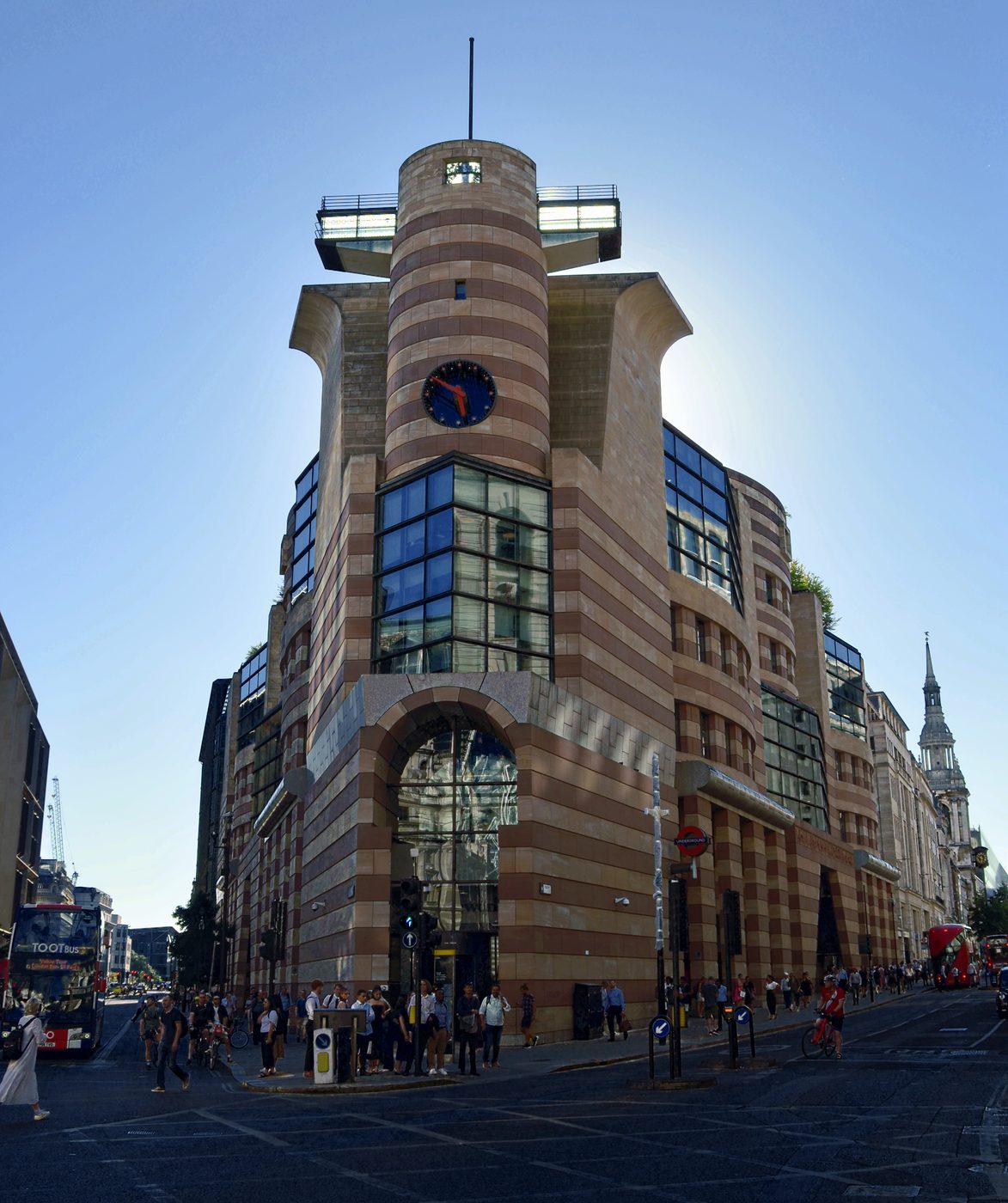
In New York, the critic Douglas Crimp's exhibition Pictures, at Artists Space in 1977, gave a name to a generation that worked with images taken from film, magazines and advertising. Cindy Sherman photographed herself as the heroines of imaginary films, Sherrie Levine rephotographed Walker Evans, Richard Prince rephotographed Marlboro advertisements, Barbara Kruger laid slogans in white on red over found photographs, and Jenny Holzer put her Truisms on posters and electronic signs. Jeff Koons made kitsch into luxury in stainless steel and porcelain, painting returned in Germany and Italy, and in London postmodern architecture reached the City with James Stirling's No 1 Poultry, completed in 1997. The V&A's exhibition Postmodernism: Style and Subversion 1970–1990, in 2011, treated it as history.
At a glance
- When
- About 1970 to 2000
- Where
- New York, Europe and London
- Leading artists
- Cindy Sherman, Sherrie Levine, Richard Prince, Robert Longo
Characteristics of Postmodernism
- Appropriation
- Existing images copied, rephotographed or reused, and the idea of originality questioned.
- High and low together
- Advertising, film, kitsch and comics beside art history.
- Quotation and irony
- Styles of the past borrowed knowingly, often with a wink.
- Words as images
- Slogans, captions and text made into the work itself.
- Identity and the media
- Who is speaking, who is looking, and how pictures shape the way people see themselves.
Postmodern artists
Every artist below has a page on this site, with a short biography and what a valuation of their work turns on.
Pictures and words
- Cindy ShermanPhotographs only herself, and has never once made a self-portrait.
- Sherrie LevineRephotographed Walker Evans, put her own name to the result, and made authorship itself the subject.
- Richard PrinceRephotographed the Marlboro cowboy, retyped other people's jokes, and has been sued over most of it.
- Robert LongoMen in Cities, drawn enormous in charcoal, and forty years of black-and-white since.
- Barbara KrugerFutura Bold Oblique, white on red, over a found photograph, saying something you cannot argue with.
- Jenny HolzerPuts language in public — on posters, LED signs, stone benches and buildings — and lets it argue with the passer-by.
Irony and the staged image
- Jeff KoonsVacuum cleaners in vitrines, basketballs in tanks, and a stainless-steel rabbit with no face.
- Jeff WallMakes photographs the way a painter or a film director makes pictures, and shows many of them as lit transparencies.
- Fischli & WeissSwiss duo who made art out of sausages, unfired clay, balanced kitchenware, carved foam and a chain reaction thirty minutes long.
In Germany
- Sigmar PolkeCo-invented Capitalist Realism, painted on printed fabric, and used materials that keep changing.
- Martin KippenbergerMade bad painting deliberately, ran a nightclub, and produced more in forty-four years than most do in eighty.
- Albert OehlenSet out to paint badly on purpose, and has spent forty years finding new ways to do it well.
Famous Postmodern works
- TruismsJenny Holzer, 1977–79
- Untitled Film StillsCindy Sherman, 1977–80, Museum of Modern Art, New York
- After Walker EvansSherrie Levine, 1981
- RabbitJeff Koons, 1986
- Untitled (Your Body Is a Battleground)Barbara Kruger, 1989, The Broad, Los Angeles
What a valuation turns on
Much postmodern art is photographic or made in editions, so the questions are those of any edition: its size, the number of the example, when it was printed, and whether it is signed and has its certificate. Colour photographs of the 1970s and 1980s fade and scratch, and face-mounted or lightbox works are easily damaged, so condition is checked closely. Jeff Koons, Cindy Sherman and Richard Prince are among the most valuable artists of their generation, and their best-known series command the highest prices.
Because the art often borrows from other images, a few works have been the subject of copyright disputes, and some editions were produced in more than one size. The artist's studio, gallery or catalogue raisonné is the reference for what a work is, and we check it before any sale.
Common questions
What is postmodernism in art?
Postmodernism in art is the period, from about 1970, when artists rejected modernism's belief in progress, originality and a pure style. They borrowed from art history, advertising, film and popular culture, mixed high and low, used text and photography, and often worked with irony.
Who are the most famous postmodern artists?
Cindy Sherman, Barbara Kruger, Jenny Holzer, Richard Prince, Sherrie Levine, Robert Longo, Jeff Koons and Jeff Wall, with Sigmar Polke and Martin Kippenberger in Germany; in architecture, Robert Venturi, Michael Graves, Philip Johnson and James Stirling.
When was postmodernism?
Roughly from the late 1960s to the end of the 1990s, at its height in the 1980s. The V&A's 2011 exhibition on it was dated 1970 to 1990.
What is the difference between modernism and postmodernism?
Modernism believed in progress, originality and a style true to its materials and its time, and each movement tried to move art forward. Postmodernism doubted all three: it borrowed and quoted from any period, mixed fine art with popular culture, and questioned whether anything could be truly original.
How do I sell a postmodern work?
Send photographs of the front, any signature, label or edition number, and the back, with any certificates or invoices, for a free, confidential valuation. The edition and the condition usually decide the most; we check them, compare a confidential private sale with auction, and keep the paperwork in your name until you are paid.