Neo-pop
Neo-pop is the art, from the 1980s onwards, that returned to the subjects of Pop art (cartoon characters, toys, celebrities and consumer goods) and remade them with an industrial finish, often at monumental scale; Jeff Koons, Takashi Murakami and KAWS are its best-known artists.
Pop art's second life began in New York in the 1980s. In 1980 Jeff Koons showed new vacuum cleaners in lit Perspex cases in the window of the New Museum, and in 1986 he cast an inflatable toy rabbit in mirror-polished stainless steel. Rabbit was followed by the Banality series, made by workshops in Germany and Italy and ending in 1988 with Michael Jackson and Bubbles, the singer and his chimpanzee life-size in gilded porcelain. In the East Village, Keith Haring and Kenny Scharf were turning cartoons and graffiti into paintings at the same time. What set the new work apart from the Pop art of the 1960s was its finish and its scale: objects fabricated to a standard no artist's hand could reach, by specialist workshops and later by the artist's own studio.
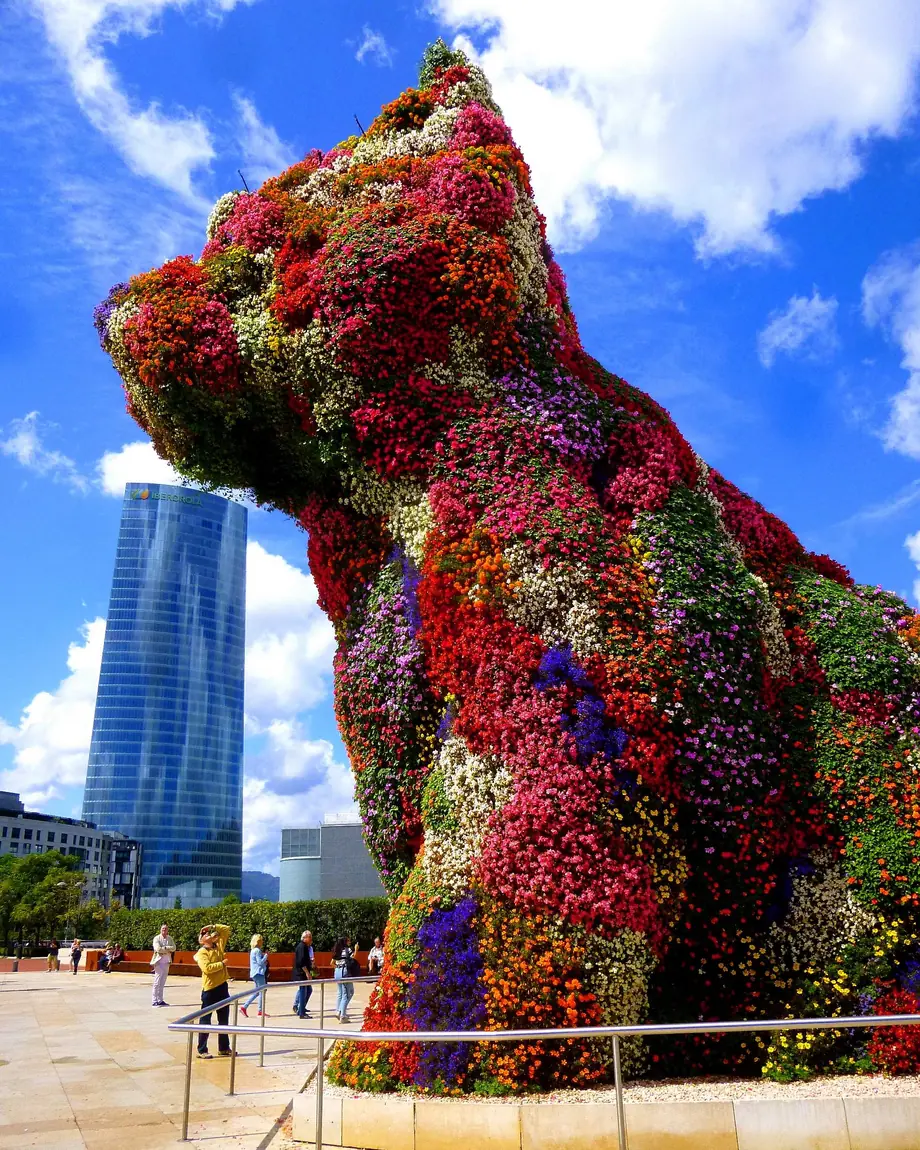
Puppy, a West Highland terrier more than twelve metres high covered in flowering plants, was first made for Arolsen Castle in Germany in 1992 and has stood outside the Guggenheim Museum in Bilbao since 1997. In Tokyo, Takashi Murakami, who had spent 1994 on a residency in New York and was much influenced by Koons, set up a production studio of his own, the Hiropon Factory, in 1996. KAWS, the New York artist Brian Donnelly, began by painting over the advertisements in bus shelters and made his first vinyl figure, COMPANION, with the Japanese brand Bounty Hunter in 1999. Tate Modern's exhibition Pop Life, in 2009, hung Koons, Murakami, Haring and Damien Hirst with Andy Warhol, the movement's forebear. The newer artists share a way of working as much as a look: toys, prints, clothing and collaborations with brands come out of the same studios as the paintings and sculpture, and are collected in their own right.
At a glance
- When
- mid-1980s to today
- Where
- New York, Tokyo and worldwide
- Leading artists
- Jeff Koons, Takashi Murakami, KAWS
Characteristics of Neo-pop
- Pop subjects
- Cartoon characters, toys, celebrities, advertising and consumer goods, as in the Pop art of the 1960s.
- Industrial finish
- Mirror-polished steel, porcelain, fibreglass and flawless lacquer, made by specialist fabricators.
- Monumental scale
- Toys and balloons enlarged to the size of monuments, from Koons's Balloon Dog to the giant COMPANION figures of KAWS.
- The studio as factory
- Large studios and teams of assistants, after Warhol's Factory: Koons's in New York, Murakami's Kaikai Kiki in Tokyo.
- Art and merchandise
- The same characters on canvases, prints, vinyl toys, clothing and collaborations with brands.
Neo-pop artists
Every artist below has a page on this site, with a short biography and what a valuation of their work turns on.
The leading artists
- Jeff KoonsVacuum cleaners in vitrines, basketballs in tanks, and a stainless-steel rabbit with no face.
- Takashi MurakamiOffset editions of three hundred are described as limited artworks daily, and they are not the same thing as a painting.
- KAWSPaintings, sculpture, vinyl figures and Uniqlo product all carry the same name, and the gaps between them are enormous.
In the East Village
Famous Neo-pop works
- RabbitJeff Koons, 1986
- Michael Jackson and BubblesJeff Koons, 1988, San Francisco Museum of Modern Art
- PuppyJeff Koons, 1992, Guggenheim Museum Bilbao
- Balloon DogJeff Koons, 1994 to 2000
- My Lonesome CowboyTakashi Murakami, 1998
- COMPANIONKAWS, 1999
What a valuation turns on
Neo-pop raises one question before any other: is this a unique work, an edition or a product? Koons made his steel sculptures in small editions, often of three, and each of his Celebration sculptures in five coloured versions, with porcelain and prints in far larger numbers. Murakami's signed offset prints run to editions of three hundred; KAWS's vinyl figures, made with toy companies, were produced in large numbers and are a different thing from his paintings and bronzes. The edition, the signature, the publisher and the paperwork settle which of these a work is, and a valuation starts there.
Condition counts for more than usual, because the surfaces are the point: a scratch in polished steel or a chip in lacquer is hard to put right invisibly, and a vinyl figure is judged with its box. Counterfeits are common at the cheaper end, KAWS figures above all, so the receipt from the original release, or the gallery invoice for a unique work, is the first document to find.
Common questions
What is Neo-pop art?
Neo-pop is art from the 1980s onwards that returns to the subjects of 1960s Pop art (cartoons, toys, celebrities and consumer goods) and remakes them as highly finished, often monumental objects. Jeff Koons in New York, Takashi Murakami in Tokyo and KAWS are its best-known artists.
Who are the Neo-pop artists?
Jeff Koons, Takashi Murakami and KAWS above all; Keith Haring and Kenny Scharf in the East Village in the 1980s; and, more recently, artists such as Hebru Brantley and Javier Calleja, whose characters appear on canvases, sculpture and editions alike.
What is the difference between Pop art and Neo-pop?
Pop art belongs to the late 1950s and 1960s, in Britain and the United States: Warhol, Lichtenstein, Hamilton and Blake, painting and printing the images of advertising and the mass media. Neo-pop, from the 1980s, took up the same subjects but made them as fabricated objects to industrial standards, spread to Japan and beyond, and treated toys, merchandise and collaborations with brands as part of the work.
Is KAWS a Neo-pop artist?
He is usually counted as one. His COMPANION, a figure derived from Mickey Mouse with crossed-out eyes, appears in paintings, monumental sculpture, prints and vinyl toys, which is how Neo-pop works. He began as a graffiti writer, painting over advertisements in New York, so he is sometimes placed with street art as well.
How do I sell a Neo-pop work?
Send photographs of the front, the back, the signature and edition number, and any box, receipt or certificate, for a free, confidential valuation. We confirm the edition and condition, then compare a confidential private sale with auction.