
Art News ·
Art News: Bridget Riley's Paintings on Canvas and Linen, and What Decides Their Value
By Whitebank Fine Art
On 14 October Bridget Riley's Streak 2, a painting of 1979, sold at Christie's in London for £5,214,000, a new auction record for the artist, and the next day Bonhams sold her Ka 4, an oil on linen of 1980, for £915,500. Our report on the two sales has the details. Most of the Rileys we are asked about are screenprints, but paintings do turn up in private collections, and they are a different thing to value. This is a guide to her paintings on board, canvas and linen: how they are made, how they changed over sixty years, and what decides what one is worth.
How a Riley painting is made
Riley, born in London in 1931, has used studio assistants to paint her finished pictures since the early 1960s, and the method is part of the work. She works out each composition and its colours herself in studies on paper, in pencil and gouache, often on graph paper, and moves from small studies to full-size cartoons, also in gouache. Her assistants then transfer the design to the canvas and paint it under her direction. A painting made this way is entirely hers; it is how all her paintings have been made, and it has no bearing on value.
From board to linen
The materials changed with the work, and they are one of the first clues to a painting's date.
- The black-and-white paintings, 1961 to 1965. These are in synthetic emulsion paint, on board or on canvas. Movement in Squares of 1961, now in the Arts Council Collection, is on board, and so is Current of 1964, which the Museum of Modern Art put on the cover of the catalogue of The Responsive Eye, its exhibition of 1965 that made Op Art famous.
- Colour, from 1967. Stripes, then curves and twisted bands, in synthetic paint on canvas or linen, among them Late Morning of 1967 to 1968, now at Tate, and Gala of 1974. In 1968 she won the International Prize for painting at the Venice Biennale.
- The return to oil, 1980. After a visit to Egypt she painted the Ka pictures and others in the Egyptian palette of blue, turquoise, ochre, brick red, black and white, and went back to oil paint, on linen.
- Diagonals and curves, 1986 to the present. Diagonal forms broke up the stripes from 1986, and curves came back from 1997. Between 1999 and 2003 she made some of the largest oils of her career; Evoë 3, of 2003, at Tate, is nearly six metres wide. In recent decades she has also made wall paintings, painted directly on the wall of a particular building.
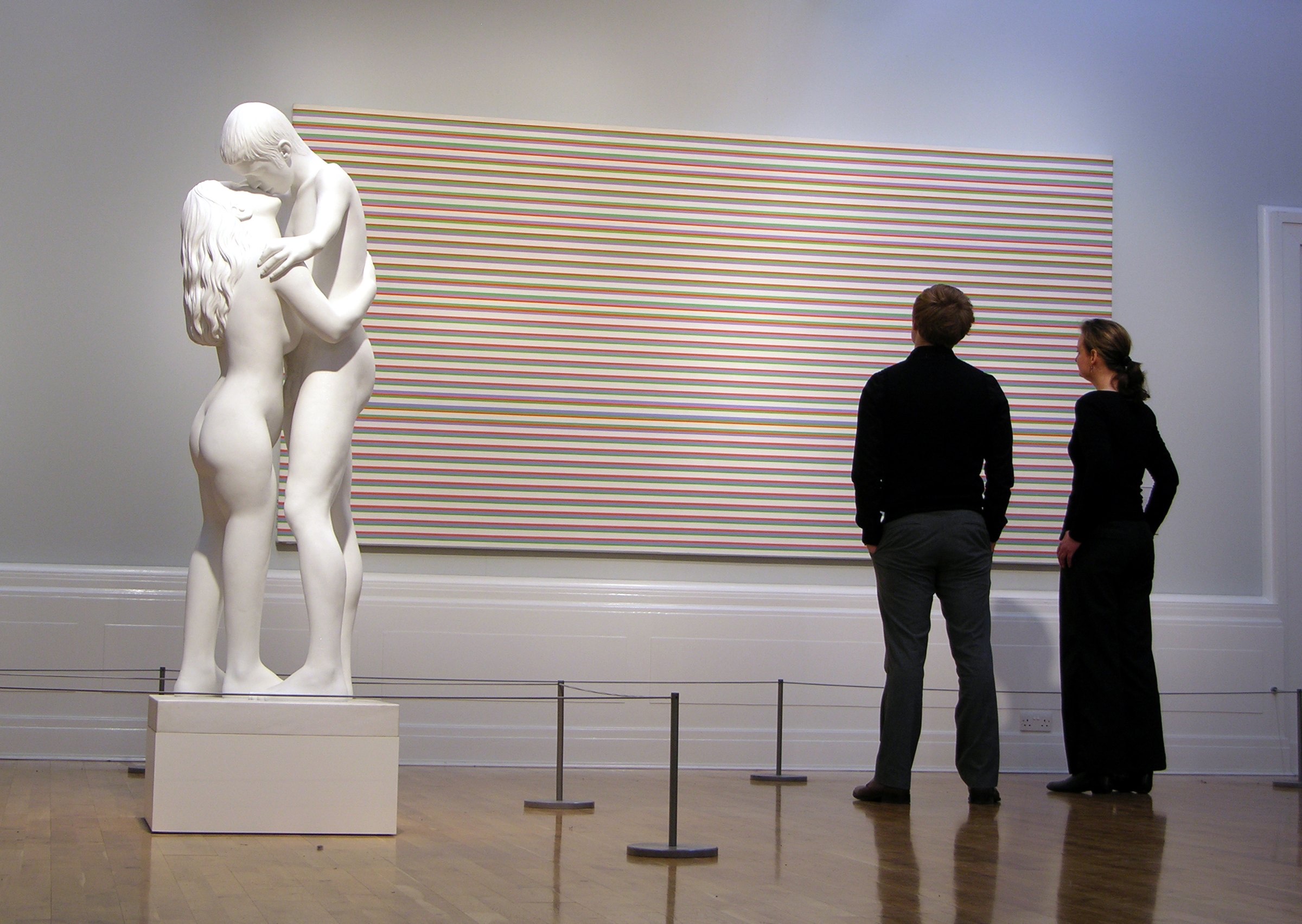
A Bridget Riley stripe painting at the Graves Gallery, Sheffield, in 2009, with a sculpture by Marc Quinn. Photo: EHildrew, CC0, via Wikimedia Commons.
Painting, study or print?
Three kinds of work carry her name, and they are very different things.
- Paintings on board, canvas or linen are unique. They are listed in Bridget Riley: The Complete Paintings, the five-volume catalogue raisonné edited by Robert Kudielka with Alexandra Tommasini and Natalia Naish and published in 2018 by the Bridget Riley Art Foundation and Thames & Hudson, which records more than 650 works. A painting that is not in it needs explaining.
- Studies and cartoons on paper, in gouache and pencil, are also unique and have a strong market of their own. They are often signed and dated, and many carry her notes on colour in the margins.
- Screenprints, published from the 1960s in editions usually of 75 to 150, are by far the most common. They can look like small paintings at first glance, but they are printed on paper and carry an edition number in pencil.
What decides the value of a painting
Period and series. The paintings of the 1960s and 1970s, the black-and-white works and the colour stripes and curves that followed, lead the market. Streak 2 took the record from Gala, which made £4,362,000 in London in March 2022. Later oils can make seven figures too, but there size counts for more: Ka 4, at 76 by 67 cm, made £915,500.
Size. Her paintings range from small canvases well under a metre to pictures several metres wide, and within a series, size counts for a great deal.
Condition. Riley's surfaces are flat, matt and unvarnished, and her effects depend on precise colour against colour. A scuff, a fingerprint, a faded band or an old retouching that would vanish in an Old Master shows at once on a Riley, so look at the surface in raking light and check the edges where the picture has been handled. Any repair should be left to a conservator who knows her work.
Provenance. A painting's history counts, and the back of the canvas often tells it: Riley usually signs, titles and dates her paintings on the reverse rather than the front, and gallery and exhibition labels on the stretcher help to trace where a picture has been. Our Op Art page sets her alongside the other artists of the movement.
If you own a painting, study or print by Riley and are thinking of selling, send us photographs of the front and the back for a free valuation. There is no obligation to sell, and we act for you rather than for the saleroom.
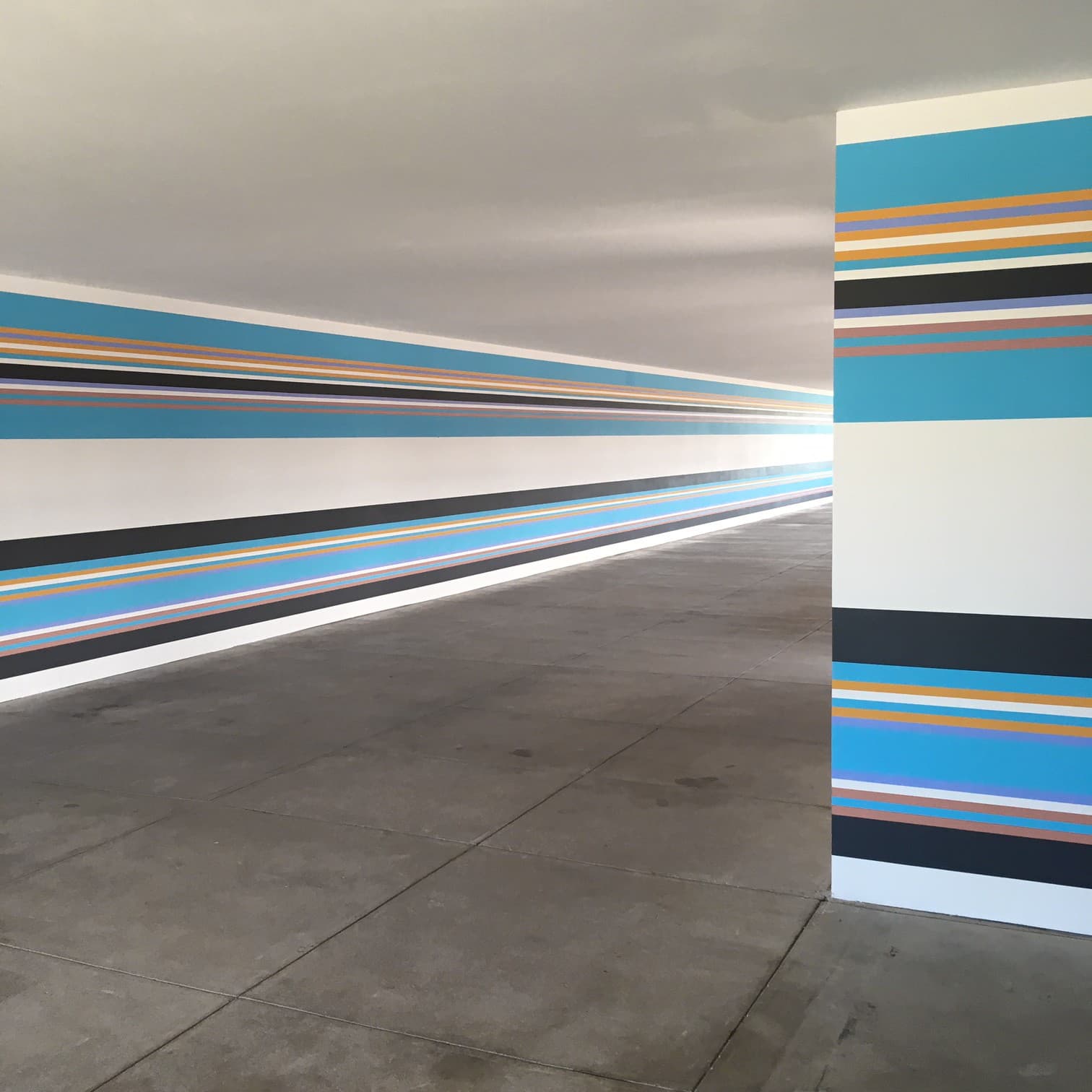
Cover: Bridget Riley, Bolt of Colour, 2017–19, a wall painting at the Chinati Foundation, Marfa, Texas. Photo: Colmandavid, CC BY-SA 4.0, via Wikimedia Commons.
Auction market