

Op art
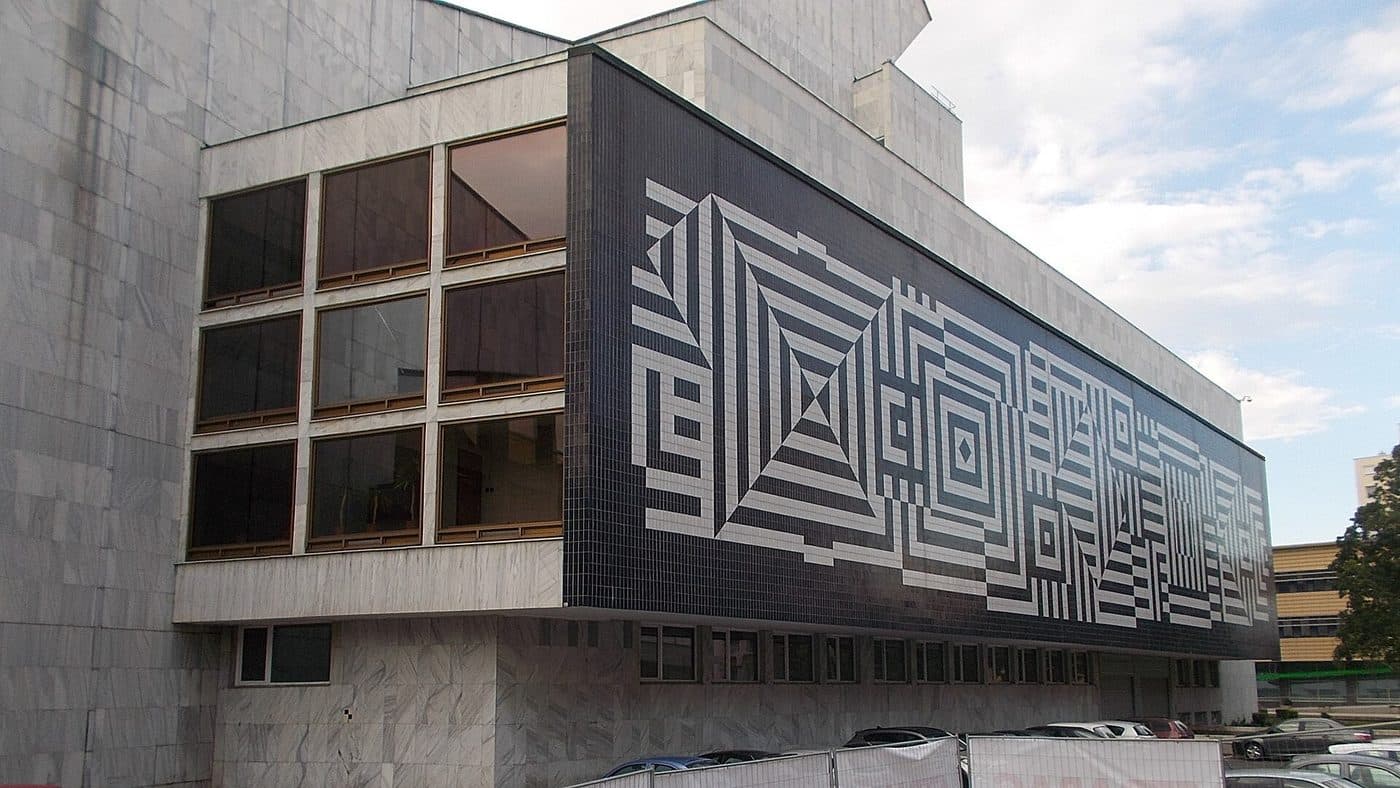
Op art, short for optical art, is abstract art that uses precise patterns, contrasts and repeated forms to create the illusion of movement, vibration or depth on a flat surface; it was named in 1964 and made famous by Bridget Riley and Victor Vasarely.
Victor Vasarely, a Hungarian graphic designer working in Paris, had been making optical images since the 1930s, and the Galerie Denise René's exhibition Le Mouvement in 1955 brought kinetic and optical art together. In London, Bridget Riley painted her first black-and-white works in 1961. Time magazine coined the term op art in October 1964, and in February 1965 the Museum of Modern Art in New York opened The Responsive Eye, with work by ninety-nine artists from some fifteen countries, Vasarely, Riley and Josef Albers among them.
The Responsive Eye was a popular success and a critical failure. Within months op patterns were on dresses, shop windows and record sleeves, and Riley, who found her own work copied onto fabric, felt it had been cheapened. The serious work went on: Riley moved into colour from 1967; Vasarely developed his system of interchangeable colour-forms, his plastic alphabet, and turned it into architecture and multiples; Jesús Rafael Soto, Carlos Cruz-Diez and the Argentine Luis Tomasello made kinetic and optical art a Latin American field of its own. Albers's Homage to the Square, a series he began in 1950, is the movement's most important forerunner.
At a glance
- When
- 1950s to 1970s
- Where
- Paris, London and New York
- Leading artists
- Bridget Riley, Victor Vasarely, Larry Poons, Luis Tomasello
Characteristics of Op art
- Optical illusion
- Patterns that seem to swell, ripple, flicker or recede.
- Precision
- Hard edges and exact geometry, often planned mathematically.
- Black and white
- Maximum contrast in the early work, and then the interaction of colours.
- Repetition and progression
- Simple units varied step by step across the surface.
- The viewer's eye
- The work completes itself in perception, and changes as you move.
Op art artists
Every artist below has a page on this site, with a short biography and what a valuation of their work turns on.
Op artists
- Bridget RileyThe screenprints are colour-critical to an unusual degree, and fading is the fault owners never see coming.
- Victor VasarelyThe father of Op art, who wanted paintings to be reproducible and designed a system for it.
- Larry PoonsMoved from crisp optical dots in the early 1960s to thick, poured and thrown fields of paint, and never went back.
- Luis TomaselloWhite reliefs of small cubes that throw coloured light back onto the wall from a colour you cannot see.
Famous Op art works
- Homage to the SquareJosef Albers, series from 1950
- Movement in SquaresBridget Riley, 1961, Arts Council Collection
- FallBridget Riley, 1963, Tate, London
- CurrentBridget Riley, 1964, Museum of Modern Art, New York
- Vega-NorVictor Vasarely, 1969, Buffalo AKG Art Museum
What a valuation turns on
Op art is unusually sensitive to condition, because the effect depends on clean, flat, even colour and crisp edges: a scuff on a white ground or a dent in a black-and-white canvas shows far more than it would on a gestural painting. Riley's paintings and works on paper are documented, and her screenprints are the commonest route into her work; with these, the edition, the date and the condition decide the value.
Vasarely is the opposite case. He made a vast number of multiples, serigraphs and editioned objects from the 1960s onward, his name is on a great deal of work of uneven quality, and there are outright fakes. Paintings, gouaches and works from the 1950s and 1960s are a different market from the late multiples, and documentation matters for both.
Common questions
What is Op art?
Op art, or optical art, is abstract art that uses geometric patterns, sharp contrasts and repetition to make a flat surface appear to move, vibrate or bulge. It was at its height in the 1960s.
Who are the most famous Op artists?
Bridget Riley and Victor Vasarely above all, with Jesús Rafael Soto, Carlos Cruz-Diez, Richard Anuszkiewicz, Julian Stanczak and Luis Tomasello. Josef Albers is its most important forerunner.
What does Op art stand for?
Optical art. Time magazine coined the shorter name in October 1964, a few months before the Museum of Modern Art's exhibition The Responsive Eye in 1965.
What is the difference between Op art and kinetic art?
Op art creates the illusion of movement on a still surface; kinetic art actually moves, by motor, air or the viewer's touch. The two were shown together in Paris in 1955 and overlap in artists such as Soto and Cruz-Diez.
How do I sell a Bridget Riley or Vasarely print?
Send photographs of the front, the signature and edition number, and the back, for a free, confidential valuation. We check the print against the catalogue, look closely at condition, and compare a confidential private sale with auction.
