

Selling street art
The market that moved from walls to editions, and mostly to paper.What decides the value of a print, and what to check before you sell one.
Street art has its own category in the salerooms now, and it behaves differently from the rest of contemporary art in the room. The work that made these artists famous is still on the wall. What comes up for sale is nearly always an edition, and editions come up often — which gives a seller something most contemporary art cannot, a public record of what the same image has made, repeatedly, in the recent past. You can price from evidence rather than from an opinion.
The same frequency cuts the other way. An image offered too soon after a comparable is found out in public, and a lot that fails to sell leaves an unsold record that follows the work into every conversation afterwards. Timing and reserve matter more here than in a thinner market, because there is nearly always another impression and the room knows it.
Then there is authentication, which decides not what a work makes but whether it reaches a sale at all. Several of these artists are anonymous by design. For a Banksy the major houses expect Pest Control paperwork before they will take a consignment — no certificate, no lot — and most of the others have no equivalent body, which throws the weight onto whatever documentation the studio issued at the point of sale. That is not a footnote. It is the difference between a work with a route to market and one without.
What makes it different to value
The artist may be anonymous
Banksy, Invader, Pejac, Jerkface and Stik do not have a studio you can write to and ask. Banksy has Pest Control, which since 2008 has been the only body that authenticates his work for sale, and which will not authenticate a piece taken off a street. Most of the others have nothing equivalent. That pushes the whole weight of a valuation onto the paperwork issued at the point of sale, and it is why a certificate matters more in this field than in almost any other.
Nearly all of the value is in editions
The walls are the reason these artists are famous and almost never the thing an owner holds. What people own is a screenprint, and screenprints here are rarely simple: the same image commonly exists in several colourways, in signed and unsigned versions, and in hand-finished variants where spray paint or gold leaf was added after printing. Those are different editions with different values, and they are very difficult to tell apart in a photograph.
Work removed from a wall is its own problem
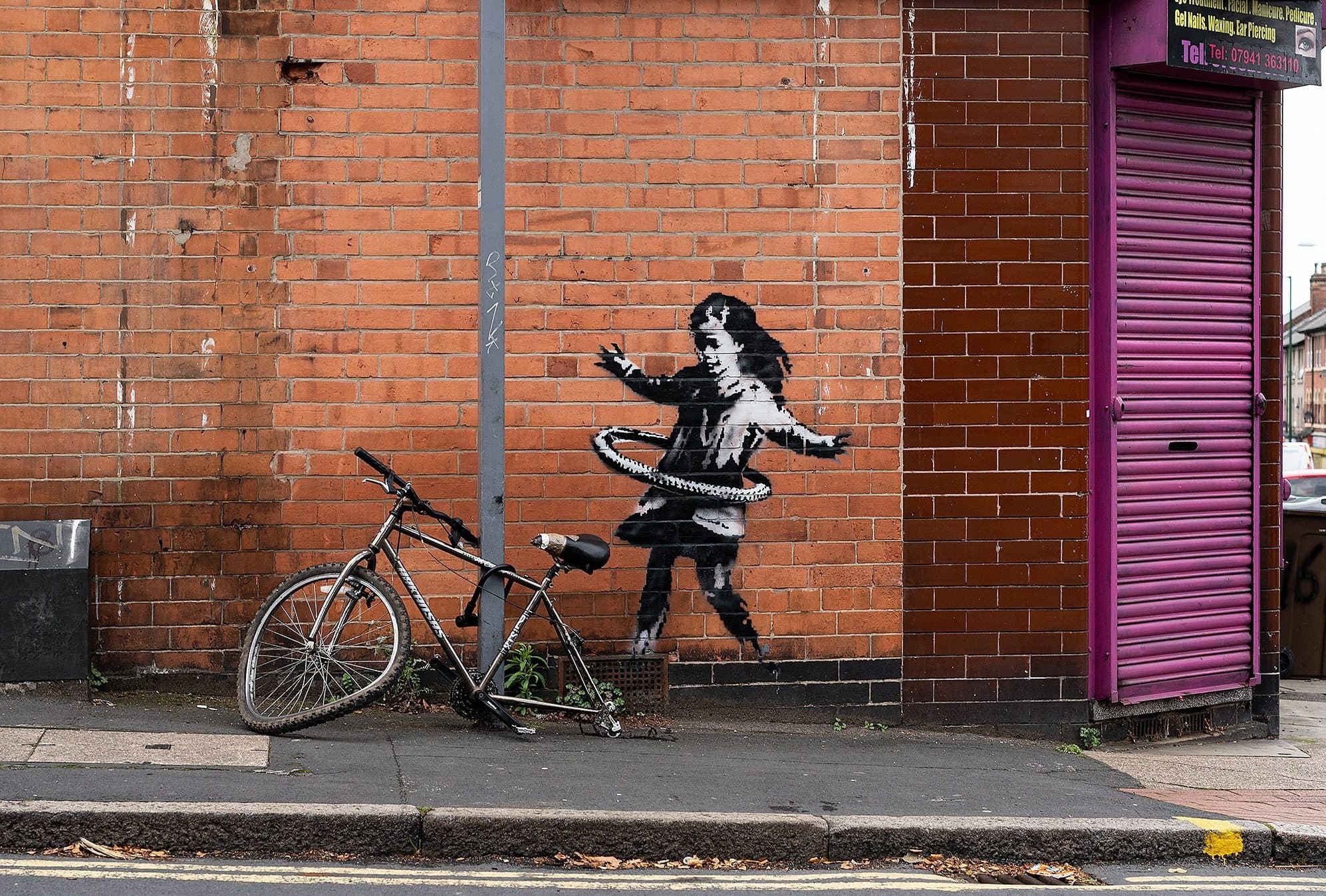
Pieces prised off buildings appear regularly and carry three difficulties at once: who owned the wall, what the removal did to the work, and whether the artist objects. Invader has been publicly hostile to the sale of his mosaics, and Pest Control does not authenticate street pieces. None of that makes such a work unsaleable, but it does mean the route to market, the disclosure and the expectations all need setting honestly before anything is consigned.
Condition is unforgiving and usually invisible
These are flat, saturated, unvarnished surfaces on paper, and they show everything. Fading is the fault we see most often and the one owners never spot, because it happens slowly on their own wall over a decade. Spray paint applied over a print scuffs. Diamond dust and foils mark. A sheet trimmed to fit a frame has lost its margins, and with them the signature, the numbering and the blindstamp that prove which edition it is.
Artists we are asked about
The names below are where the questions come from most often. A name here describes the range we advise on — it is not a claim to hold or to have sold that artist’s work.
- Banksyguide
- KAWSguide
- Keith Haringguide
- Invader
- Stik
- Shepard Fairey
- D*Face
- Ben Eine
- Mr Brainwash
- Mr Doodle
- RETNA
- Pejac
- Richard Hambleton
- Conor Harrington
- JonOne
- Thierry Noir
- Kenny Scharf
- Jerkface
- Jean-Michel Basquiat
Not listed is not a problem — the full A to Z runs a good deal wider, and the first question we answer is what a work actually is, whoever made it.
Common questions
How do I know if my street art print is an original edition?
The evidence is in the margin and on the reverse — a pencil signature, an edition number, a publisher's blindstamp, and a sheet that matches the recorded size for that edition. Framing normally hides exactly those, which is why the first thing we ask for is a photograph of the back of the work as well as the front.
Is a hand-finished print worth more than a plain one?
Usually, and sometimes substantially, but only if the hand-finishing is documented. Studios in this field routinely release the same image plain, hand-finished, and in several colourways. Where the paperwork does not record which you have, the market prices it as the cheaper one.
Can I sell a piece taken from a street?
Sometimes, but it needs handling carefully. Ownership of the wall, the condition after removal and the artist's own position all bear on it, and for some artists no authentication is available at all. Send photographs and whatever history came with it and we will tell you plainly where it stands.
Does an auction house or a private sale suit street art better?
It depends on the edition and on how often it comes up. Frequently traded prints have a visible recent record, which auction handles well. Scarce or hand-finished pieces, and anything that has been offered publicly before, are often better placed privately. We take a view on both before recommending either.
If you own one
Send photographs of the front, the back and the margins, along with any certificate or receipt. The margins and the reverse are where the edition is proved, and they are what a frame hides. A valuation costs nothing and commits you to nothing.
Write to info@whitebankfineart.co.uk, or start below.
Whitebank Fine Art is an art advisory and gallery, not an auction house, and is not affiliated with any auction house or with the artists named, their estates or their representatives. Nothing here is investment advice.