
Pejac valuation
Spanish street artist of small, quiet interventions that use the building as half the picture.
Pejac is a Spanish artist born in Santander in 1977 who studied fine art in Barcelona and works with a restraint unusual in street art: the pieces are small, almost always in black or a single colour, and depend entirely on the surface they are placed on — a drainpipe becomes a tree trunk, a crack in the render becomes a river, a window’s shadow becomes a forest.
What a work by Pejac is worth
Send photographs and whatever paperwork came with it. The first question is what the work actually is — edition or unique, when, and in what condition — because everything else follows from the answer. A valuation is free, made online from the photographs you send, and it commits you to nothing. We act for sellers across the United Kingdom, Europe and the United States.
Write to info@whitebankfineart.co.uk, or start below.
Bio
Pejac is a Spanish artist born in Santander in 1977 who studied fine art in Barcelona and works with a restraint unusual in street art: the pieces are small, almost always in black or a single colour, and depend entirely on the surface they are placed on — a drainpipe becomes a tree trunk, a crack in the render becomes a river, a window’s shadow becomes a forest. He has worked in Istanbul, Paris, Tokyo, Hong Kong and Amman, including in a Jordanian refugee camp, and made a body of work drawn on the walls of a psychiatric hospital.
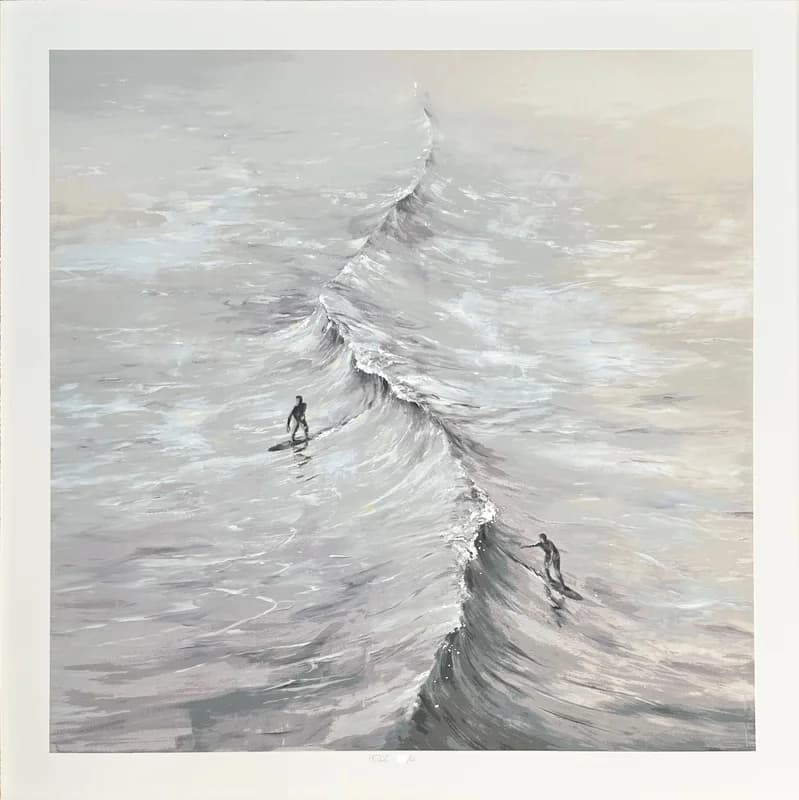
The studio work is a print-led market. Screenprints and giclees are published in editions of around fifty to two hundred, frequently released in timed online sales and often hand-finished, and edition, release and any embellishment are what set the value; pencil signature, numbering and a studio blindstamp should be present. Unique works on canvas, panel and found objects — glass, doors, metal — are far scarcer. Interventions made on buildings are not removable in any practical sense, and pieces offered as such warrant scepticism.
What actually comes to market
Editions on paper are the great majority of it: screenprints and giclees, usually in the low hundreds at most. Alongside them sit hand-finished variants of the same images, made in much smaller numbers. Unique works on canvas, on panel and on found objects — glass, doors, sheet metal — are scarcer again and come up rarely.
Hand-finishing is the difference
This is the thing most often missed, and it is the thing that most often decides what a work is. The same image can exist as a straight edition, as a hand-finished variant in a fraction of the number, and as a unique work. From the front, at a distance, in an ordinary photograph, all three look much the same. They are not remotely the same object.
Light raked across the surface from one side shows what was added after printing — the sheen and the relief of applied paint against the flat, even lie of screen ink. If you do nothing else before writing to us, take that photograph.
How the editions were sold
Most went out through timed online releases and ballots rather than through a gallery over a counter, which means almost every example has a purchase record sitting behind it somewhere — an order confirmation, a dated email, a shipping note. That record is worth finding. It dates the work, identifies the edition and settles which variant was bought, and it does all three faster and more conclusively than examining the sheet can.
Signature, numbering and blindstamp
Pencil signature and numbering should be present, along with a studio blindstamp on the editions that carried one. A blindstamp is embossed rather than inked and photographs badly under flat overhead light; catch it at a low angle instead. As ever, the whole sheet including the margins, rather than the image cropped to its edges.
Interventions on buildings
The street pieces are not removable in any practical sense — that is the point of them, since the wall, the pipe, the crack or the window is doing half the work and the drawing means nothing without it. Anything offered as a Pejac lifted from a building deserves scepticism before it deserves anything else.
What to have ready
The full sheet square on in daylight, margins included; the same sheet lit from one side so any hand-finishing shows; a close photograph of the signature, the numbering and the blindstamp; the sheet measurements; and the original order confirmation or receipt if you can find it. If the work is on canvas, panel or an object rather than paper, photograph the edges and the reverse as well.
Whitebank Fine Art is an art advisory and gallery, not an auction house, and is not affiliated with any auction house or with the artist, their estate or their representatives. This page describes the range we advise on. Nothing here is investment advice.