
Stik valuation
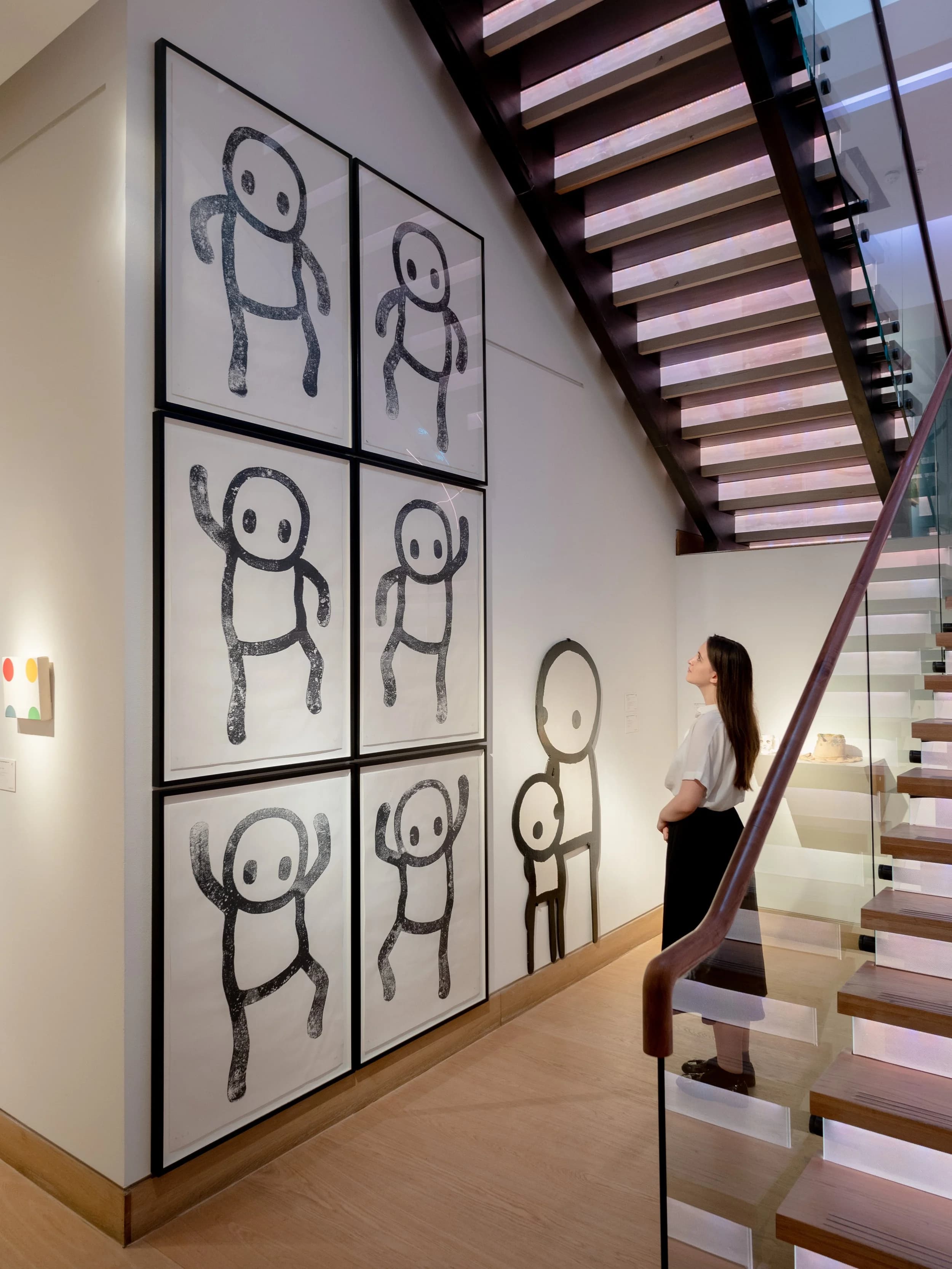
Six lines and two dots, painted very large, usually about people who have nowhere to live.
Stik is a British street artist who was homeless in London while developing the figure that made his name: a stick person made from six lines and two dots, with no features at all, whose entire emotional content is carried by the angle of the head and the position of the shoulders.
What a work by Stik is worth
Send photographs and whatever paperwork came with it. The first question is what the work actually is — edition or unique, when, and in what condition — because everything else follows from the answer. A valuation is free, made online from the photographs you send, and it commits you to nothing. We act for sellers across the United Kingdom, Europe and the United States.
Write to info@whitebankfineart.co.uk, or start below.
Bio
Stik is a British street artist who was homeless in London while developing the figure that made his name: a stick person made from six lines and two dots, with no features at all, whose entire emotional content is carried by the angle of the head and the position of the shoulders. The economy is the point, and it allows the figures to stand for whoever is looking. He has painted large murals in Hackney, across London and internationally, has worked with the NHS and with housing and homelessness charities, and has consistently used the work to raise money for them.
A print-led market with an unusual structure, because many editions were released through charity partnerships and community distributions at low prices, and their provenance and documentation vary accordingly. Screenprints are published in editions from around fifty to several hundred, sometimes in multiple colourways; edition, release and any hand-finishing set the value, and pencil signature and numbering should be present. Unique works on canvas and board are far scarcer. Because the image is six lines, imitation is trivially easy and documentation matters more than usual.
What actually comes to market
Screenprints are the bulk of it by a wide margin, and they are what nearly everybody who writes to us owns. Unique works on canvas and board exist in far smaller numbers. Then there are the books, the posters and the printed ephemera, which are not editions and are confused with them constantly — a poster from an exhibition and a numbered screenprint of the same image are different objects and it is worth establishing which one you have before anything else.
Charity and community releases
This is the part that makes Stik different from almost anyone else in the field. A great many editions went out through charity partnerships, hospital and housing projects, and distributions to people living locally — frequently by ballot, frequently at little or no cost. That is to the artist’s credit and it creates a practical difficulty at the same time: the provenance of a large number of Stik prints is a personal account rather than a receipt.
It does not sink a sale. It does change what is needed to support one, and it is worth thinking hard about what you still have — a ballot confirmation, an email from the organising charity, a letter, a dated photograph of the collection day. Evidence of that kind is more useful here than it would be for an artist whose work only ever moved through galleries.
Colourways, signed and unsigned
The same image commonly exists in several colourways, and in signed and unsigned versions. Those are different editions with different values, and they are very hard to tell apart from a photograph of the image alone. Where the edition carried a pencil signature and numbering, both should be present and legible.
Photograph the whole sheet including the margins, in daylight, square on. That single photograph answers most of the questions we would otherwise have to ask.
Authentication
There is no third-party authority for Stik — nothing equivalent to Pest Control, and nobody who will examine a work after the fact and issue a ruling on it. What stands in its place is the paperwork from the original release, and the fact that the image is six lines and two dots makes that paperwork carry more weight here than it would for an artist whose hand is harder to copy.
Condition
Flat black on white paper shows everything. Handling creases, fingerprints in the margins, a soft corner, the faint tide line from an old mount — all of it reads immediately, and none of it can be undone cheaply. Fading is the fault owners almost never spot, because it happens slowly on their own wall over a decade and the sheet they remember hanging is the sheet they still think they are looking at.
What to have ready
The full sheet photographed square on in daylight, margins included; the reverse; a close photograph of the signature and numbering; the measurements of the sheet rather than the frame; and whatever record you have of how it came to you, however informal. If it arrived through a charity release or a community distribution, say so — that is useful information, not a problem to be glossed over.
Best auction results
- Holding Hands (Maquette) £287,500
- Patinated bronze, 2020 · London · 23 October 2020
- Publicly reported
- The maquette for the Hoxton sculpture, and the artist's auction record.
- Children of Fire £246,000
- Mural, 2011 · London · 30 June 2022
- Publicly reported
- Liberty, the complete set £200,000
- Screenprints, 2013 · London · 18 September 2019
- Publicly reported
- A complete deluxe set. Sets hold together at auction in a way single sheets out of the same release do not.
- Big Mother £193,750
- Mural, 2014 · London · 5 December 2018
- Publicly reported
Results as reported at the time of sale, inclusive of buyer's premium. They are a record of what specific works achieved on specific days, not a guide to what any other work is worth.
Whitebank Fine Art is an art advisory and gallery, not an auction house, and is not affiliated with any auction house or with the artist, their estate or their representatives. This page describes the range we advise on. Nothing here is investment advice.