
Invader valuation
Has been cementing mosaic space invaders onto cities since 1998, and mapping them.
Invader is an anonymous French artist who since 1998 has been fixing small mosaics of ceramic tiles, based on the sprites from the 1978 arcade game Space Invaders, onto walls in cities worldwide — several thousand of them, in a numbered, mapped and documented campaign he calls an Invasion, complete with published city guides and a mobile application for finding them.
What a work by Invader is worth
Send photographs and whatever paperwork came with it. The first question is what the work actually is — edition or unique, when, and in what condition — because everything else follows from the answer. A valuation is free, made online from the photographs you send, and it commits you to nothing. We act for sellers across the United Kingdom, Europe and the United States.
Write to info@whitebankfineart.co.uk, or start below.
Bio
Invader is an anonymous French artist who since 1998 has been fixing small mosaics of ceramic tiles, based on the sprites from the 1978 arcade game Space Invaders, onto walls in cities worldwide — several thousand of them, in a numbered, mapped and documented campaign he calls an Invasion, complete with published city guides and a mobile application for finding them. The choice of tile is deliberate: it is a durable outdoor material with a pixel already built in. He has been arrested repeatedly, and one mosaic has been to the International Space Station.
The studio work is where the market is, and it divides into Alias pieces — studio-made mosaics corresponding to a specific street installation, each with its own reference code and certificate — Rubikcubist works made from Rubik’s cubes, and editioned prints. The certificate and the reference code are essential; Aliases without them are very difficult to sell. Mosaics prised off walls appear regularly and carry both ownership problems and severe condition problems, and the artist has been publicly hostile to their sale. Fakes of the tile works are common.
What actually comes to market
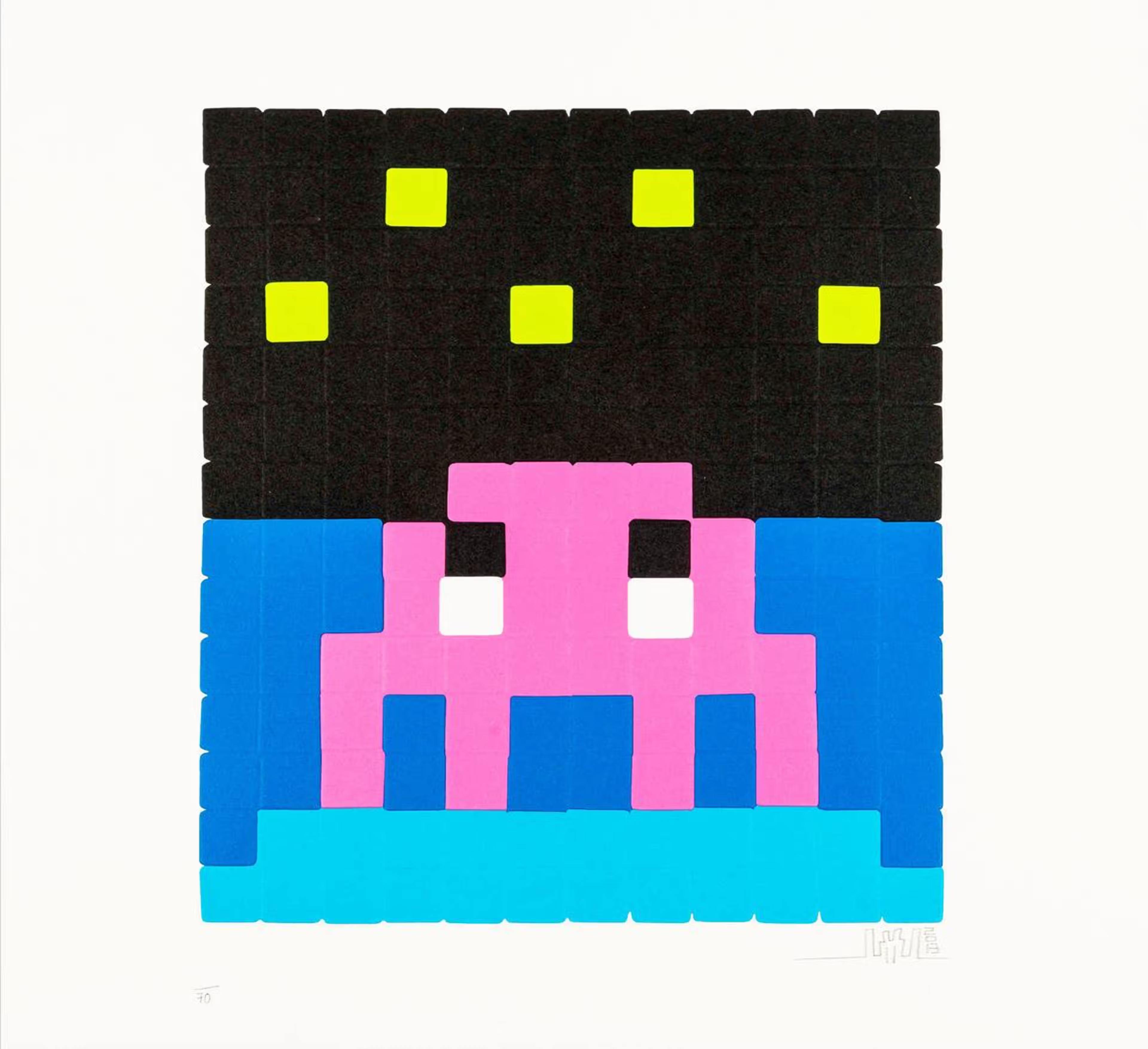
Four quite different kinds of object arrive under this name, and they are not variations on one another. Aliases are studio mosaics made to correspond to a particular street installation and tied to that piece’s reference code. Rubikcubist works are built from Rubik’s cubes rather than tiles. Invasion Kits are boxed, editioned sets from which a mosaic can be assembled. And there are the prints, which is what most people who write to us own.
The street mosaics themselves are the reason for all of it and are almost never the thing an owner holds. That gap — between the work that made the name and the work that trades — is wider here than for almost any other artist we are asked about, and it is the source of most of the confusion we see.
The reference code and the certificate
This is the whole ballgame for an Alias. Each one corresponds to a numbered street piece and carries that piece’s code, and the certificate issued with it is what ties the object in front of you to that record. Keep the two together. An Alias separated from its paperwork is in real difficulty whatever it is, because there is no way to put the connection back.
There is no Pest Control equivalent in this market — no third-party body that will examine a work after the fact and rule on it. The documentation issued at the point of sale is the entire evidence, which is why we ask for it before anything else and why we would rather see a photograph of the certificate than of the work.
Prints and the catalogue raisonné
An official catalogue raisonné of the prints on paper exists and documents the editions made between 2001 and 2020. Checking a sheet against it settles most of what a seller needs to know at once: which edition it belongs to, what it should measure, how many were made, and whether yours is one of the signed ones.
On the sheet itself, look at the pencil signature, the numbering and the margins. A print trimmed to fit a frame has usually lost the numbering and sometimes the signature too, and with them the evidence of which edition it is — which is a condition problem and an identification problem at the same time. Photograph the whole sheet, margins included, rather than the image alone.
Mosaics taken off walls
Pieces prised off buildings come up regularly and carry three problems at once: who owned the wall, what the removal did to the work, and the artist’s own publicly stated hostility to their sale. None of that makes such a piece unsaleable. It does change the route to market, the disclosure required and what a buyer will pay, and all three are better settled before anything is consigned than discovered afterwards.
Fakes and repairs
The tile works are among the more heavily copied things in this field, for the obvious reason that ceramic tile is available to anybody. Re-tiled and repaired pieces are a separate question again, and a legitimate work that has been patched is not the same proposition as one that has not. Photographs of the reverse, the edges and the fixing are worth as much to us as photographs of the front.
What to have ready
The front, the reverse and the edges in daylight; the full sheet including margins if it is a print; the certificate and reference code if there is one; the original invoice, confirmation email or gallery receipt if you still have it; and the measurements. If the paperwork is lost, say so rather than leaving it out — it is a common situation and it is better addressed at the start than halfway through a consignment.
Best auction results
- Astroboy TK_119 $1.22m
- Ceramic tile on Perspex, 2014 · New York · 15 November 2019
- Publicly reported
- The artist's auction record, and a studio work rather than anything taken off a wall.
- Rubik Space €492,600
- Rubik's Cubes on plywood, 2005 · Paris · 16 December 2020
- Publicly reported
- Rubik Mona Lisa €480,200
- Rubik's Cubes, 2005 · Paris · 23 February 2020
- Publicly reported
Results as reported at the time of sale, inclusive of buyer's premium. They are a record of what specific works achieved on specific days, not a guide to what any other work is worth.
Whitebank Fine Art is an art advisory and gallery, not an auction house, and is not affiliated with any auction house or with the artist, their estate or their representatives. This page describes the range we advise on. Nothing here is investment advice.