
Art News ·
Art News: Salvador Dalí prices, what his paintings and prints sell for and how to spot a fake
By Whitebank Fine Art
A Salvador Dalí oil painting sold at auction in 2026 for $7.27 million in New York and HK$17.28 million in Hong Kong, and his large works on paper made up to €192,000 in Paris. His prints are a different market: at Sotheby's this year they sold for between £1,792 and £15,360. His auction record is £13.5 million, for Portrait of Paul Éluard, of 1929, at Sotheby's in London in 2011. Prices below include the buyer's premium.
Whitebank Fine Art, a London art advisory and gallery, gathered these results from Christie's and Sotheby's in November 2026.
Salvador Dalí painting prices in 2026
| Work | Medium | Sale | Price |
|---|---|---|---|
| Chair de poule rhinocérontique, 1956 | Oil on canvas, 91.6 by 70.3 cm | Christie's New York, 18 May | $7,273,000 |
| Ensorcellement, Les sept arts, 1957 | Oil on canvas, 84 by 114.5 cm | Christie's Hong Kong, 29 September | HK$17,280,000 |
| L'Enfer, 1960 | Gouache, watercolour and ink on paper, 104.9 by 75.8 cm | Christie's Paris, 23 October | €192,000 |
Chair de poule rhinocérontique shows a classical female nude breaking into fragments over a calm sea, from the mid-1950s, when the rhinoceros horn ran through much of his work. It was estimated at $5 million to $8 million. Ensorcellement, painted in 1957 and once owned by the Broadway producer Billy Rose, was estimated at HK$9 million to HK$12 million and sold well above that. L'Enfer was estimated at €40,000 to €60,000. In the same Paris sale, Le Purgatoire made €179,200 and Composition, deux femmes et une ville dans le fond €128,000, both well above their estimates.
Paintings by Dalí come up rarely, which is why searches for a price list of his paintings find so little. Most of what is sold under his name is a print, a drawing, a sculpture cast or a book.
What Dalí drawings and sculptures sell for
At Sotheby's in 2026, about two dozen Dalí lots were offered, and they show how wide the range is:
- Drawings and designs. An illustration for the Marquis de Sade, Dumont et Martin, made HK$1,920,000 in Hong Kong. A design for his tarot cards, Le Char, made £44,800 in London, and a stage design for an opera £40,960. A small drawing, Cerezas estereoscópicas, of 1975, made €5,120 in Paris.
- Sculpture. Dalí's bronzes were cast in editions, often in more than one size. Vénus de Milo aux tiroirs, the Venus with drawers, made $640,000 in New York, and another cast made €82,550 in Paris. Casts of Le Cabinet anthropomorphique sold for between €9,525 and $32,000.
- Jewellery and objects. Gold and jewelled pieces to his designs, and gold coins struck in his name, sold for between CHF 12,160 and €44,800.
What Dalí prints sell for
Sotheby's sold three Dalí prints in 2026, all in London. Fantastic Beach Scene made £15,360 in March, and Divine Back of Gala, from the portfolio After 50 Years of Surrealism, made £4,480 in the same sale. A single sheet from Les Caprices de Goya, his 1977 reworking of Goya's etchings, made £1,792 in September.
Most Dalí prints that change hands are single sheets from the large illustrated suites he produced from the 1950s to the 1970s: The Divine Comedy, Alice's Adventures in Wonderland, Les Caprices de Goya, the Shakespeare and Bible series. Complete sets and single sheets are valued separately, and a sheet from a recorded edition in good condition is worth more than one that cannot be traced.
How to spot a fake Dalí print
Dalí prints are widely faked, and the reasons are well known. In his later years he signed large numbers of blank sheets of paper, which were later printed with images he may never have seen. Reproductions of his paintings were sold as original lithographs. And editions were printed in several versions, on different papers, with numbering that can be hard to follow.
What to check:
- Is it in the catalogues? The standard references are Michler and Löpsinger's catalogue raisonné of his prints and Albert Field's official catalogue of his graphic works. Sotheby's describes Fantastic Beach Scene as Michler-Löpsinger 57. A print that is in neither needs a specialist.
- Look through a magnifying glass. An offset reproduction is built from a regular pattern of tiny dots. A lithograph, etching or woodcut is not.
- The paper. Fine prints are on good paper, often with a watermark such as Arches or Rives, and sometimes a publisher's blindstamp. Check that the paper matches what the catalogue records for that edition.
- The signature and numbering. A pencil signature does not prove much on its own, because of the blank sheets. The numbering should match the published edition size.
- The certificate. A certificate from the gallery that sold the print is a sales document, not proof that the print is authentic.
For paintings, the Fundació Gala-Salvador Dalí in Figueres publishes a catalogue raisonné of his paintings, and a painting that is not in it will be hard to sell.
Dalí price questions
How much is a Salvador Dalí painting worth? His oil paintings sold in 2026 for $7.27 million and HK$17.28 million. His record is £13.5 million, for Portrait of Paul Éluard in 2011. Three works in one Paris sale in October made €128,000 to €192,000.
How much is a Dalí print worth? At Sotheby's in 2026 Dalí prints sold for £1,792 to £15,360. Value depends on the image, the edition, the paper, the condition and whether the print is recorded in the catalogues.
Are Dalí lithographs real? Some are, and many are reproductions. Check the print against the catalogues and look for a dot pattern under a magnifying glass.
Did Dalí sign blank paper? Yes. It is the main reason a signature alone does not prove that a Dalí print is genuine.
What is the most expensive Dalí ever sold? Portrait of Paul Éluard, of 1929, which sold for £13.5 million at Sotheby's in London in February 2011.
If you own a Dalí
Dalí was a leading figure in Surrealism, and his market runs from museum paintings to decorative prints. If you own a Dalí print, drawing or sculpture, send us photographs of the front, the signature and numbering, the back, any watermark or blindstamp and any paperwork through our art valuation page. There is no obligation to sell, and we act for you rather than for the saleroom.
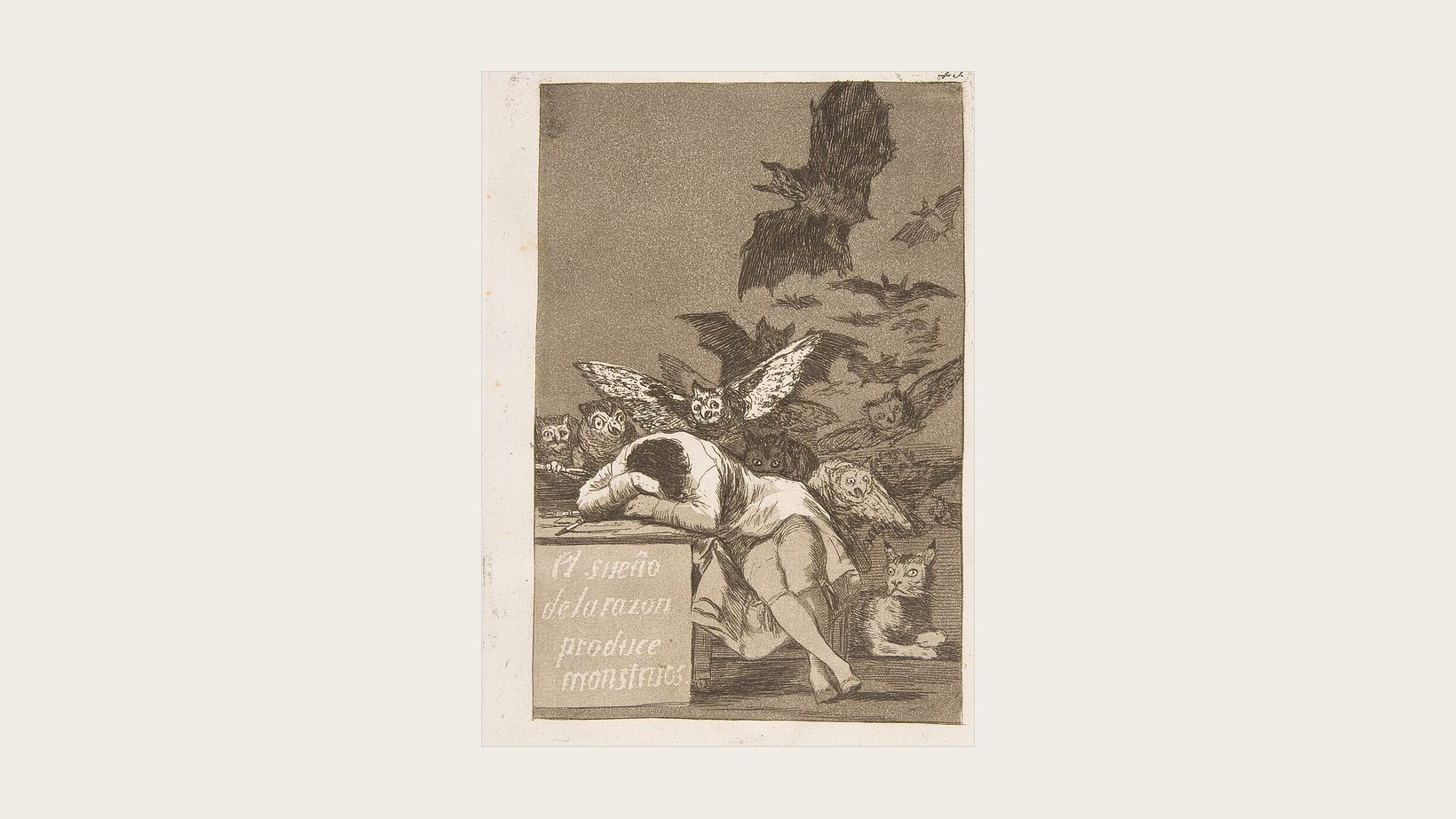
Cover: Francisco de Goya, The Sleep of Reason Produces Monsters, plate 43 of Los Caprichos, 1799, etching and aquatint. The Metropolitan Museum of Art, New York. Public domain. Dalí reworked the whole of Los Caprichos in his own Les Caprices de Goya of 1977.
Auction market · Prints and editions