Salvador Dali valuation
Melting clocks, a waxed moustache, and a signature he sold by the ream.
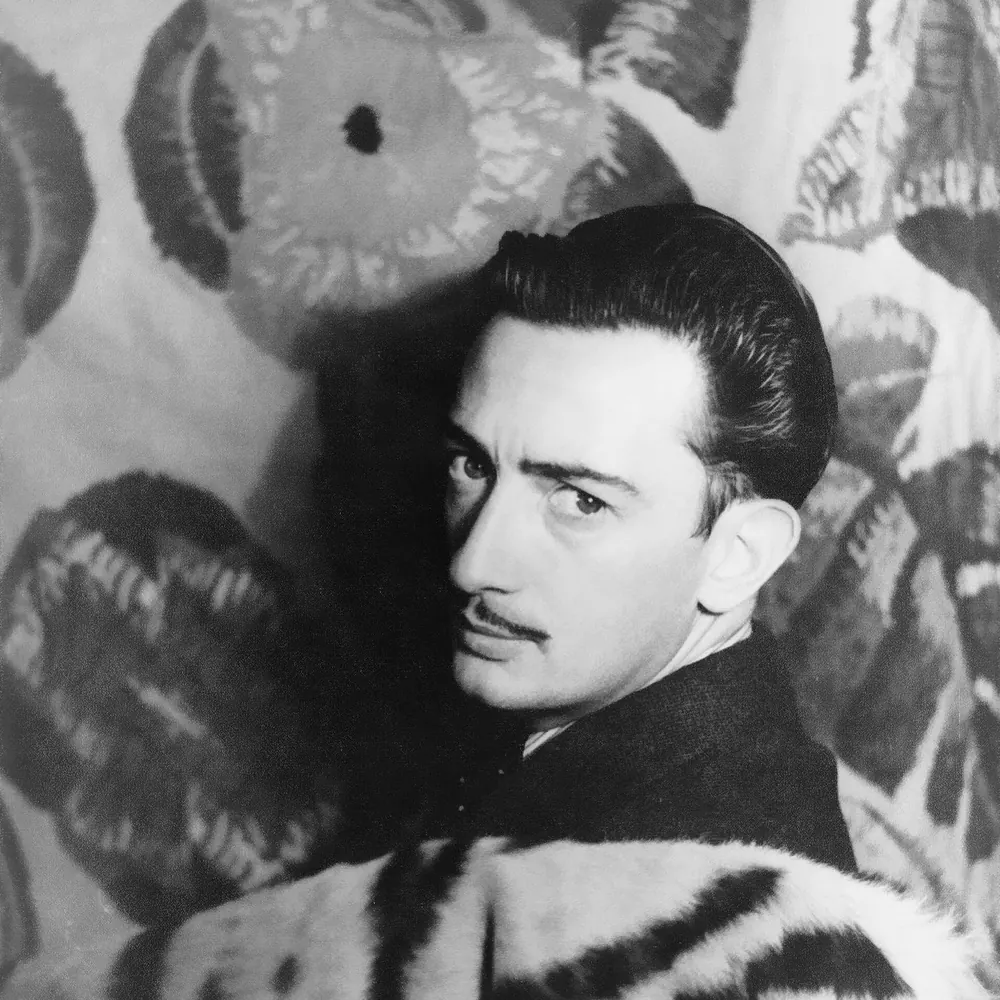
Salvador Dali was born at Figueres in Catalonia in 1904, was expelled from the Madrid academy, joined the Surrealists in 1929 and was expelled from them too. The Persistence of Memory, painted in 1931, made the soft watch the most recognisable image in twentieth-century art. He worked with Bunuel on Un Chien Andalou, designed a dream sequence for Hitchcock, collaborated with Schiaparelli and Disney, and spent his later decades as a public performance of himself. He died at Figueres in 1989, in a museum he had built for his own work.
No modern artist carries a larger forgery and misattribution problem. In his last years, in poor health, Dali signed very large quantities of blank sheets which were subsequently printed on and sold as limited editions; tens of thousands of such sheets are in circulation, and a pencil signature on a Dali print therefore proves considerably less than it does elsewhere. Anything on paper needs identifying against Michler and Lopsinger, with attention to publisher, paper, watermark and whether the edition is a lifetime one. Sculpture editions published posthumously are numerous. The Fundacio Gala-Salvador Dali is the authority for paintings.
The genuine Dalí print most often found in a private collection is a sheet from the Divine Comedy: a hundred colour wood engravings, one for each canto, cut by Raymond Jacquet and Jean Taricco from Dalí's own watercolours and published in Paris by Les Heures Claires in the early 1960s. Reproducing the watercolours took several thousand separate blocks. Impressions exist both pencil-signed and unsigned, on different papers, as loose sheets and as bound sets, and those details, rather than the image, decide what a particular sheet is.
Sculpture needs the same care. Many bronzes sold under his name were cast after his death from models he had approved, some in large editions, and a cast tells you little until its foundry mark, edition number and casting date are known. That does not make a posthumous cast worthless. It means the paperwork that came with the piece, and the date it was made, matter as much as the signature on it.
From 1948 Dalí and Gala lived at Port Lligat, near Cadaqués, wintering in Paris and New York. There he developed what he called nuclear mysticism, joining Catholic imagery to the physics of the atom in The Madonna of Port Lligat and The Christ of Saint John of the Cross, and later in La Gare de Perpignan of 1965 and The Hallucinogenic Toreador. The Swallow's Tail, shown in 1983, is said to be his last painting.
The objects are a market of their own. Edward James commissioned the Lobster Telephone in 1936 and the Mae West Lips Sofa the following year, and between 1941 and 1970 Dalí designed 39 pieces of jewellery, among them The Royal Heart, in gold with 46 rubies, 42 diamonds and four emeralds. He also designed the Chupa Chups logo, in 1969, and worked with Elsa Schiaparelli on the lobster dress and the shoe hat.
Selling a work
We represent the seller rather than the auction house: comparing houses and sale dates, negotiating the seller's terms, and keeping the paperwork and remittance in your name. What sets the value of a Salvador Dali sets out what we look at first.
Art movement
Other artist guides
- Banksy
- David Hockney
- Damien Hirst
- James McQueen
- Andy Warhol
- Pablo Picasso
- Yayoi Kusama
- Tracey Emin
- KAWS
- Keith Haring
- L. S. Lowry
- Bridget Riley
- Grayson Perry
- Takashi Murakami
- David Shrigley
- Jack Vettriano
- Beryl Cook
- Henry Moore
- Roy Lichtenstein
- Lucian Freud
- Barbara Hepworth
- Peter Blake
- Henri Matisse
- Martin Parr
- Mr Brainwash
- Patrick Caulfield
- Harland Miller
- Marc Chagall