Art News ·
Art News: Van Eyck exhibition at the National Gallery, tickets and what to see
By Whitebank Fine Art
Van Eyck: The Portraits opens at the National Gallery in London on 21 November 2026 and runs until 11 April 2027. For the first time, it brings together all nine known painted portraits by Jan van Eyck and his only surviving drawing, lent from Berlin, Bruges, Dresden and Vienna to join the gallery's own. The gallery says the portraits make up about half of the twenty or so pictures by him that survive. Standard tickets are £18, with an audio guide included, and under-18s go free.
Whitebank Fine Art, a London art advisory and gallery, took the details below from the National Gallery's own pages on 10 November 2026.
Van Eyck: The Portraits, tickets and dates
- Dates: 21 November 2026 to 11 April 2027, in the Ground Floor Galleries.
- Tickets: £18 standard admission, including an exhibition audio guide. Under-18s and National Gallery members go free, and booking is open on the gallery's website.
- Members' preview: 20 November 2026, already sold out.
- Opening times: the gallery is usually open daily from 10am to 6pm, and until 9pm on Fridays. It closes from 24 to 26 December and on 1 January.
What is in the exhibition
The show is built around reunions. The gallery's Arnolfini Portrait, of 1434, hangs for the first time beside a second portrait of what is probably the same man, Portrait of a Man (Giovanni Arnolfini?), of about 1435 to 1438, lent by the Gemäldegalerie in Berlin. The gallery points out that, apart from rulers, painting the same sitter twice was unheard of at the time, which suggests a particular bond between painter and patron.
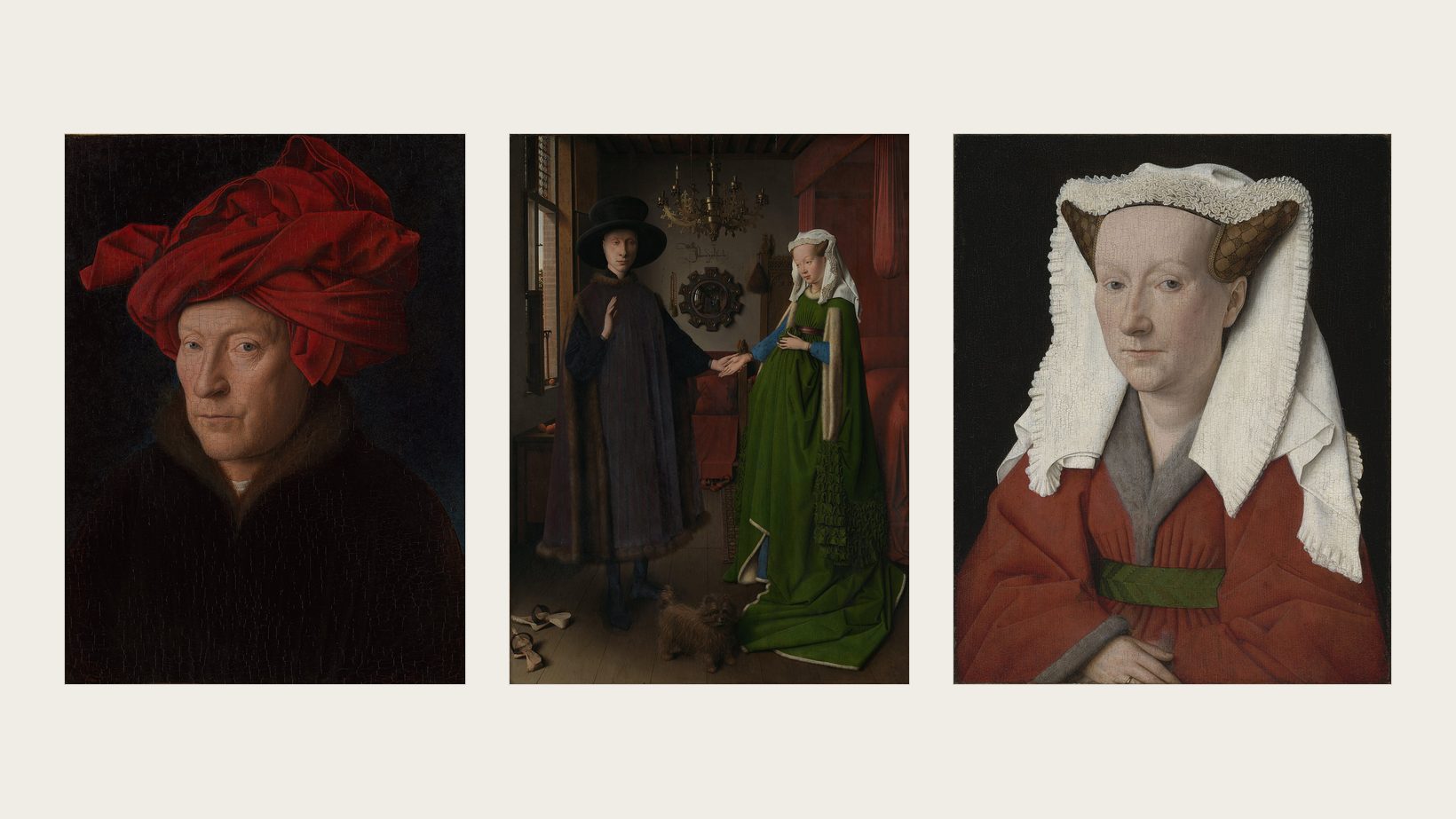
The newly conserved Portrait of a Man (Self Portrait?), of 1433, also from the National Gallery's collection, is shown with van Eyck's portrait of his wife, Margaret, the Artist's Wife, of 1439, from the Groeningemuseum in Bruges. The gallery calls Margaret the first dated portrait of an identifiable woman from outside the aristocracy.
From Vienna come both of the Kunsthistorisches Museum's van Eycks, the first time it has lent the pair at once. Jan de Leeuw, of 1436, shows a goldsmith who was probably the painter's friend, looking straight out at the viewer, an effect van Eyck seems to have pioneered. The other, Portrait of an Elderly Man, of about 1438, is reunited for only the second time with the drawing made for it.
That drawing, lent by the Kupferstich-Kabinett in Dresden, is van Eyck's only surviving drawing. It is in silverpoint and goldpoint, with the painter's notes on colour written beside the face, and the gallery describes it as the earliest record of a formal portrait sitting to survive. Three other drawings join it, among them Rogier van der Weyden's Portrait of a Young Woman, of about 1435 to 1440, from the British Museum.
Several of the panels are shown in the round for the first time, so the painted marbling on their backs can be seen.
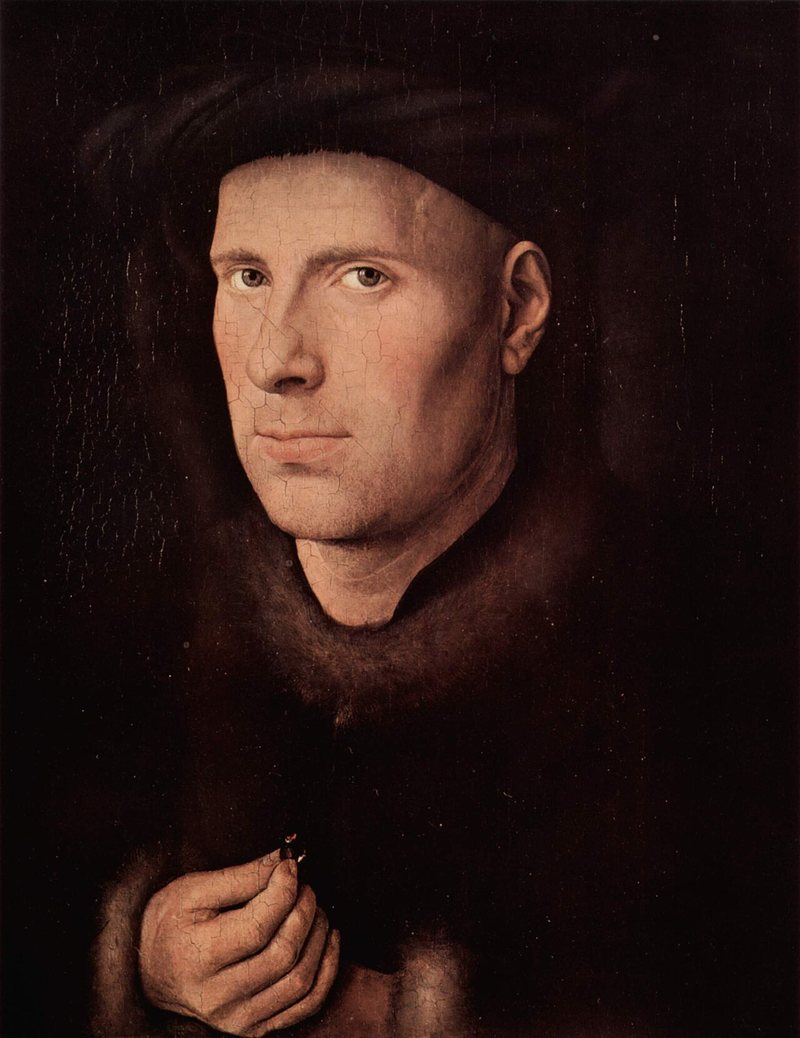
Jan van Eyck, Portrait of Jan de Leeuw, 1436. Kunsthistorisches Museum, Vienna.
Why van Eyck's portraits matter
Portraits before van Eyck tended to show rank and elegance, and their sitters were too generalised to recognise. He painted the people he saw: the stubble, the bloodshot eyes, the untidy hair. His sitters were mostly craftsmen, merchants and members of his own family. The exhibition's curator, Emma Capron, says portraiture "bursts onto the scene fully formed in the 1430s" in his hands.
He also signed and dated his portraits, sometimes to the day, at a time when most painters stayed anonymous, and some carry his motto, Als ich kan, as well as I can. The inscriptions are painted to look carved into stone or cut into metal, and the frames and backs of the panels imitate marble and precious materials. These were objects to be held and turned over and talked about, which is why the gallery is showing some of them free-standing.
Who was Jan van Eyck?
Van Eyck is first recorded in 1422, working in The Hague for John of Bavaria, ruler of Holland. From 1425 he was painter to Philip the Good, Duke of Burgundy, who also sent him on diplomatic missions: in 1428 he went to Portugal to paint Isabella of Portugal, the duke's future wife, in a portrait now lost. He settled in Bruges, where he died in 1441. With his brother Hubert he painted the Ghent Altarpiece, completed in 1432.
He worked at the point where Gothic art gave way to the northern Renaissance. He did not invent oil painting, but his layered glazes gave light, texture and detail a new reality.
The catalogue
Van Eyck: The Portraits, by Emma Capron and Nicholas Flory, runs to 208 pages and costs £40 in hardback, or £35 at the gallery. The National Gallery says it is the first book in English on van Eyck's portraits.
Also at the National Gallery this winter
Renoir and Love runs until 31 January 2027, and Yinka Shonibare and Thomas Gainsborough: A Conversation until 7 February 2027. Catharina van Hemessen: Signature Works follows from 4 March to 30 May 2027. Our guide to London's winter exhibitions covers the rest of the city, and free art galleries in London lists the collections you can see without a ticket.
Van Eyck and the art market
Paintings by van Eyck are almost all in museums and churches and practically never change hands. What does come to market is the work of the Early Netherlandish painters who followed him, and of the workshops that repeated his compositions long after his death. With these panels the questions are attribution, date and condition. Tree-ring dating of the oak, infrared images of the drawing under the paint and analysis of the paint layers can place a picture in time and in a workshop, and the extent of later restoration matters as much as the name.
Van Eyck exhibition questions
When is the van Eyck exhibition at the National Gallery? From 21 November 2026 to 11 April 2027.
How much are tickets? £18 for standard admission, with an audio guide included. Under-18s and members go free.
What is in the exhibition? All nine of van Eyck's known painted portraits and his only surviving drawing, with three drawings by other artists, among them Rogier van der Weyden.
Is the Arnolfini Portrait in the exhibition? Yes. It is shown for the first time with the portrait of Giovanni Arnolfini from Berlin.
Did van Eyck paint a self-portrait? The National Gallery's Portrait of a Man, of 1433, may be one, which is why its title carries a question mark. It is in the exhibition, newly conserved, beside his portrait of his wife.
If you own an early Netherlandish painting
A panel attributed to van Eyck's circle or to a Bruges workshop needs careful research before any figure is put on it. For a view on yours, send photographs of the front, the back of the panel, any labels, seals or inscriptions, and any paperwork through our art valuation page. There is no obligation to sell, and we act for you rather than for the saleroom.
Cover: Jan van Eyck, Portrait of a Man (Self Portrait?), 1433, and The Arnolfini Portrait, 1434, National Gallery, London; Margaret, the Artist's Wife, 1439, Groeningemuseum, Bruges. Public domain, via Wikimedia Commons.
Exhibitions