
Renaissance
The Renaissance is the revival of art and learning in Europe from about 1400 to 1600, which began in Florence and looked back to ancient Greece and Rome; its painters, from Sandro Botticelli, Leonardo da Vinci, Michelangelo, Raphael and Titian in Italy to Jan van Eyck, Albrecht Dürer, Hans Holbein and Pieter Bruegel in northern Europe, brought perspective, anatomy and the possibilities of oil paint to a new realism.
The Renaissance began in Florence in the early fifteenth century. The architect Filippo Brunelleschi worked out the rules of linear perspective, the painter Masaccio used them in his frescoes for the Brancacci Chapel, and the sculptor Donatello studied the statues of ancient Rome; together they gave art a new, measurable realism. Scholars were rediscovering Greek and Latin texts at the same time, and rich patrons, the Medici above all, paid for paintings, palaces and chapels. By the 1480s Botticelli was painting pagan goddesses for Medici circles, and in the High Renaissance, from about 1490 to the Sack of Rome in 1527, Leonardo da Vinci, Michelangelo and Raphael worked in Florence, Milan and the Rome of Pope Julius II. Venice went its own way, with the warm colour and light of Giovanni Bellini, Giorgione and Titian. The word, French for 'rebirth', echoes the Italian 'rinascita' used by Giorgio Vasari in his Lives of the Artists of 1550.
North of the Alps a parallel revolution came through oil paint. In Bruges in the 1430s Jan van Eyck used glazes of oil colour to paint light, textures and the smallest details with a precision never seen before, and the Netherlandish painters who followed him were admired and collected in Italy. Albrecht Dürer of Nuremberg travelled to Venice twice and brought Italian ideas of proportion and perspective home, spreading them through his woodcuts and engravings; prints made images cheap and portable across Europe. Hans Holbein the Younger took the new realism to the court of Henry VIII, and Pieter Bruegel the Elder painted the peasants and landscapes of the Low Countries. The Reformation changed what Protestant patrons would pay for, and by the end of the sixteenth century the Renaissance had given way to Mannerism and then to the Baroque.
At a glance
- When
- About 1400 to 1600
- Where
- Florence, Rome and Venice, then the Netherlands, Germany and across Europe
- Leading artists
- Sandro Botticelli, Leonardo da Vinci, Michelangelo, Raphael
Characteristics of the Renaissance
- Perspective
- Space constructed on mathematical rules, with lines converging on a vanishing point.
- The human figure
- Bodies studied from life, from anatomy and from ancient sculpture.
- Classical antiquity
- Gods, heroes and architecture from Greece and Rome alongside Christian subjects.
- Light and modelling
- Forms rounded by light and shade, and Leonardo's soft sfumato.
- Oil paint and detail
- Translucent glazes and minute detail, perfected in the Netherlands.
Renaissance artists
Every artist below has a page on this site, with a short biography and what a valuation of their work turns on.
In Florence and Rome
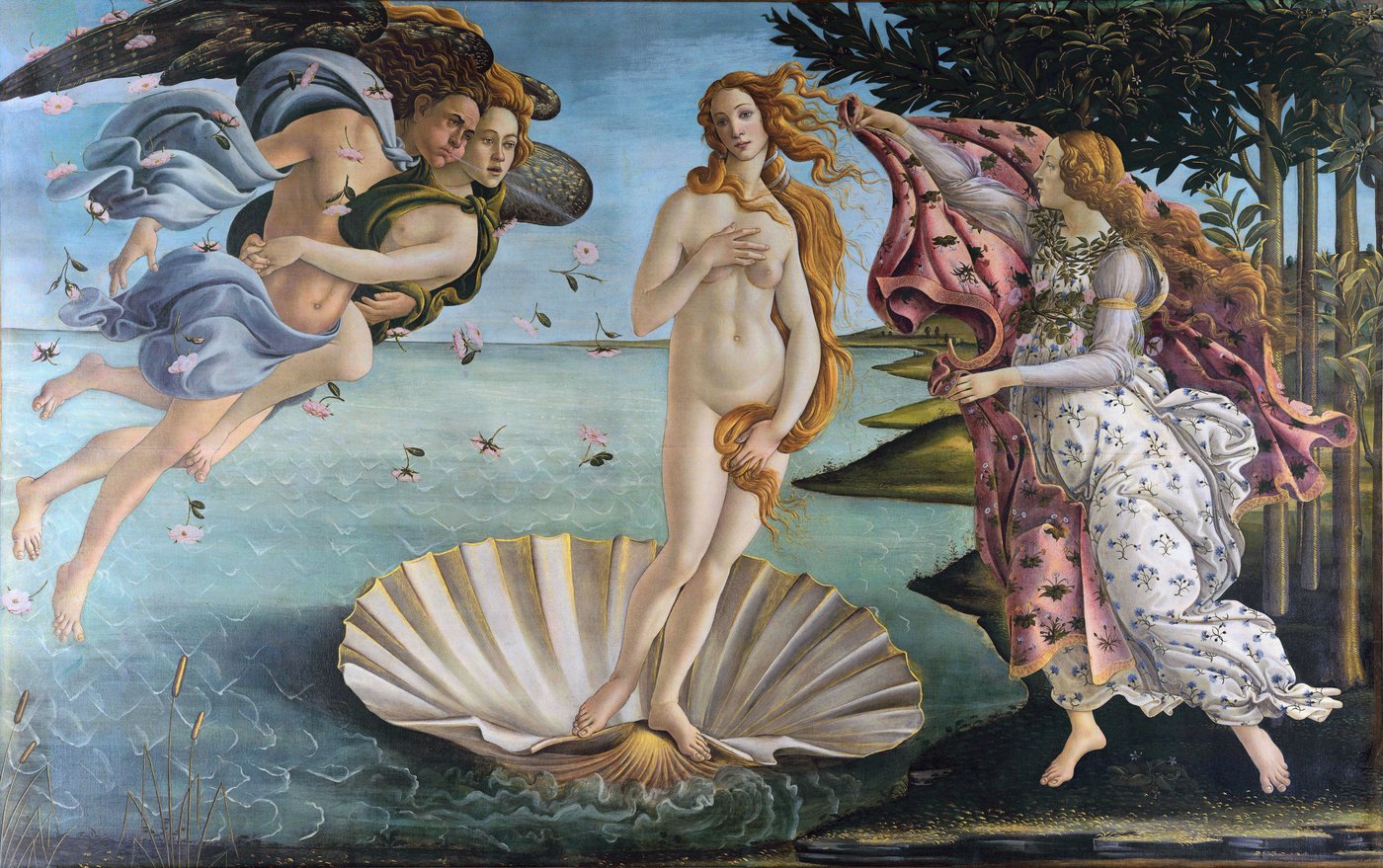
- Sandro BotticelliThe Birth of Venus and Primavera, and the Florentine Madonnas his busy workshop painted for private devotion.
- Leonardo da VinciThe Mona Lisa, The Last Supper and thousands of pages of notebooks, by the most famous artist of the Renaissance.
- MichelangeloSculptor of the David and painter of the Sistine Chapel ceiling, whose drawings are among the rarest works on the market.
- RaphaelThe School of Athens, the Sistine Madonna and the Madonnas that defined grace for four centuries of painters.
In northern Europe
- Jan van EyckThe Arnolfini Portrait and the Ghent Altarpiece, by the painter who showed what oil paint could do.
- Albrecht DürerPainter, draughtsman and the greatest printmaker of the Northern Renaissance, from the Apocalypse woodcuts to Melencolia I.
- Hans Holbein the YoungerThe portrait painter of Henry VIII's court, whose drawings and The Ambassadors fixed the image of Tudor England.
- Pieter Bruegel the ElderHunters in the Snow and The Tower of Babel, by the painter whose sons and grandsons made his name a family business.
Famous Renaissance works
- The Arnolfini PortraitJan van Eyck, 1434, National Gallery, London
- The Birth of VenusSandro Botticelli, about 1485, Uffizi, Florence
- The Last SupperLeonardo da Vinci, 1495–98, Santa Maria delle Grazie, Milan
- Sistine Chapel ceilingMichelangelo, 1508–12, Vatican City
- The School of AthensRaphael, 1509–11, Vatican City
- Bacchus and AriadneTitian, 1520–23, National Gallery, London
What a valuation turns on
Almost every celebrated Renaissance painting is in a church or a museum, so what comes to market is mostly the work of the masters' workshops, followers and imitators, and the first question about any picture is who painted it. Catalogues use a precise ladder of terms, from a work by the artist through 'workshop of', 'circle of' and 'follower of' to 'manner of' and 'after', and each step down divides the value. Prints are where the period is most within reach: Dürer's woodcuts and engravings, the engravings Marcantonio Raimondi made after Raphael, and the prints published from Bruegel's designs, where the quality of the impression, early or late, decides the value.
Most Renaissance pictures were painted on wooden panels, and their condition is the second question: panels split, warp and are attacked by worm, and many have been thinned, cradled or transferred to canvas, and overpainted in old restorations. Technical study now settles a great deal, from tree-ring dating of the oak panels used in the Netherlands to infrared images of the drawing under the paint. A provenance with no gaps between 1933 and 1945 is essential before an important work can be sold, and paintings that have been in Britain for many years may need an export licence to leave the country.
Common questions
What is Renaissance art?
Renaissance art is the painting, sculpture and architecture of Europe from about 1400 to 1600. It began in Florence, looked back to the art of ancient Greece and Rome, and is known for linear perspective, the study of anatomy, balanced compositions and a new realism, achieved in the north through oil paint.
What are the characteristics of Renaissance art?
Linear perspective and convincing space; the human figure studied from life, anatomy and ancient sculpture; subjects from classical myth as well as the Bible; forms modelled with light and shade; and, especially in the Netherlands, translucent oil glazes and minute detail.
Who are the most famous Renaissance artists?
In Italy, Masaccio, Donatello, Sandro Botticelli, Leonardo da Vinci, Michelangelo, Raphael, Giovanni Bellini and Titian; in northern Europe, Jan van Eyck, Albrecht Dürer, Hans Holbein the Younger and Pieter Bruegel the Elder.
When was the Renaissance?
From about 1400 to about 1600. It began in Florence, reached its height in the High Renaissance of about 1490 to 1527, and spread across Europe before giving way to Mannerism and the Baroque.
What is the difference between the Italian and the Northern Renaissance?
The Italian Renaissance looked to ancient Rome and built its pictures on perspective, proportion and the idealised human body. The Northern Renaissance, in the Netherlands and Germany, was rooted in close observation of the real world, painted in oil with extraordinary detail, and spread widely through prints.
How do I sell an Old Master painting or print?
Send photographs of the front and the back, with any labels, inscriptions, seals or collectors' marks, for a free, confidential valuation. Attribution, condition and provenance decide the most; we look at all three, compare a confidential private sale with auction, and keep the paperwork in your name until you are paid.