Alfred Wallis valuation
Self-taught St Ives painter of boats, harbours and lighthouses, worked from memory in ship's paint on scraps of cardboard.
Alfred Wallis (1855–1942) was born in Devonport in Devon.
What a work by Alfred Wallis is worth
Send photographs and whatever paperwork came with it. The first question is what the work actually is — edition or unique, when, and in what condition — because everything else follows from the answer. A valuation is free, made online from the photographs you send, and it commits you to nothing. We act for sellers across the United Kingdom, Europe and the United States.
Write to info@whitebankfineart.co.uk, or start below.
Bio
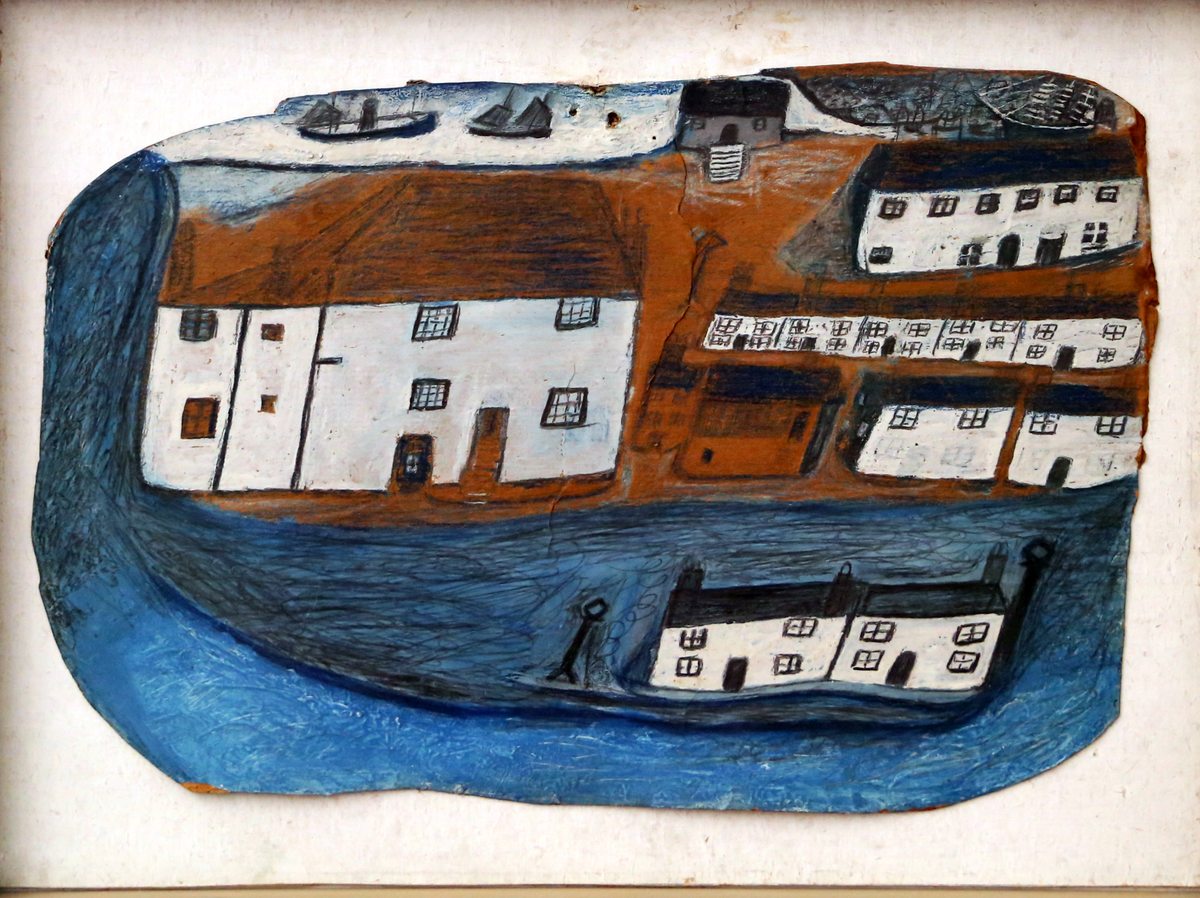
Alfred Wallis (1855–1942) was born in Devonport in Devon. He fished from Newlyn with the Mount's Bay fleet, and in 1876 became a Merchant Navy mariner, sailing schooners between Penzance and Newfoundland. In 1882 he moved to St Ives, where he worked in a marine stores business buying scrap iron, sails and rope, which he took over and ran until 1912. Widowed in 1922, he took up painting in his seventies, with no training, to keep loneliness at bay. He painted from memory: the sailing ships and steamers he had known at sea, St Ives harbour and its lighthouse, houses and the Cornish landscape, ignoring perspective and sizing things by their importance. He used ship's paint, mostly greys, blacks and greens, on scraps of cardboard from packing boxes. In August 1928 Ben Nicholson and Christopher Wood bought several of his paintings, and through them Jim Ede, who went on to create Kettle's Yard in Cambridge, promoted his work in London and collected more than 120 of his paintings. Tate and Kettle's Yard hold his work, and Kettle's Yard opened the exhibition Alfred Wallis Rediscovered in 2020.
His works are unique: paintings in oil and ship's paint on scraps of cardboard, some cut from boxes or printed papers, and drawings in pencil and crayon. Card of this kind is fragile, so a buyer will look for tears, worn or trimmed edges, flaking paint and any repairs. A record of who has owned the work, with any labels or letters that belong to it, should be kept together.
At a glance
- Born
- 8 August 1855, Devonport
- Died
- 29 August 1942, Madron
Alfred Wallis paintings
Alfred Wallis painted ships, harbours, lighthouses and the cottages of St Ives, almost always from memory. He painted the world of sail and early steam as it was disappearing, and in his own spelling his subject was "what use To Bee out of my own memery what we may never see again". Perspective is ignored and each thing is sized by its importance, so that many of his pictures resemble early maps.
His materials look accidental, but close study suggests they were chosen with care. He tore card from packing boxes, often keeping its uneven shape, and insisted on one brand of ship's paint, Peacock & Buchan, bought from a hardware shop in the Digey in St Ives. He also worked in graphite and oil on paper.
Ben Nicholson, Christopher Wood and Alfred Wallis in St Ives
In August 1928 Ben Nicholson and Christopher Wood visited St Ives for the day and bought some of his paintings. They came back with their partners, stayed for several weeks, and kept buying. Nicholson later wrote that to Wallis his paintings were never "paintings" but actual events. Wallis went on painting as he always had, while the younger artists celebrated his direct way of making an image.
Through them his work reached Jim Ede, who promoted it in London and gave it a lasting home at Kettle's Yard in Cambridge. In his lifetime his paintings sold for only a few shillings. They can be seen today at Tate St Ives and Kettle's Yard, which opened Alfred Wallis Rediscovered in 2020, and he is often grouped with the St Ives School, although he had no training and belonged to no group.
Alfred Wallis prints and selling a painting
Wallis made unique paintings and drawings, and an Alfred Wallis print is a later reproduction of one of them, whatever its frame or label says. A real Wallis is a physical object, with paint sitting on card or paper, often with an uneven edge.
Because the pictures look simple, the history of the object counts for a great deal. Dealers' labels, letters, exhibition records and any link to Ede, Nicholson or the St Ives circle all help. Robert Jones, author of Alfred Wallis: Artist and Mariner, is consulted in the cataloguing of his work.
Best auction results
- Ships and Lighthouse, Houses £34,830
- Graphite and oil on paper, signed · London · 17 October 2026
- Publicly reported
- Against an estimate of £20,000 to £30,000. A recent sale, not the artist's highest result.
Results as reported at the time of sale, inclusive of buyer's premium. They are a record of what specific works achieved on specific days, not a guide to what any other work is worth.
Whitebank Fine Art is an art advisory and gallery, not an auction house, and is not affiliated with any auction house or with the artist, their estate or their representatives. This page describes the range we advise on. Nothing here is investment advice.