
Folk Art
Folk art is art made by people without academic training, often within a shared local or community tradition, and it includes painted signs, quilts, carvings, weathervanes and portraits, as well as the pictures of Edward Hicks and Grandma Moses.
Folk art existed long before anyone called it art. Tavern signs, ship portraits, samplers, quilts, carved figures and painted furniture were made for use and for local pleasure, passed from one maker to the next. Modern artists were among the first to value them. In the United States, collectors including Abby Aldrich Rockefeller began buying in the 1920s, and in 1932 the Museum of Modern Art in New York showed American Folk Art: The Art of the Common Man in America, 1750 to 1900.
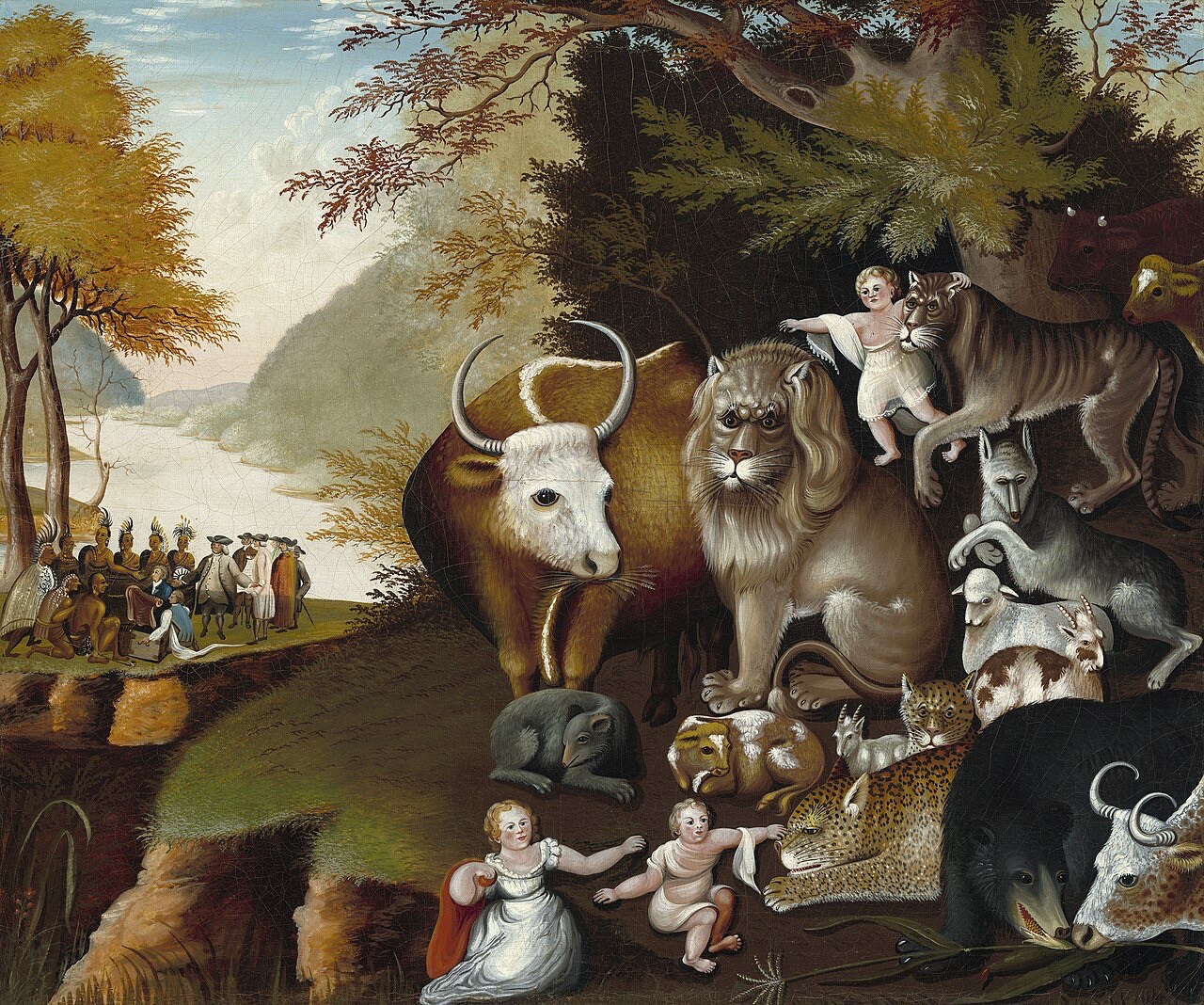
Individual names came to the fore: Edward Hicks, the Quaker minister who painted The Peaceable Kingdom again and again; Grandma Moses, who began in her seventies; and Bill Traylor, who was born into slavery and drew in his eighties on the streets of Montgomery. In Britain, the Cornish fisherman Alfred Wallis was discovered by Ben Nicholson and Christopher Wood in 1928, and Tate Britain's exhibition British Folk Art in 2014 brought pub signs, ship models and needlework into the museum. The boundaries are loose, and many of the same makers are also described as naive or outsider artists.
At a glance
- When
- Centuries old; collected since the 1920s
- Where
- Worldwide, with strong traditions in Britain and the United States
- Leading artists
- Edward Hicks, Grandma Moses, Bill Traylor
Characteristics of folk art
- No academic training
- Skills learned at home or in a trade, not in art school.
- Local tradition
- Forms and subjects handed down within a community.
- Useful objects
- Signs, furniture, quilts and tools made for everyday life.
- Flat, direct design
- Strong pattern and clear outline, with little concern for perspective.
- Everyday materials
- Wood, fabric, tin and house paint.
Folk artists
Every artist below has a page on this site, with a short biography and what a valuation of their work turns on.
American painters
- Edward HicksAmerican Quaker minister and painter of the many versions of The Peaceable Kingdom.
- Grandma MosesAmerican folk painter of farm life who began to paint seriously in her seventies.
- Bill TraylorAfrican-American self-taught artist who began drawing in his eighties on the streets of Montgomery, Alabama.
Famous Folk works
- The Peaceable KingdomEdward Hicks, about 1834, National Gallery of Art, Washington
- The Tree of LifeHannah Cohoon, 1854, Hancock Shaker Village, Massachusetts
- The Flax Scutching BeeLinton Park, 1885, National Gallery of Art, Washington
- Sugaring OffGrandma Moses, 1943
What a valuation turns on
Anonymous objects are valued on their design, surface and rarity. Old paint is prized, so a weathervane, sign or piece of furniture that has been stripped or repainted loses much of its appeal. British ship portraits, inn signs and needlework samplers each have collectors of their own, and a dated or inscribed sampler or a named vessel adds interest.
For named artists the record matters: Grandma Moses has a published catalogue raisonné, and Alfred Wallis's scraps of card and board have long been widely imitated. Modern reproductions and deliberately aged pieces are common in this field, so age should be confirmed through materials, construction and wear, and any history in one family noted.
Common questions
What is folk art?
Folk art is art made by people without academic training, usually within a local tradition. It includes paintings, signs, quilts, carvings and decorated objects made for everyday life.
What is the difference between folk art and naive art?
Folk art grows out of shared community traditions. Naive art is the work of individual self-taught painters, who often imitate the conventions of fine art.
What is the difference between folk art and outsider art?
Folk artists work within a tradition and a community. Outsider art, or art brut, describes work made apart from both, a term Jean Dubuffet developed in the 1940s.
Who are the most famous folk artists?
Edward Hicks, Grandma Moses and Bill Traylor in the United States, and Alfred Wallis in Britain.
How do I sell a folk art painting or antique sign?
Send photographs of the front, any signature or marks, and the back for a free, confidential valuation, with any labels or documents. We check the work against the published record, look at condition, and compare a confidential private sale with auction.