

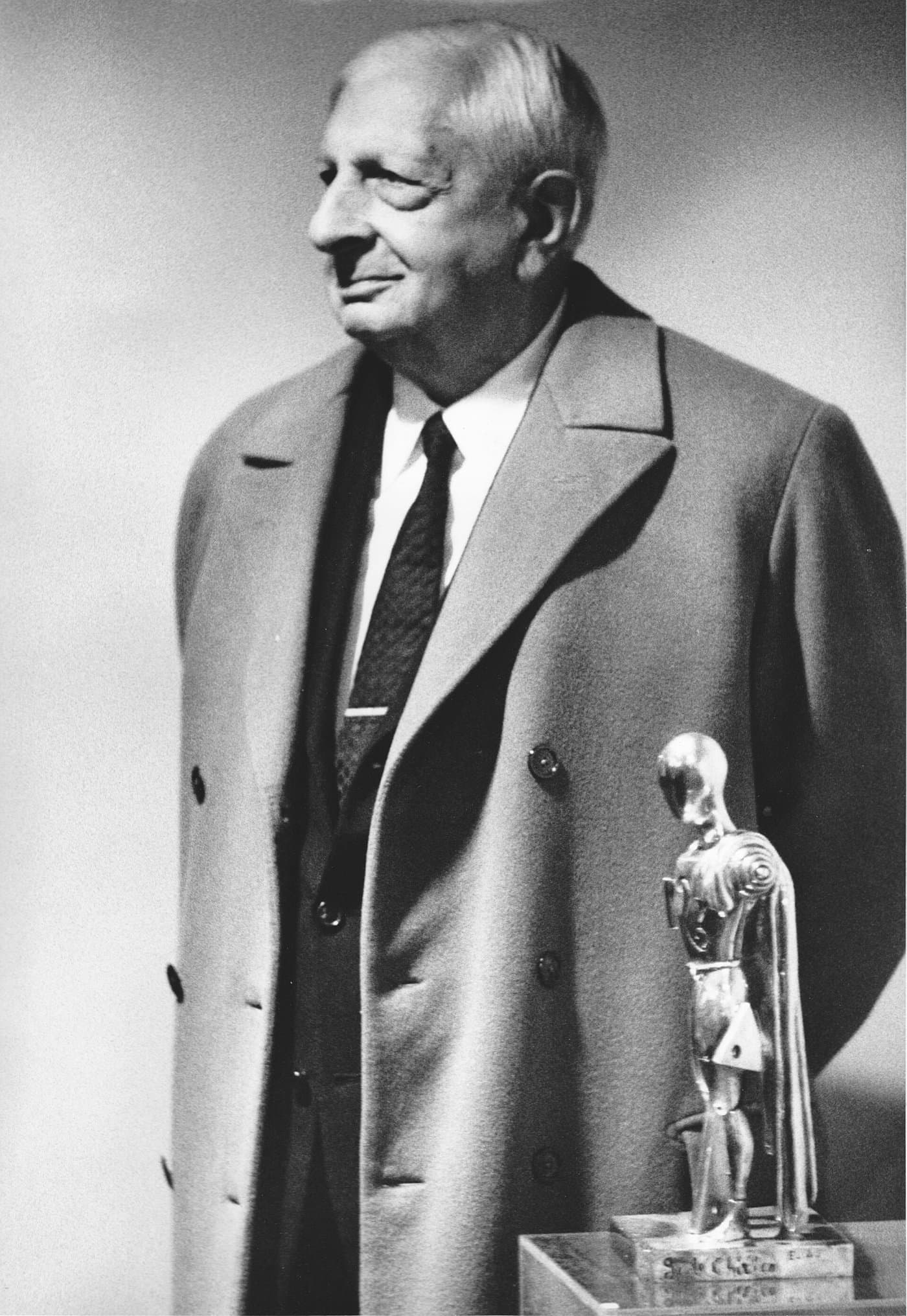
Giorgio de Chirico valuation
Painted empty arcades and long shadows before he was thirty, and repainted them for the next fifty years.
Giorgio de Chirico was born to Italian parents in Greece in 1888 and produced between about 1909 and 1919 the Metaphysical paintings that made him: empty Italian piazzas, arcades in raking light, faceless mannequins, trains on the horizon, objects assembled without a reason.
What a work by Giorgio de Chirico is worth
Send photographs and whatever paperwork came with it. The first question is what the work actually is — edition or unique, when, and in what condition — because everything else follows from the answer. A valuation is free, made online from the photographs you send, and it commits you to nothing. We act for sellers across the United Kingdom, Europe and the United States.
Write to info@whitebankfineart.co.uk, or start below.
Bio
Giorgio de Chirico was born to Italian parents in Greece in 1888 and produced between about 1909 and 1919 the Metaphysical paintings that made him: empty Italian piazzas, arcades in raking light, faceless mannequins, trains on the horizon, objects assembled without a reason. The Surrealists took him as a founding father, and then broke with him furiously when he repudiated modernism, turned to a neo-baroque manner, and began producing new versions of his own early pictures — sometimes backdated. He continued doing so until his death in Rome in 1978.
That practice is the central problem and the central skill in this market. Genuine de Chirico paintings exist in three categories that are priced very differently: the original metaphysical works of the 1910s, the artist's own later repetitions, and outright forgeries, of which there are a great many. Dating, materials analysis and the archives of the Fondazione Giorgio e Isa de Chirico are all normally required. The lithographic and etched output of the post-war decades is large and much more straightforward. Provenance across the 1930s and 1940s should be checked carefully as a matter of course.
At a glance
- Born
- 10 July 1888, Volos
- Died
- 20 November 1978, Rome
- Movement
- Metaphysical Painting
More on Wikipedia.
Self-forgeries, and the Fondazione
De Chirico resented the critical preference for his early work and produced backdated versions of his metaphysical pictures, both to profit from them and, as he saw it, in retribution, and he also denounced as forgeries a number of paintings attributed to him in public and private collections. A signature and a date on a de Chirico are therefore not evidence on their own.
The Fondazione Giorgio e Isa de Chirico in Rome, which also runs his house and studio in Piazza di Spagna as a museum, is the authority on the work, and its opinion, with the catalogues of the paintings and of the graphic work, is what an attribution rests on.
Volos, Florence and the return to craft
De Chirico was born at Volos in Greece, where his father, an engineer, was building railways, and his younger brother became the writer and painter Alberto Savinio. From 1900 he studied drawing and painting at the Athens Polytechnic. In Florence in 1910, after what he described as a revelation in Piazza Santa Croce, he painted The Enigma of an Autumn Afternoon, the first of the metaphysical town squares, and a few days in Turin in July 1911, on his way to Paris, gave him its arcades and piazzas. Guillaume Apollinaire praised the work almost at once.
In November 1919 his article The Return of Craftsmanship, in Valori plastici, announced the turn to the old masters. André Breton came across one of the metaphysical paintings at Paul Guillaume's gallery in Paris, and in 1922 Yves Tanguy decided to become a painter after seeing one in a dealer's window. De Chirico published his novel Hebdomeros in 1929, met Isabella Pakszwer Far in 1930, lived in the United States from 1936 and settled in Rome in 1944. From 1939 he painted in a neo-Baroque manner that looked to Rubens.
Whitebank Fine Art is an art advisory and gallery, not an auction house, and is not affiliated with any auction house or with the artist, their estate or their representatives. This page describes the range we advise on. Nothing here is investment advice.
