
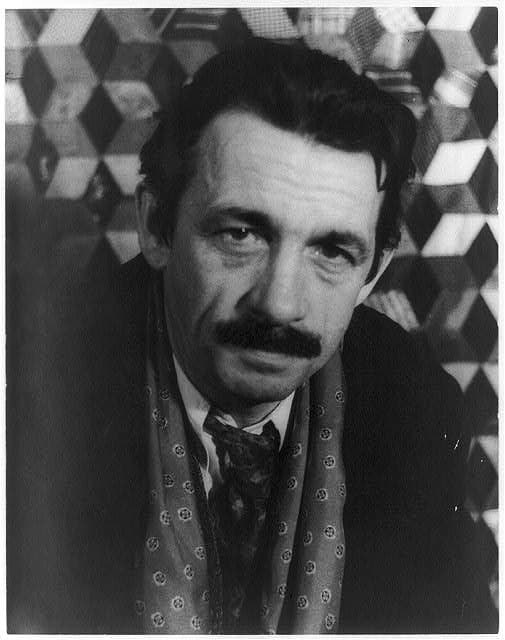
Thomas Hart Benton valuation
American Regionalist muralist, and the man who taught Jackson Pollock.
Thomas Hart Benton was born in Neosho, Missouri in 1889 into a political family, studied in Chicago and Paris, and returned to America determined to paint it rather than Europe.
What a work by Thomas Hart Benton is worth
Send photographs and whatever paperwork came with it. The first question is what the work actually is — edition or unique, when, and in what condition — because everything else follows from the answer. A valuation is free, made online from the photographs you send, and it commits you to nothing. We act for sellers across the United Kingdom, Europe and the United States.
Write to info@whitebankfineart.co.uk, or start below.
Bio
Thomas Hart Benton was born in Neosho, Missouri in 1889 into a political family, studied in Chicago and Paris, and returned to America determined to paint it rather than Europe. With Grant Wood and John Steuart Curry he became the public face of Regionalism in the 1930s: rolling, muscular, deliberately unmodern murals of farm work, river towns, industry and American history, several of them still in place in state capitols and universities. He taught at the Art Students League, where Jackson Pollock was among his students, and later dismissed his own influence on him as merely technical. He died in his Kansas City studio in 1975.
Benton worked out his murals through a long sequence of preparatory material — small clay maquettes, oil sketches, drawings — and this preparatory work is much of what comes to market, valued according to how closely it relates to a known finished mural. He also produced lithographs through Associated American Artists in editions of a few hundred, which are the most accessible part of the output and where condition, margins and the sharpness of an impression decide value. Tempera and oil-and-tempera panels are the top of the market.
At a glance
- Born
- 15 April 1889, Neosho
- Died
- 19 January 1975, Kansas City
- Movement
- Regionalism
More on Wikipedia.
Chicago, Paris and the Indiana murals
Benton studied at the School of the Art Institute of Chicago from 1907 and at the Académie Julian in Paris from 1909, and in 1922 married Rita Piacenza, one of his students. In 1932 he painted The Arts of Life in America for the Whitney Museum and won the commission for the murals of Indiana life at the 1933 Century of Progress Exhibition in Chicago, which are now at Indiana University in Bloomington.
On 24 December 1934 he appeared on one of Time magazine's first colour covers, in an article on Regionalism with Grant Wood and John Steuart Curry. In 1935 he left New York for Missouri, where he painted A Social History of the State of Missouri for the State Capitol in Jefferson City, and he spent some fifty summers on Martha's Vineyard.
Norfolk, the camoufleur and America Today
Benton's father, Colonel Maecenas Benton, was a lawyer elected four times to Congress, and he named his son after his own great-uncle, one of Missouri's first two senators. Thomas spent his childhood between Washington and Missouri, was sent to the Western Military Academy in 1905, and as a teenager worked as a cartoonist in Joplin. He moved to New York in 1912. In the First World War he served in the Navy at Norfolk, Virginia, drawing shipyard work and later, as a camoufleur, the camouflaged ships entering the harbour, which he said was the most important thing he had yet done as an artist.
Back in New York in the early 1920s he declared himself an enemy of modernism and toured the country making sketches he would return to for years. America Today, his murals of 1930 and 1931 for the New School for Social Research, was bought and restored by AXA Equitable in 1984 and given to the Metropolitan Museum in 2012. He taught at the Art Students League from 1926 to 1935 and at the Kansas City Art Institute from 1935 to 1941. During the Second World War his series The Year of Peril was widely distributed as prints, and he illustrated editions of Tom Sawyer, The Grapes of Wrath and Life on the Mississippi.
Whitebank Fine Art is an art advisory and gallery, not an auction house, and is not affiliated with any auction house or with the artist, their estate or their representatives. This page describes the range we advise on. Nothing here is investment advice.