

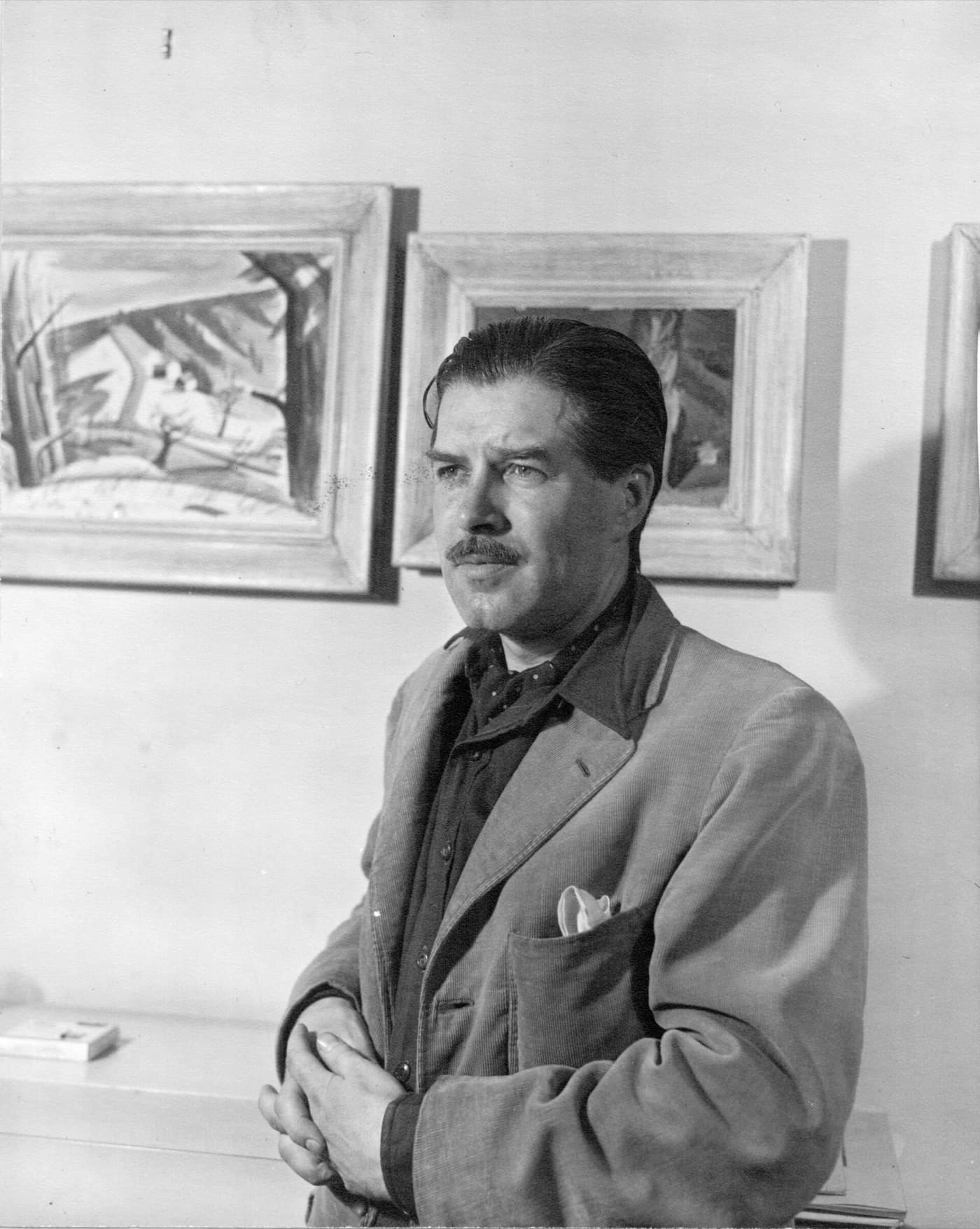
Jack Bush valuation
Toronto commercial artist by day, Painters Eleven by night, then Colour Field by conviction.
Jack Bush was born in Toronto in 1909 and worked for most of his life as a commercial artist, painting seriously in the evenings and at weekends.
What a work by Jack Bush is worth
Send photographs and whatever paperwork came with it. The first question is what the work actually is — edition or unique, when, and in what condition — because everything else follows from the answer. A valuation is free, made online from the photographs you send, and it commits you to nothing. We act for sellers across the United Kingdom, Europe and the United States.
Write to info@whitebankfineart.co.uk, or start below.
Bio
Jack Bush was born in Toronto in 1909 and worked for most of his life as a commercial artist, painting seriously in the evenings and at weekends. He was a founder of Painters Eleven, the group that brought abstraction to Ontario in 1953, and a studio visit from the critic Clement Greenberg in 1957 changed his direction: he thinned the paint, abandoned the gestural surface and moved towards flat, staining colour on raw canvas. The mature work, from about 1960, is the sash and column paintings and then the loose, singing colour arrangements of the 1970s. He gave up commercial work only in 1968, and died in 1977.
Bush is principally a Canadian market, though the Colour Field connection gives the strongest work an international reach. The stained canvases on raw cotton duck are the top of the output; the earlier Painters Eleven period is a smaller and more specialist field. Because the paint is thin and much of the canvas is left bare, staining, discolouration of the unprimed ground and old restoration are especially visible and bear directly on value. Watercolours and gouaches on paper are numerous. Signature, title and date are usually on the reverse.
At a glance
- Born
- 20 March 1909, Toronto
- Died
- 24 January 1977, Toronto
- Movement
- Abstract Expressionism
More on Wikipedia.
Montreal, New York and São Paulo
Bush studied at the Royal Canadian Academy school in Montreal and began as a landscape painter under the influence of Charles Comfort and the Group of Seven. His first solo exhibition in New York was in 1962, and from 1964 he stopped holding solo shows in Toronto so that he would not be seen as a provincial painter.
In March 1966 he switched permanently from oil thinned with turpentine to water-based acrylic, so the date of a stained painting tells you which medium it is in, and that bears on its condition. He represented Canada at the São Paulo Biennial in 1967, and in 1976 the Art Gallery of Ontario toured a retrospective and he was appointed to the Order of Canada.
Night classes, Greenberg and Matisse
In Montreal Bush studied with Adam Sheriff Scott and Edmond Dyonnet, and in Toronto he drew from the model at Charles Comfort's weekly sessions and took night classes at the Ontario College of Art. From 1942 he was one of the principals of a commercial art business, and he worked as a commercial artist for 41 years in all. Greenberg, critical at first, told him to look in his oils for the thinness and clarity of colour he already had in his works on paper, and Bush became friends with Jules Olitski, Kenneth Noland and Anthony Caro.
He compared his paintings to jazz, and Matisse was the painter he measured himself against: he once told Noland he would like to hit Matisse's ball out of the park. Greenberg later named him, with Noland, a supreme colourist. His work is in the National Gallery of Canada, the Art Gallery of Ontario, the Montreal Museum of Fine Arts, the Museum of Fine Arts in Boston and Tate, and the National Film Board of Canada released Murray Battle's documentary Jack Bush in 1979.
Whitebank Fine Art is an art advisory and gallery, not an auction house, and is not affiliated with any auction house or with the artist, their estate or their representatives. This page describes the range we advise on. Nothing here is investment advice.
