

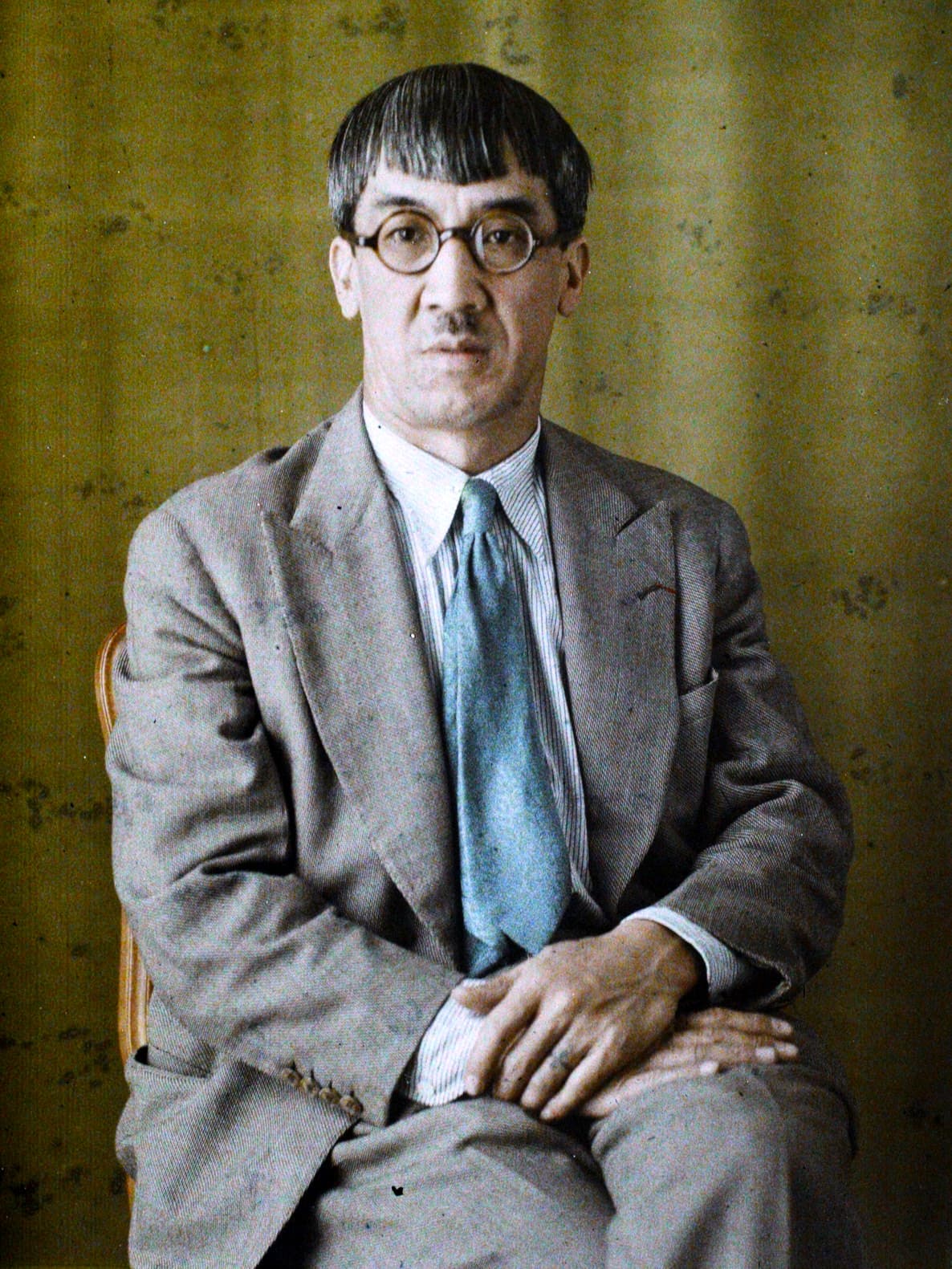
Tsuguharu Foujita valuation
Brought a Japanese brush to Montparnasse and painted the whitest nudes in Paris.
Tsuguharu Foujita was born in Tokyo in 1886 and arrived in Paris in 1913, where he became one of the few Japanese artists at the centre of the Ecole de Paris, known as much for his bowl haircut and round glasses as for the pictures.
What a work by Tsuguharu Foujita is worth
Send photographs and whatever paperwork came with it. The first question is what the work actually is — edition or unique, when, and in what condition — because everything else follows from the answer. A valuation is free, made online from the photographs you send, and it commits you to nothing. We act for sellers across the United Kingdom, Europe and the United States.
Write to info@whitebankfineart.co.uk, or start below.
Bio
Tsuguharu Foujita was born in Tokyo in 1886 and arrived in Paris in 1913, where he became one of the few Japanese artists at the centre of the Ecole de Paris, known as much for his bowl haircut and round glasses as for the pictures. His achievement was technical: a ground of extraordinary smooth white on which he drew with a fine Japanese brush in sumi ink, giving nudes and cats a line no European painter could match. He returned to Japan and painted war pictures for the Imperial Army, a period that damaged his standing at home, then came back to France, converted to Catholicism as Leonard, and died in 1968.
This is a market driven principally from Japan, and the Paris years of the 1920s are far ahead of everything else. Foujita is extensively forged, and the composition of that white ground is one of the technical grounds on which genuine works are distinguished, so scientific examination is common at the upper end. Cats and nudes are the subjects that lead. Alongside paintings there is a substantial output of drawings, watercolours, illustrated books and etchings, much of it from the 1920s, and these are widely copied as well.
At a glance
- Born
- 27 November 1886, Shin-ogawamachi
- Died
- 29 January 1968, Zurich
- Movements
- Expressionism, School of Paris
More on Wikipedia.
Fernande, the Galerie Chéron and Reims
In Paris Foujita lived in Montparnasse, and at the Cité Falguière he met Modigliani and Soutine. In 1917 he married Fernande Barrey, who showed his drawings to the dealer Georges Chéron; Chéron bought everything he was shown and gave Foujita his first solo exhibitions. By the early 1920s the work had settled into self-portraits, interiors and still lifes, and nudes.
He returned to France in 1950, became a French citizen in 1955 and was baptised a Catholic in 1959. His last years went into the frescoes of a small chapel he built at Reims, and he died in January 1968, shortly after it was finished. Retrospectives in Japan since 2006 have reassessed his place in Japanese art.
Kuroda, the Toile de Jouy nude and Latin America
Foujita was born in Ushigome, Tokyo, the son of an army medical director, and at fourteen had a watercolour shown at the Exposition Universelle in Paris among works by Japanese middle school pupils. From 1905 he studied Western-style painting under Seiki Kuroda at what is now the Tokyo University of the Arts, with classes in nihonga as well, but his paintings were refused three years running at the official Bunten salon. In Paris he changed the signature from Fujita to Foujita, shared a studio with Riichirō Kawashima, worked mainly in watercolour while other Japanese painters there set out to master oil, and saw a Henri Rousseau on the wall of Picasso's studio. During the First World War he and Kawashima volunteered with the Red Cross alongside Ossip Zadkine, and he spent 1916 in London.
Reclining Nude with Toile de Jouy, for which Kiki de Montparnasse posed, was a success at the Salon d'Automne of 1922; from the ukiyo-e masters Harunobu and Utamaro he took the practice of leaving skin uncoloured. In the late 1920s he painted two panels of birds and flowers for the Cercle de l'Union Interalliée in Paris. Between 1931 and 1933 he travelled through Latin America: four months in Rio de Janeiro, where Ismael Nery painted his portrait, a successful exhibition in Buenos Aires, and seven months in Mexico from November 1932, where the mural movement led by his friend Diego Rivera impressed him. After settling again in Paris in 1950 he designed costumes for Madame Butterfly at La Scala in 1951, and he was made an officer of the Legion of Honour in 1957.
Whitebank Fine Art is an art advisory and gallery, not an auction house, and is not affiliated with any auction house or with the artist, their estate or their representatives. This page describes the range we advise on. Nothing here is investment advice.
