

Helen Frankenthaler valuation
Poured thinned paint into raw canvas in 1952 and changed what the next generation did with a brush.
Helen Frankenthaler was born in New York in 1928 and in 1952, at twenty-three, painted Mountains and Sea by pouring thinned oil directly onto unprimed cotton duck laid on the floor, so the colour soaked into the weave rather than sitting on it.
What a work by Helen Frankenthaler is worth
Send photographs and whatever paperwork came with it. The first question is what the work actually is — edition or unique, when, and in what condition — because everything else follows from the answer. A valuation is free, made online from the photographs you send, and it commits you to nothing. We act for sellers across the United Kingdom, Europe and the United States.
Write to info@whitebankfineart.co.uk, or start below.
Bio
Helen Frankenthaler was born in New York in 1928 and in 1952, at twenty-three, painted Mountains and Sea by pouring thinned oil directly onto unprimed cotton duck laid on the floor, so the colour soaked into the weave rather than sitting on it. Morris Louis and Kenneth Noland saw it the following year and described it as a bridge between Pollock and what was possible; the soak-stain method effectively began Colour Field painting. She worked for six decades, moved to acrylic in the 1960s, and made exceptional woodcuts in her later years. She died in 2011.
The 1950s and 1960s stained canvases lead the market. Because the paint is in the canvas rather than on it, these works cannot be surface-cleaned in the usual way, and staining, discolouration of the raw ground and old restoration are effectively permanent — condition is unusually determinative. Frankenthaler's prints are a major body of work in themselves, particularly the woodcuts made with Kenneth Tyler, which involved dozens of blocks and are technically remarkable. The Helen Frankenthaler Foundation holds the archive and the catalogue raisonne project.
At a glance
- Born
- 12 December 1928, New York City
- Died
- 27 December 2011, Darien
- Movements
- Abstract Expressionism, Color Field
More on Wikipedia.
The woodcuts, and Madame Butterfly
Her prints are catalogued in Frankenthaler: A Catalogue Raisonné, Prints 1961–1994, by Pegram Harrison and Suzanne Boorsch, published by Abrams in 1996. Prints made after 1994 fall outside it, and they include some of the most ambitious woodcuts. Madame Butterfly, a triptych published by Tyler Graphics in 2000 in an edition of 33, took two years to print and used 102 colours from 46 woodblocks.
Dulwich Picture Gallery's Radical Beauty in 2021, the first major exhibition of her woodcuts in Britain, showed thirty works lent by the Helen Frankenthaler Foundation, Madame Butterfly among them. For a print, the publisher, the edition and the catalogue number, or for later prints the publisher's documentation, are what identify it.
Dalton, Bennington and Essence Mulberry
Frankenthaler's father, Alfred, was a New York State Supreme Court judge, and she grew up on the Upper East Side with two older sisters. She studied at the Dalton School under the muralist Rufino Tamayo and then at Bennington College under Paul Feeley. Through Clement Greenberg she came to know the New York painters, and in the summer of 1950 she studied with Hans Hofmann. The first Pollock show she saw, at the Betty Parsons Gallery in 1950, made her want to master that language. Greenberg later included her in his exhibition Post-Painterly Abstraction in 1964.
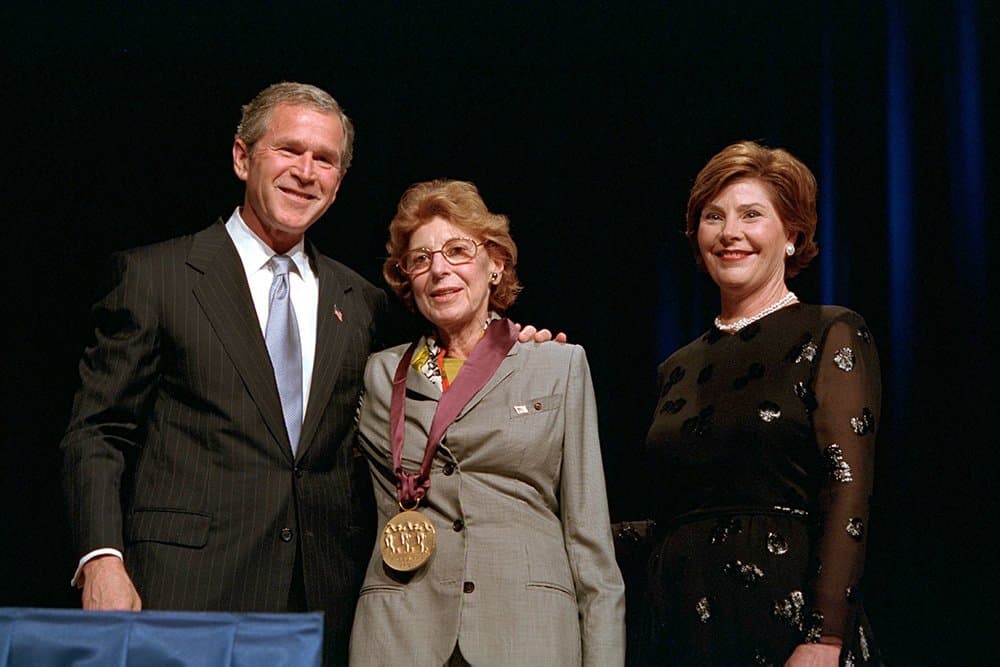
She began using acrylic in 1963, and by the 1970s she had given up the soak-stain method for thicker paint and brighter colour. She made her first prints with Tatyana Grosman at Universal Limited Art Editions on Long Island in 1961. Her first woodcut with Kenneth Tyler, Essence Mulberry of 1977, used eight colours and drew on fifteenth-century woodcuts at the Metropolitan Museum and a mulberry tree outside Tyler's studio. The Museum of Modern Art gave her a retrospective in 1989, she served on the National Council on the Arts, and she received the National Medal of Arts in 2001.
Whitebank Fine Art is an art advisory and gallery, not an auction house, and is not affiliated with any auction house or with the artist, their estate or their representatives. This page describes the range we advise on. Nothing here is investment advice.
