
Arts and Crafts
The Arts and Crafts movement was a British reform of design from about 1860 to 1920, led by William Morris and inspired by John Ruskin, which rejected industrial manufacture in favour of handmade work, simple forms and designs drawn from nature.
The Great Exhibition of 1851 convinced many people that industry had ruined design. John Ruskin's essay The Nature of Gothic, published in 1853, argued that the medieval craftsman had found joy in his work in a way the factory hand could not. William Morris took that as a programme. After Philip Webb built Red House for him, Morris founded a decorating firm in 1861 with friends including Edward Burne-Jones, Dante Gabriel Rossetti and Ford Madox Brown, to make stained glass, furniture, wallpaper and textiles by hand.
The name came from the Arts and Crafts Exhibition Society, founded in London in 1887 and first shown the following year, with Walter Crane as its first president. C. R. Ashbee's Guild of Handicraft moved to Chipping Campden in 1902, and designers such as C. F. A. Voysey and Ernest Gimson brought the ideas into architecture and furniture. The pottery of William De Morgan and the Martin Brothers belongs to the same world, as do Charles Rennie Mackintosh in Glasgow and Gustav Stickley in the United States. A contradiction remained at its heart, since handmade things were expensive and only the wealthy could afford them.
At a glance
- When
- About 1860 to 1920
- Where
- Britain, then Europe and the United States
- Leading artists
- William Morris, Edward Burne-Jones
Characteristics of the Arts and Crafts movement
- Handmade work
- Visible craftsmanship and respect for the maker's labour.
- Truth to materials
- Oak left plain, joints left visible, and materials used for what they are.
- Patterns from nature
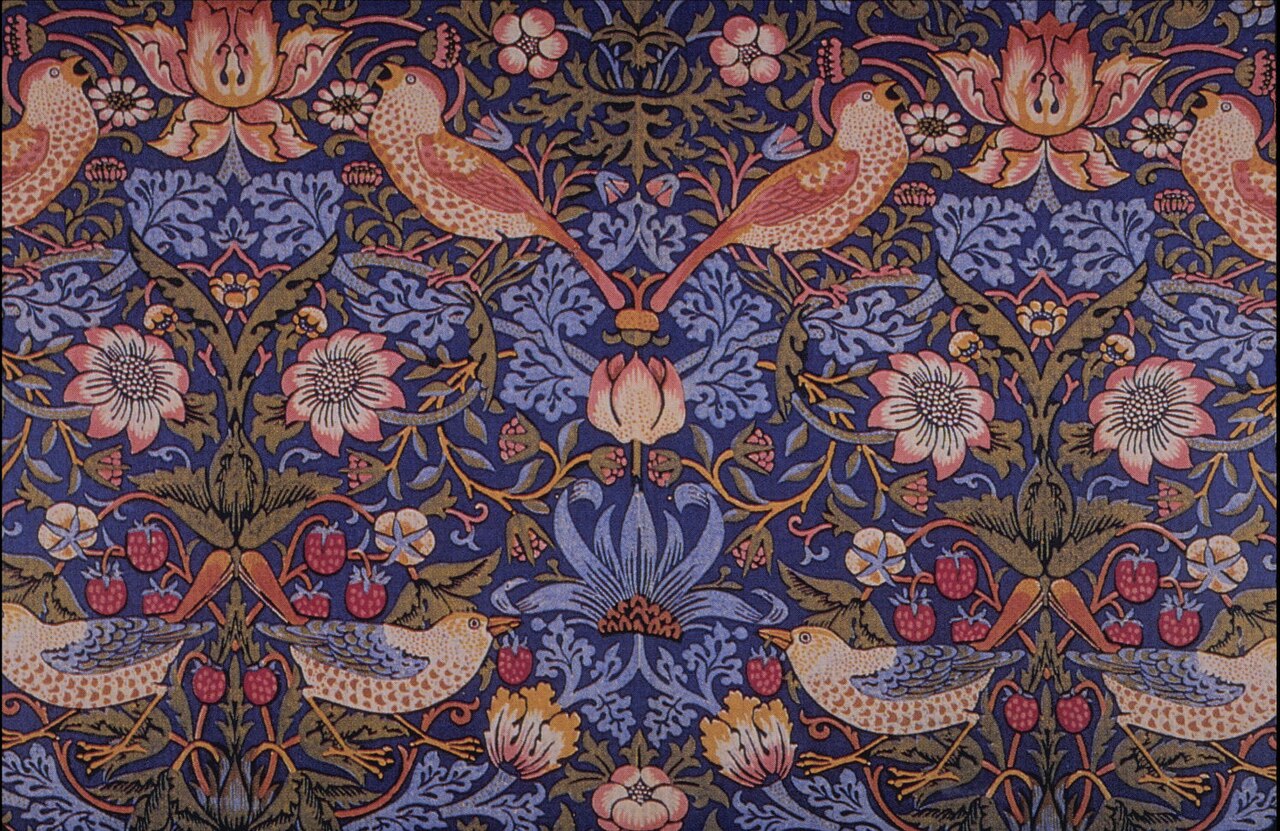
- Birds, leaves and flowers in repeating, flat designs.
- Medieval inspiration
- A romantic ideal of guild and workshop drawn from the Middle Ages.
- Social purpose
- A belief that better work and better things would make a better society.
Arts and Crafts artists
Every artist below has a page on this site, with a short biography and what a valuation of their work turns on.
The Morris circle
Famous Arts and Crafts works
- Red HousePhilip Webb and William Morris, 1859–60, Bexleyheath, London
- The Strawberry ThiefWilliam Morris, 1883, Victoria and Albert Museum, London
- The Holy Grail tapestriesEdward Burne-Jones and Morris & Co., 1891–94, Birmingham Museum and Art Gallery
- The Works of Geoffrey ChaucerKelmscott Press, 1896
- Glasgow School of ArtCharles Rennie Mackintosh, 1897–1909, Glasgow
What a valuation turns on
The market spans furniture, textiles, ceramics, metalwork, stained glass and books. Marks count for a great deal: De Morgan's impressed stamps, Liberty's retail marks and the labels on furniture all help to fix a maker and date. Morris & Co. kept making his patterns until 1940 and they have been reprinted since, so a textile or wallpaper needs to be dated and not simply recognised.
Original finish and condition are central. Refinished oak, replaced handles, faded textiles and restored lustre pottery are all harder to sell than untouched examples. Documents, showroom labels and a history in one family all improve a piece's standing. The first editions of the Kelmscott Press form a distinct collecting field, in which binding and completeness decide value.
Common questions
What was the Arts and Crafts movement?
A British design reform from about 1860 to 1920, led by William Morris, which rejected factory production in favour of handmade work, simple forms and patterns drawn from nature.
Who started the Arts and Crafts movement?
William Morris put the ideas of the critic John Ruskin into practice, and the firm he founded in 1861 is generally seen as its beginning.
What are the characteristics of Arts and Crafts design?
Visible handcraft, honest use of materials, simple forms, medieval influence and stylised patterns of plants and birds.
What is the difference between Arts and Crafts and Art Nouveau?
Arts and Crafts stressed handwork and social reform and looked back to the Middle Ages. Art Nouveau, which it helped to inspire, embraced new materials and whiplash curves for a fashionable modern style.
How do I sell William Morris textiles or De Morgan pottery?
Send photographs of the front, any signature or marks, and the back for a free, confidential valuation, with any labels or documents. We check the work against the published record, look at condition, and compare a confidential private sale with auction.