
Art Nouveau
Art Nouveau was an international style of art, architecture and design, at its height from about 1890 to 1910, built on long, flowing lines taken from plants and the female figure, which set out to bring art into every part of modern life, from posters and furniture to the entrances of the Paris Métro.
The name comes from a shop. In December 1895 the dealer Siegfried Bing opened the Maison de l'Art Nouveau in Paris, selling furniture, glass and prints by designers who had turned their backs on the revival styles of the nineteenth century. The style took other names wherever it appeared: Jugendstil in Germany, after the Munich magazine Jugend, Secession style in Vienna, Modernisme in Barcelona, and Stile Liberty in Italy, after the London shop. Its roots were in the Arts and Crafts movement in Britain, in the Japanese prints that reached Europe in quantity from the 1860s, and in Symbolist painting.
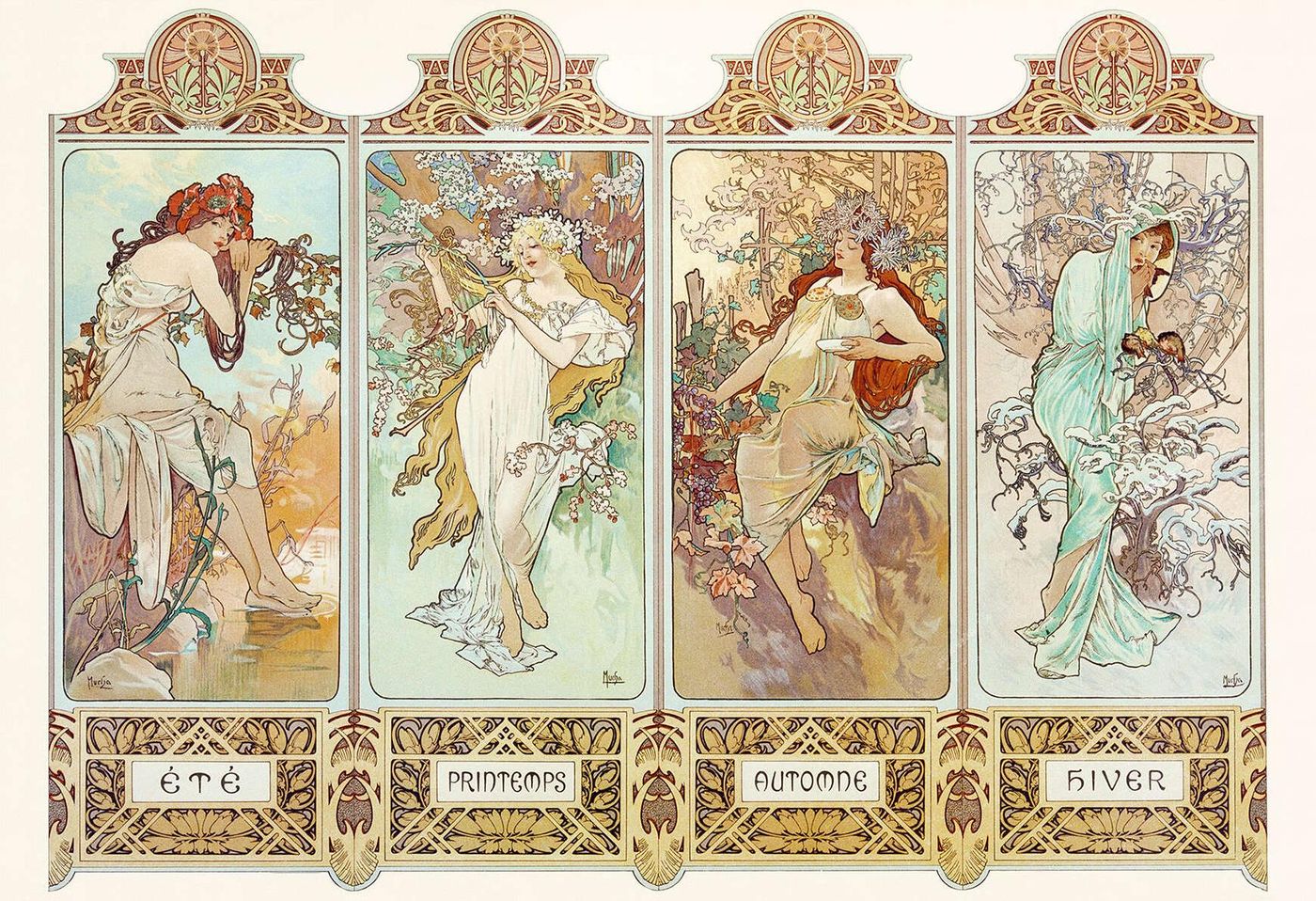
In Brussels Victor Horta built the Hôtel Tassel in 1893, with ironwork and mosaic floors that curl like tendrils. In Paris the Czech artist Alphonse Mucha made his name with his poster for Sarah Bernhardt in Gismonda at the turn of 1895, and Hector Guimard designed the cast-iron entrances to the new Métro. Émile Gallé and the School of Nancy made glass and furniture, René Lalique jewellery, and Louis Comfort Tiffany lamps and windows in New York. In Vienna Gustav Klimt led the artists who broke away from the city's established exhibiting society in 1897 to found the Secession; in Glasgow Charles Rennie Mackintosh gave the style straight lines. By the First World War it had gone out of fashion, and the geometric style of the 1920s, Art Deco, grew up partly in reaction to it.
At a glance
- When
- About 1890 to 1910
- Where
- Brussels, Paris, Vienna, Glasgow and beyond
- Leading artists
- Gustav Klimt, Jan Toorop
Characteristics of Art Nouveau
- The whiplash line
- Long, sinuous curves that swell and spring back, named after the crack of a whip.
- Nature as pattern
- Lilies, irises, peacocks, dragonflies, stems and roots, drawn as ornament.
- The female figure
- Women with long, flowing hair, framed by haloes, flowers and decorative borders, above all in Mucha's posters.
- Art in everything
- No line between fine and applied art: buildings, furniture, glass, jewellery, posters and books designed as one.
- Japanese influence
- Flat colour, strong outline and asymmetry learned from Japanese woodblock prints.
Art Nouveau artists
Every artist below has a page on this site, with a short biography and what a valuation of their work turns on.
Vienna and the Netherlands
Famous Art Nouveau works
- Hôtel Tassel, BrusselsVictor Horta, 1893
- The Three BridesJan Toorop, 1893, Kröller-Müller Museum, Otterlo
- GismondaAlphonse Mucha, 1894–95
- Paris Métro entrancesHector Guimard, 1900
- The KissGustav Klimt, 1907–08, Belvedere, Vienna
What a valuation turns on
Art Nouveau is collected as much as design as it is as painting. Posters, above all Mucha's, glass by Gallé, Daum and Tiffany, Lalique jewellery, bronzes, silver and furniture each have their own specialists, and a great deal of what circulates is later than it looks: Mucha's posters and panels have been reprinted and reproduced for more than a century, Tiffany lamps have been copied in great numbers, and Gallé's firm went on making cameo glass under his name for decades after his death in 1904.
So the first questions are what the object is and when it was made: for a poster or decorative panel, whether it is a colour lithograph of the period, which shows in the paper, the printer's line and the colour; for glass and metalwork, the mark and the way it was made. For the painters, Klimt above all, the questions are those of any major painting: the catalogue raisonné, the provenance, including the years 1938 to 1945 in Vienna, and the condition.
Common questions
What is Art Nouveau?
Art Nouveau was an international style of art, architecture and design from about 1890 to 1910, built on long, flowing lines taken from plants, flowers and the female figure. It set out to unite fine and applied art, and is seen in Mucha's posters, Klimt's paintings, Horta's houses, Guimard's Métro entrances and Tiffany's glass.
When was Art Nouveau?
It took shape in the early 1890s, was at its height around the Paris Exposition Universelle of 1900, and had largely given way to other styles by the First World War.
Who are the most famous Art Nouveau artists?
Alphonse Mucha for posters, Gustav Klimt for painting, Victor Horta, Hector Guimard and Antoni Gaudí for architecture, Émile Gallé, René Lalique and Louis Comfort Tiffany for glass and jewellery, and Charles Rennie Mackintosh in Glasgow.
What is the difference between Art Nouveau and Art Deco?
Art Nouveau, from the 1890s to about 1910, is organic: curving lines, plants and flowing hair. Art Deco, from the 1920s and 1930s, is geometric and streamlined: zigzags, sunbursts, stepped forms and luxurious or industrial materials.
How do I sell an Art Nouveau poster or object?
Send photographs of the front, the back and any signature, printer's line or mark, with any labels or receipts, for a free, confidential valuation. Whether a piece is of the period or a later reprint or copy is usually the first question; we check it, compare a confidential private sale with auction, and keep the paperwork in your name until you are paid.