

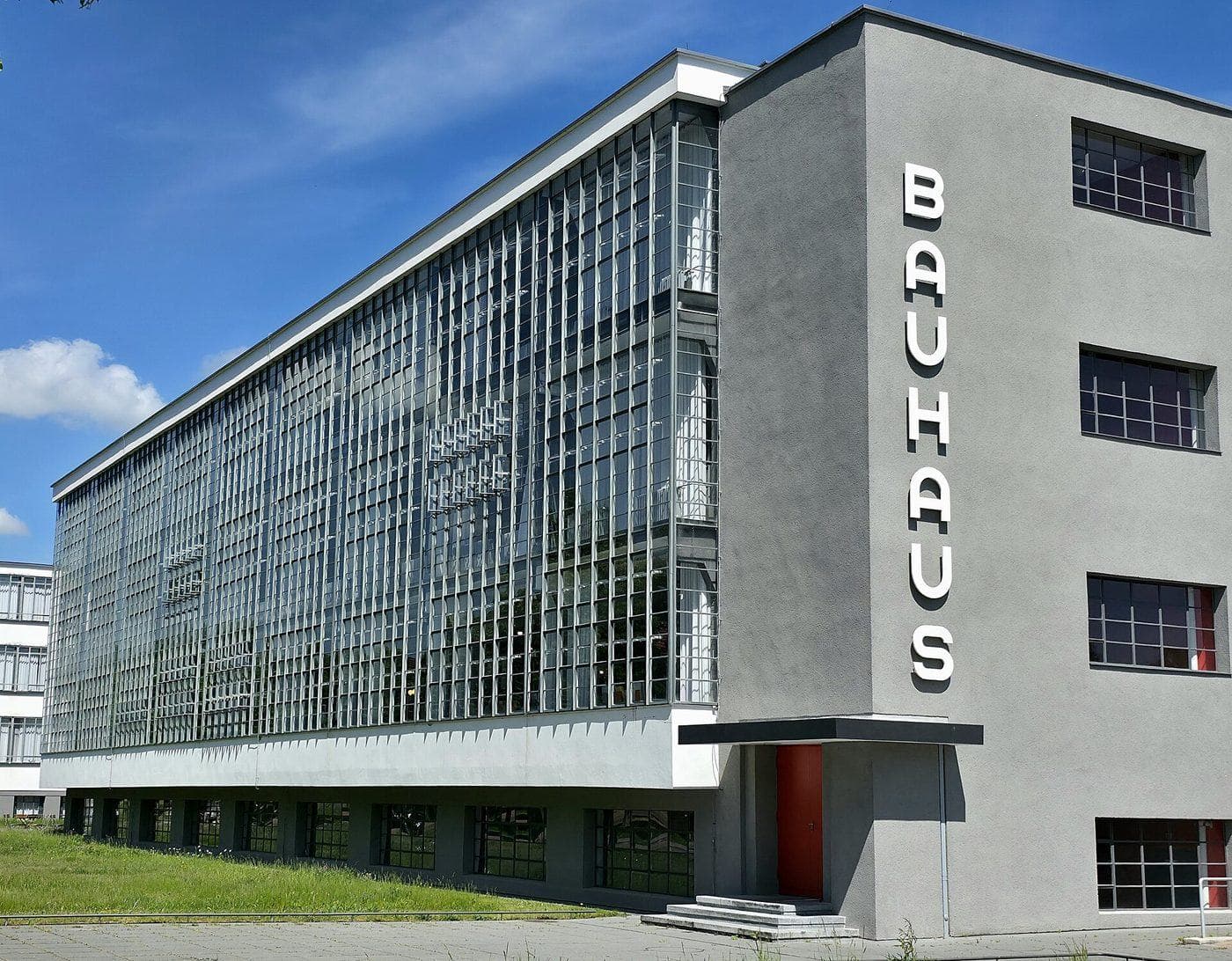
Bauhaus
The Bauhaus was a school of art, architecture and design founded by Walter Gropius in Weimar in 1919, which set out to unite fine art and craft for the industrial age; it moved to Dessau in 1925 and to Berlin in 1932, and closed under Nazi pressure in 1933.
Gropius's founding manifesto called on artists and craftsmen to build the new structure of the future together, and its cover was a woodcut of a cathedral by Lyonel Feininger, the first master he appointed. Students took a preliminary course, then trained in workshops, metal, weaving, ceramics, wall painting and printing among them, under two masters each: an artist and a craftsman. The painters Gropius brought in made the Bauhaus as important for art as for design: Johannes Itten, Paul Klee, Wassily Kandinsky, Oskar Schlemmer and László Moholy-Nagy. Josef Albers arrived as a student and became a master.
In 1925 the school moved to Dessau, into the building Gropius designed for it, with its glass curtain wall, now a World Heritage Site. Under Hannes Meyer and then Ludwig Mies van der Rohe it became more technical and more architectural. The Nazis forced it out of Dessau in 1932 and closed its Berlin premises in 1933, and its teachers carried its ideas abroad: Albers to Black Mountain College and later Yale, Moholy-Nagy to the New Bauhaus in Chicago, Gropius to Harvard, Mies to Chicago. Feininger returned to New York, where he had been born.
At a glance
- When
- 1919 to 1933
- Where
- Weimar, Dessau and Berlin
- Leading artists
- Wassily Kandinsky, Paul Klee, Lyonel Feininger, Laszlo Moholy-Nagy
Characteristics of the Bauhaus
- Art and craft as one
- No hierarchy between painting, weaving, furniture and typography.
- Function first
- Design stripped of ornament and shaped by use and material.
- Geometry and primary colour
- Circle, square and triangle; red, yellow and blue.
- Industrial materials
- Tubular steel, glass and concrete, and designs meant for mass production.
- Teaching by experiment
- The preliminary course: material, colour and form studied from first principles.
Bauhaus artists
Every artist below has a page on this site, with a short biography and what a valuation of their work turns on.
Bauhaus masters
- Wassily KandinskyGave up a law professorship at thirty and painted his way out of the recognisable world.
- Paul KleeTook a line for a walk, taught at the Bauhaus, and made nearly ten thousand works.
- Lyonel FeiningerBauhaus master who built churches, ships and sea out of overlapping planes of transparent colour.
- Laszlo Moholy-NagyBauhaus master who made pictures without a camera and ordered a painting over the telephone.
- Josef AlbersBauhaus master turned American teacher, and the painter who spent twenty-five years on one square inside another.
Famous Bauhaus works
- Yellow-Red-BlueWassily Kandinsky, 1925, Centre Pompidou, Paris
- Wassily chair (Model B3)Marcel Breuer, 1925–26
- Bauhaus building, DessauWalter Gropius, 1925–26
- Ad ParnassumPaul Klee, 1932, Kunstmuseum Bern
- Bauhaus StairwayOskar Schlemmer, 1932, Museum of Modern Art, New York
What a valuation turns on
The fine art made at the Bauhaus is largely the work of its masters, and its market is the market for Kandinsky, Klee, Feininger, Moholy-Nagy, Albers and Schlemmer generally: paintings, watercolours, drawings and prints, many made long after the school closed. The Bauhaus print portfolios, Neue Europäische Graphik, published from Weimar between 1921 and 1924, are collected both as sets and as single sheets.
Bauhaus design, lamps, metalwork, furniture and textiles, is a separate field and full of later licensed reissues and copies, so the maker's mark, the date of manufacture and the material need establishing. Klee and Kandinsky are fully catalogued, Kandinsky's prints separately, and Albers's work is reviewed by the Josef and Anni Albers Foundation.
Common questions
What is Bauhaus art?
Bauhaus art is the work made and taught at the Bauhaus, the German school of art, architecture and design that ran from 1919 to 1933. It joined fine art to craft and industry, and is known for geometric form, primary colour and functional design.
Who were the Bauhaus artists?
Its masters included Lyonel Feininger, Johannes Itten, Paul Klee, Wassily Kandinsky, Oskar Schlemmer, László Moholy-Nagy and Josef Albers, with Anni Albers, Marianne Brandt, Marcel Breuer and Gunta Stölzl among those who trained there.
Why did the Bauhaus close?
Political pressure. The Nazi-led council in Dessau forced it out in 1932; it moved to Berlin as a private school under Mies van der Rohe and closed in 1933, after a police raid, rather than accept the regime's conditions.
What are the characteristics of Bauhaus design?
Simple geometric forms, primary colours, no applied ornament, industrial materials such as tubular steel and glass, and the principle that form should follow from function and from the way a thing is made.
How do I sell a Bauhaus print or a work by a Bauhaus master?
Send photographs of the front, the signature and the back, with any labels or certificates, for a free, confidential valuation. We check the work against the artist's catalogue, or the design piece against its maker's marks, and compare a confidential private sale with auction.
