
Mannerism
Mannerism is the style of Italian art from about 1520 to 1600 that followed the High Renaissance, and which replaced its balance and natural proportion with elongated figures, ambiguous space and artificial colour, in the work of Pontormo, Parmigianino, Bronzino and El Greco.
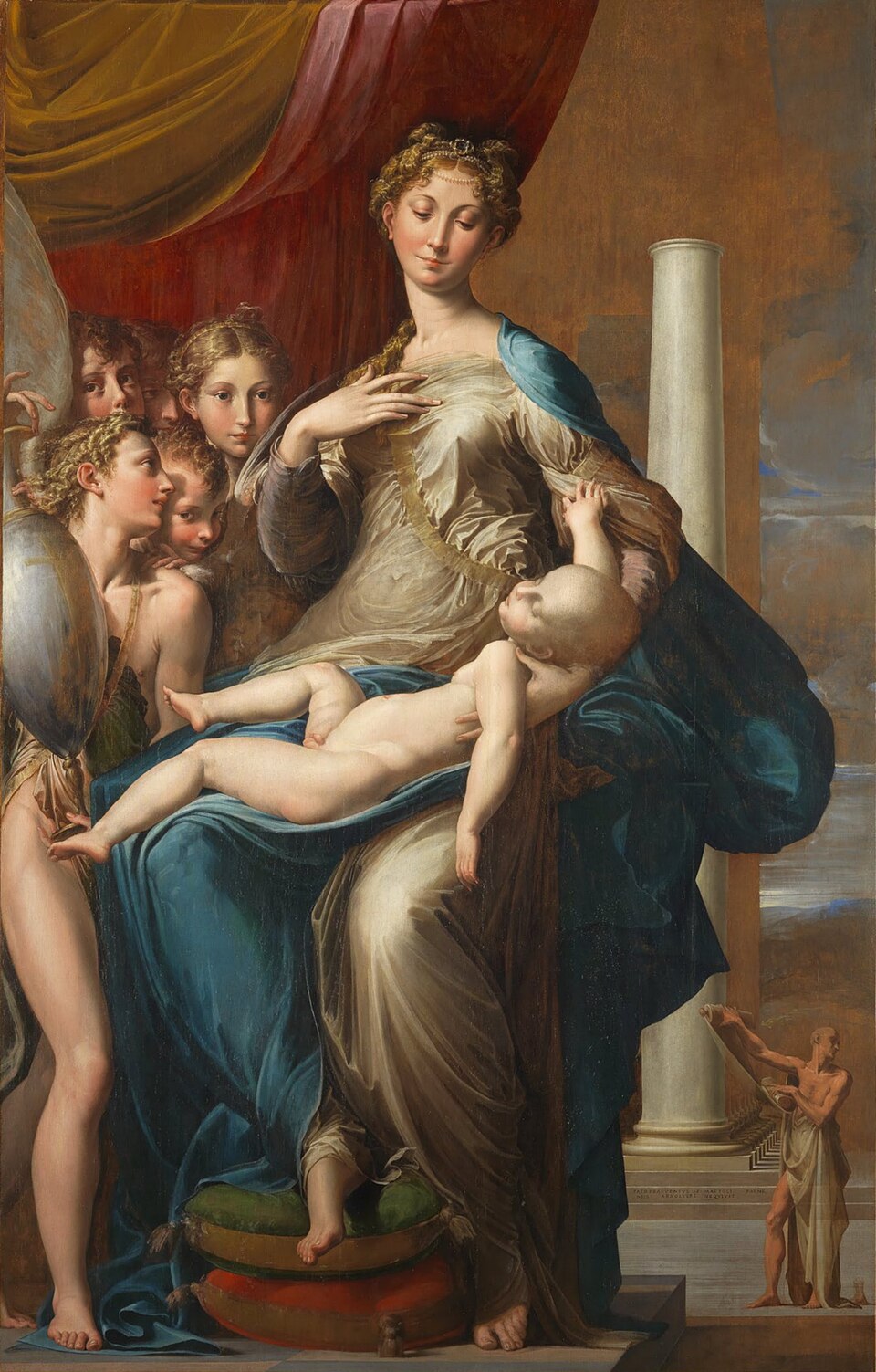
By 1520 Leonardo, Michelangelo and Raphael had set a standard that seemed impossible to beat, and younger painters in Florence and Rome started to bend the rules instead. Pontormo's Deposition in Santa Felicita in Florence has no ground, no cross and colours of pale pink and blue. Parmigianino gave his Madonna a swan's neck. The word comes from maniera, meaning style, which Giorgio Vasari used as praise; later critics turned Mannerism into a term of disapproval, and only in the twentieth century was it taken seriously again.
The Sack of Rome in 1527 scattered artists around Europe and helped the style to travel. Rosso Fiorentino and Primaticcio took it to the French court at Fontainebleau, Giulio Romano to Mantua, and Arcimboldo served the Habsburgs in Vienna and Prague. In Florence Bronzino gave it a cool, polished form at the court of Cosimo I de' Medici. The Cretan-born El Greco, who settled in Toledo in 1577, carried it to its most intense and personal conclusion. The Baroque, with its directness and drama, replaced it at the end of the century.
At a glance
- When
- About 1520 to 1600
- Where
- Florence and Rome, then Fontainebleau, Prague and Spain
- Leading artists
- Pontormo, Parmigianino, Bronzino
Characteristics of Mannerism
- Elongated figures
- Long necks, small heads and limbs drawn out for grace.
- Unstable space
- Crowded compositions, odd scale and a lack of solid ground.
- Artificial colour
- Acid pinks, greens and blues chosen for effect.
- Twisting poses
- The figura serpentina, a body that spirals upward.
- Learned wit
- Allegories, puns and visual puzzles for educated courtly viewers.
Mannerist artists
Every artist below has a page on this site, with a short biography and what a valuation of their work turns on.
In Florence and Parma
- PontormoFlorentine painter of strange, weightless figures and acid colour, a founder of Mannerism.
- ParmigianinoItalian painter and printmaker from Parma, known for the elongated grace of the Madonna with the Long Neck.
- BronzinoFlorentine court painter to the Medici, known for his cool, polished portraits.
Famous Mannerist works
- Self-Portrait in a Convex MirrorParmigianino, about 1524, Kunsthistorisches Museum, Vienna
- DepositionPontormo, 1525–28, Santa Felicita, Florence
- Madonna with the Long NeckParmigianino, about 1534–40, Uffizi, Florence
- An Allegory with Venus and CupidBronzino, about 1545, National Gallery, London
- The Burial of the Count of OrgazEl Greco, 1586–88, Santo Tomé, Toledo
What a valuation turns on
Paintings by the principal Mannerists rarely leave museums. Drawings by Parmigianino and his contemporaries appear more often and are keenly studied, and the engravings and etchings of the period, along with chiaroscuro woodcuts, offer a more accessible way into the style. Courtly portraits were made in numbers by workshops, and the question for most pictures is how much was done by the master.
Most paintings are on panel, and a split, cradled or thinned support affects value, as does overcleaning of smooth paint surfaces. Attribution is a matter for specialist opinion, supported by technical study and by the history of ownership.
Common questions
What is Mannerism in art?
Mannerism is the style that followed the High Renaissance in Italy from about 1520. It favours elongated figures, unstable space and artificial colour over natural balance and proportion.
What does Mannerism mean?
The word comes from the Italian maniera, meaning style or manner. Giorgio Vasari used it as a term of praise, and later critics used it to suggest empty artifice.
Who are the most famous Mannerist artists?
Pontormo, Parmigianino, Bronzino, Rosso Fiorentino, Giulio Romano and El Greco.
What is the difference between Mannerism and the Renaissance?
High Renaissance painting seeks balance, natural proportion and clear space. Mannerism takes those skills and deliberately distorts them for elegance and effect.
How do I sell an Old Master drawing or a sixteenth-century painting?
Send photographs of the front, any signature or marks, and the back for a free, confidential valuation, with any labels or documents. We check the work against the published record, look at condition, and compare a confidential private sale with auction.