Naive art
Naive art is art made by painters without formal training, or in a deliberately untrained manner, marked by bright flat colour, careful detail, simplified perspective and directness; its first celebrated figure was the Paris customs officer Henri Rousseau.
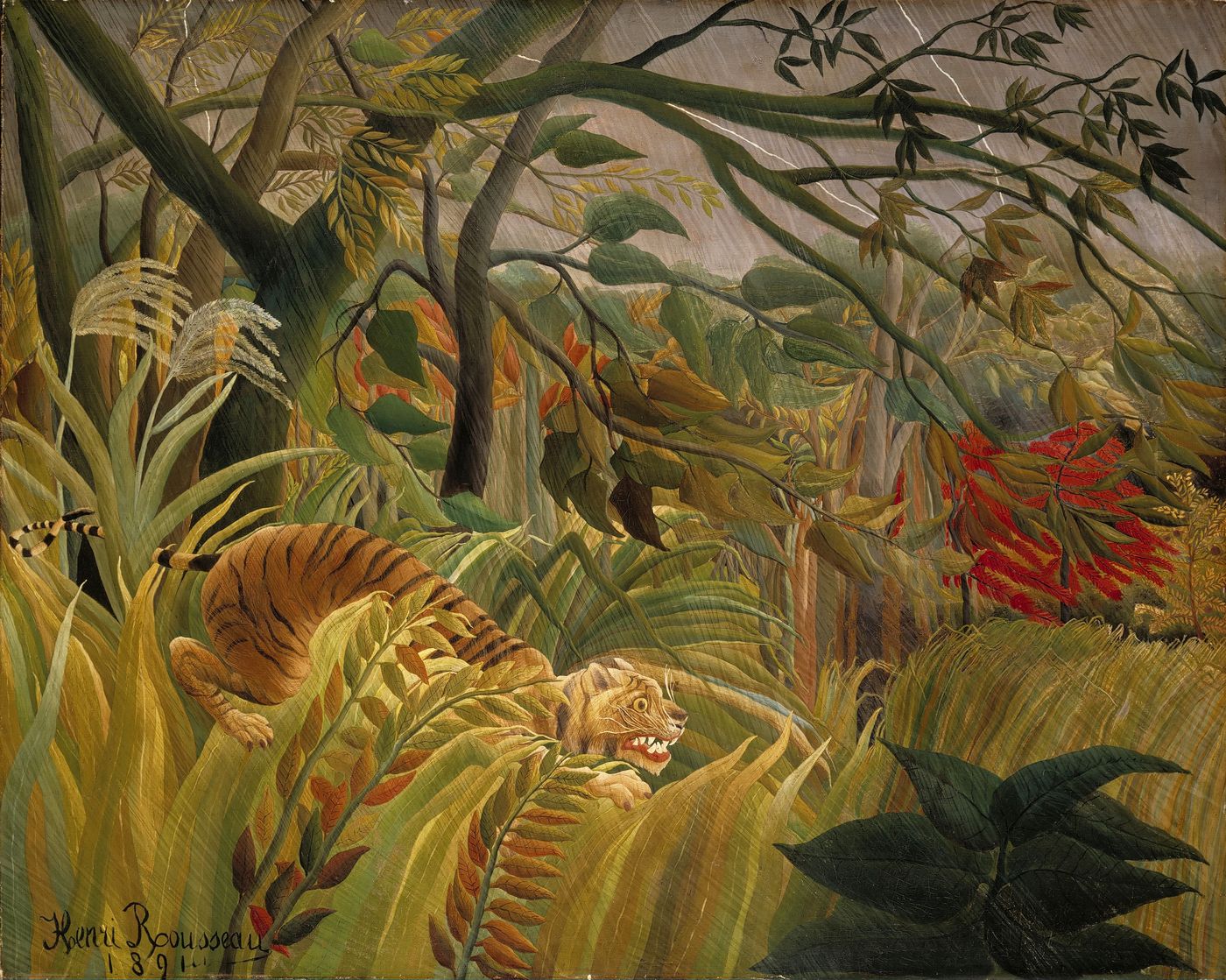
Henri Rousseau, a collector of tolls at the gates of Paris, began to paint seriously in his forties and showed every year from 1886 at the Salon des Indépendants, which had no jury. The critics mocked him; the avant-garde did not. In 1908 Picasso gave a banquet in his honour at the Bateau-Lavoir, and his jungles, painted from visits to the hothouses of the Jardin des Plantes and from picture books, have been admired ever since. The German critic Wilhelm Uhde, who collected him early, went on to champion other self-taught painters, Séraphine Louis, Camille Bombois, André Bauchant and Louis Vivin among them, and showed them together in Paris in 1928 as the Painters of the Sacred Heart.
In Britain the best-known case is Alfred Wallis, a retired Cornish mariner who began to paint ships and harbours on scraps of card after his wife died in 1922, and who was found in St Ives in 1928 by Ben Nicholson and Christopher Wood. Beryl Cook, who had no training, painted pubs, seaside towns and nights out from the 1960s, and became one of the most popular British painters of her time. L. S. Lowry is often called naive, though he studied for years at art schools in Manchester and Salford and disliked the word. Elsewhere naive painting has its own traditions, from the Haitian painters encouraged at the Centre d'Art in Port-au-Prince from 1944 to the Hlebine school in Croatia.
At a glance
- When
- 1880s to the present
- Where
- France, then worldwide
- Leading artists
- Henri Rousseau
Characteristics of naive art
- Self-taught
- Little or no academic training, and a way of painting worked out alone.
- Flat, bright colour
- Clear, unmodulated colour with little shading or atmosphere.
- Detail everywhere
- Every leaf, brick and window given the same care, with nothing blurred into the distance.
- Perspective by eye
- Scale and space worked out by feel: figures sized by importance, buildings that tilt, roads that rise up the picture.
- Everyday and imagined subjects
- Local life, festivals, ships and animals, and jungles and dreams that the painter never saw.
Naive artists
Every artist below has a page on this site, with a short biography and what a valuation of their work turns on.
The first naive painter
Famous Naive works
- Tiger in a Tropical Storm (Surprised!)Henri Rousseau, 1891, National Gallery, London
- The Sleeping GypsyHenri Rousseau, 1897, Museum of Modern Art, New York
- The DreamHenri Rousseau, 1910, Museum of Modern Art, New York
- The Hold House, Port Mear Square Island, Port Mear BeachAlfred Wallis, about 1932, Tate, London
- Going to the MatchL. S. Lowry, 1953, The Lowry, Salford
What a valuation turns on
Naive painting divides sharply between the handful of artists whose names carry weight, Rousseau, Séraphine, Wallis, Lowry and Beryl Cook among them, and the great mass of anonymous and amateur work, much of which has little value however charming it is. Because the manner is easy to imitate and these painters are popular, forgeries and pastiches are common: Lowry and Wallis above all have been copied and faked for decades.
Provenance therefore matters more than usual. For Wallis, a history that runs back to St Ives and the circle of Nicholson, Wood and Jim Ede is the strongest support; for Lowry, the labels of his dealers and the inscriptions on the back; for Beryl Cook, whose paintings were widely reproduced as prints and cards, the first thing to establish is whether a work is an original painting or one of the many signed prints.
Common questions
What is naive art?
Naive art is art made by painters without formal training, or in a deliberately untrained manner. It is recognisable by bright, flat colour, careful detail across the whole picture and simplified perspective. Henri Rousseau, the Paris customs officer who showed from 1886, is its best-known figure.
Who are the most famous naive artists?
Henri Rousseau, Séraphine Louis, Camille Bombois and André Bauchant in France, Alfred Wallis and Beryl Cook in Britain, Grandma Moses in the United States, Niko Pirosmani in Georgia and Hector Hyppolite in Haiti.
Was L. S. Lowry a naive artist?
Not strictly. He is often called one because of his simplified figures and flat, high viewpoints, but he studied part-time at art schools in Manchester and Salford for more than ten years and rejected the description.
What is the difference between naive art and outsider art?
Naive art usually means self-taught painters working within recognisable traditions of picture-making, often for an audience. Outsider art, from Jean Dubuffet's 'art brut' of the 1940s, means work made entirely outside the art world, often by people living in isolation or in psychiatric care.
How do I sell a naive painting?
Send photographs of the front, the signature and the back, with any labels, letters or receipts, for a free, confidential valuation. With the best-known naive painters the history of the work is often the deciding question; we check it, compare a confidential private sale with auction, and keep the paperwork in your name until you are paid.