Modernism
Modernism is the broad name for the art of roughly the century from the 1860s to the 1960s that broke with academic tradition, putting colour, form, surface and material ahead of storytelling and the imitation of nature; it takes in most of the movements from Impressionism to Minimalism.
Modernism was never a single movement, and few artists used the word of themselves. It describes an attitude: that art had to answer to modern life and to its own means rather than to the rules of the academies. The story is usually begun in Paris, with Édouard Manet's Le Déjeuner sur l'herbe, shown at the Salon des Refusés in 1863, and with Charles Baudelaire's essay The Painter of Modern Life, published the same year, which asked artists to catch the passing moment of the modern city. Cézanne's rebuilding of form and space, the colour of the Fauves and the fractured views of Cubism followed, and between 1905 and 1915 nearly every rule of picture-making was broken.
Its centres moved with history: Paris before the First World War, then Berlin, Moscow and the Bauhaus, and after 1940 New York, where the critic Clement Greenberg described Modernist painting, in 1960, as art examining its own medium. In Britain it arrived later and kept its own character, from Roger Fry's Post-Impressionist exhibitions of 1910 and 1912 to Henry Moore, Barbara Hepworth and Ben Nicholson in the 1930s and the St Ives painters after the war. By the late 1960s Pop, Minimalism and Conceptual art had pulled away from Greenberg's account of it, and 'postmodern' came into use for what followed.
At a glance
- When
- 1860s to about 1970
- Where
- Paris, then Europe and America
- Leading artists
- Édouard Manet, Paul Cezanne, Pablo Picasso, Henri Matisse
Characteristics of Modernism
- A break with the academy
- The rules of the official schools and Salons, of finish, subject and perspective, set aside.
- Truth to the medium
- Paint left looking like paint and stone like stone; the flat canvas and the material on show rather than disguised.
- Simplification
- Forms reduced to essentials, from Cézanne's cylinder, sphere and cone to pure abstraction.
- Experiment
- New techniques and materials: collage, the readymade, direct carving, the poured and dripped canvas.
- Modern life
- The city, the machine, speed and the inner life of the individual as subjects.
Modernist artists
Every artist below has a page on this site, with a short biography and what a valuation of their work turns on.
Paris
- Édouard ManetPainted modern Paris against the Salon's grain, and made Le Déjeuner sur l'herbe and Olympia the start of modern art.
- Paul CezanneThe painter both Picasso and Matisse called the father of us all, working the same mountain for decades.
- Pablo PicassoFifty thousand works across seventy-five years, in every medium there is — which makes identification the whole job.
- Henri MatisseTrained for the law, discovered painting in a sickbed, and ended cutting colour with scissors.
- Georges BraqueInvented Cubism alongside Picasso, then spent forty years quietly not being him.
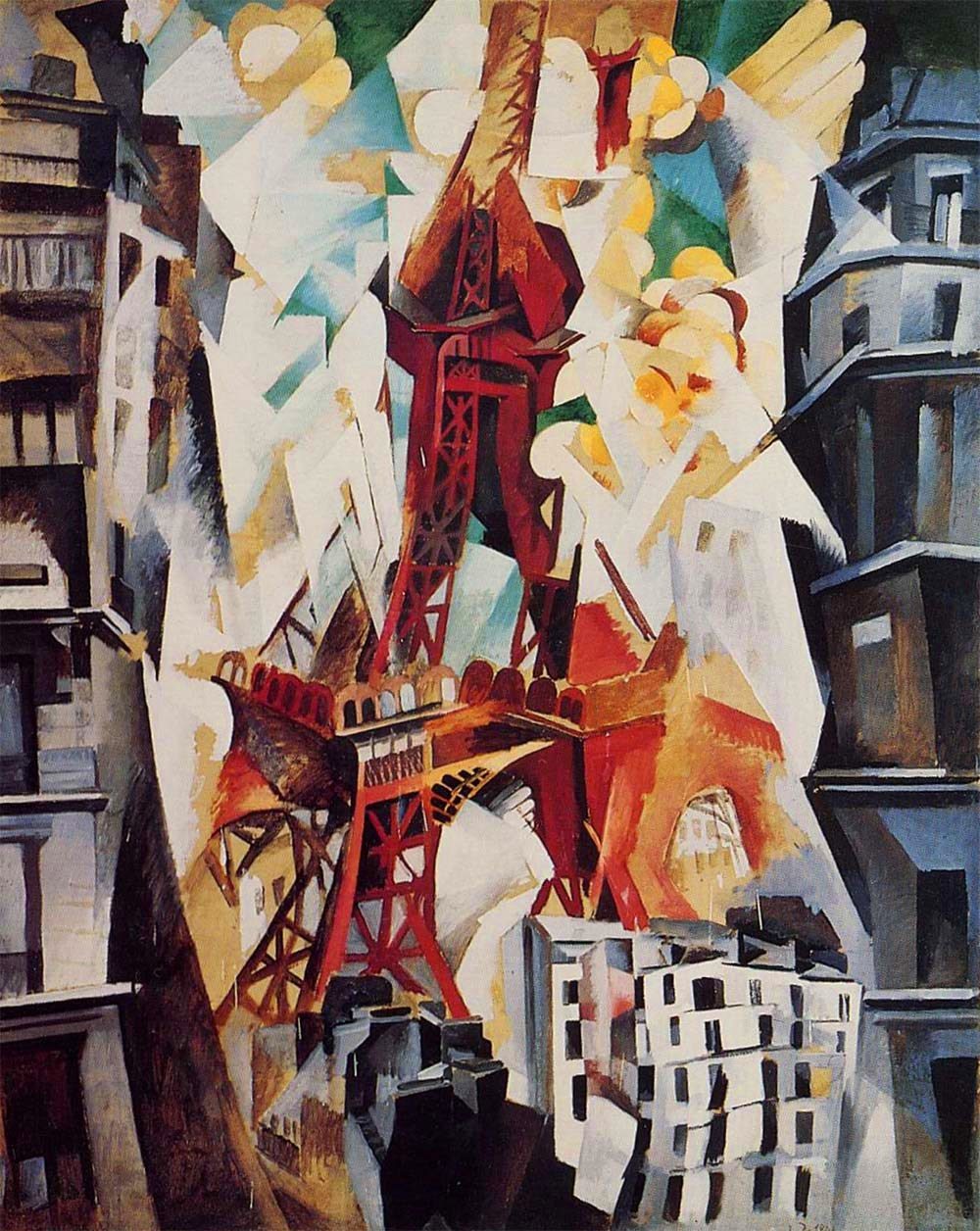
- Robert DelaunayPainted the Eiffel Tower breaking apart, then discs of pure colour; Apollinaire called the result Orphism.
- Amedeo ModiglianiLong necks, blank eyes, and one of the most comprehensively faked names in twentieth-century art.
Abstraction and the Bauhaus
- Wassily KandinskyGave up a law professorship at thirty and painted his way out of the recognisable world.
- Kazimir MalevichInvented Suprematism, painted the Black Square, and took painting to pure abstraction in 1915.
- Piet MondrianReduced painting to black lines, white ground and three primary colours, and got there step by step.
- Paul KleeTook a line for a walk, taught at the Bauhaus, and made nearly ten thousand works.
Britain
- Henry MooreCoal miner's son who put the hole through the figure and filled the world's plazas with reclining women.
- Barbara HepworthPut the hole through the middle of the sculpture, and made St Ives a centre of European modernism.
- Ben NicholsonCarved white reliefs in the 1930s and spent fifty years arranging jugs, hills and rectangles.
- Paul NashWar artist in both wars, and the painter who made the English landscape look like a dream someone else was having.
Famous Modernist works
- Le Déjeuner sur l'herbeÉdouard Manet, 1863, Musée d'Orsay, Paris
- Les Demoiselles d'AvignonPablo Picasso, 1907, Museum of Modern Art, New York
- The DanceHenri Matisse, 1910, State Hermitage Museum, St Petersburg
- FountainMarcel Duchamp, 1917
- Recumbent FigureHenry Moore, 1938, Tate, London
What a valuation turns on
Modernist painting and sculpture is the heart of what the salerooms call Impressionist and Modern art, and the work of its best-known names is among the most closely studied, and most often faked, in the market. For nearly all of the artists here there is a catalogue raisonné, and for several a foundation, committee or estate that gives opinions on works not yet in it, so the first question is usually whether a work is recorded and with what history.
Works on paper, prints and sculpture are separate questions again. A drawing or watercolour by a major Modernist can be valued very differently from a painting; a print depends on its edition, signature and condition; and a bronze on whether it was cast in the artist's lifetime or later, by which foundry and in what number. Because so much of this art passed through Europe in the 1930s and 1940s, provenance for those years is checked before any sale.
Common questions
What is Modernism in art?
Modernism is the broad term for the art of about the 1860s to the 1960s that broke with academic tradition. It put colour, form, surface and material ahead of storytelling and imitation, and it includes movements from Impressionism and Cubism to abstraction, Surrealism and Abstract Expressionism.
When was the Modernist period in art?
It is usually dated from Manet and the Salon des Refusés of 1863 to the 1960s, when Pop art, Minimalism and Conceptual art began what came to be called postmodernism. Its most radical years were from about 1905 to 1915.
Who are the most important Modernist artists?
Édouard Manet, Paul Cézanne, Pablo Picasso, Henri Matisse, Georges Braque, Wassily Kandinsky, Kazimir Malevich, Piet Mondrian, Marcel Duchamp and Constantin Brâncuși in Europe; Henry Moore, Barbara Hepworth and Ben Nicholson in Britain; Jackson Pollock and Mark Rothko in New York.
What is the difference between modern and contemporary art?
Modern art usually means the art of the Modernist period, from about the 1860s to the 1960s or 1970s. Contemporary art means art made since then, usually taken as since about 1970, by living or recently living artists.
How do I sell a Modernist painting or sculpture?
Send photographs of the front, the signature and the back, with any labels, certificates or invoices, for a free, confidential valuation. Whether the work is in the artist's catalogue raisonné is usually the first question; we check it, compare a confidential private sale with auction, and keep the paperwork in your name until you are paid.