

Post-Impressionism
Post-Impressionism is the name for the painters who, from the mid-1880s, took Impressionism's bright colour and modern subjects and pushed them towards structure, symbol and emotion: Paul Cézanne, Vincent van Gogh, Paul Gauguin and Georges Seurat above all.
It was never a group and never had a programme. The term belongs to the English critic Roger Fry, who needed a title for the exhibition he organised at the Grafton Galleries in London in November 1910, Manet and the Post-Impressionists. The show scandalised London and fixed the word for good, applied backwards to artists who had worked in France from the mid-1880s, several of whom had never met.
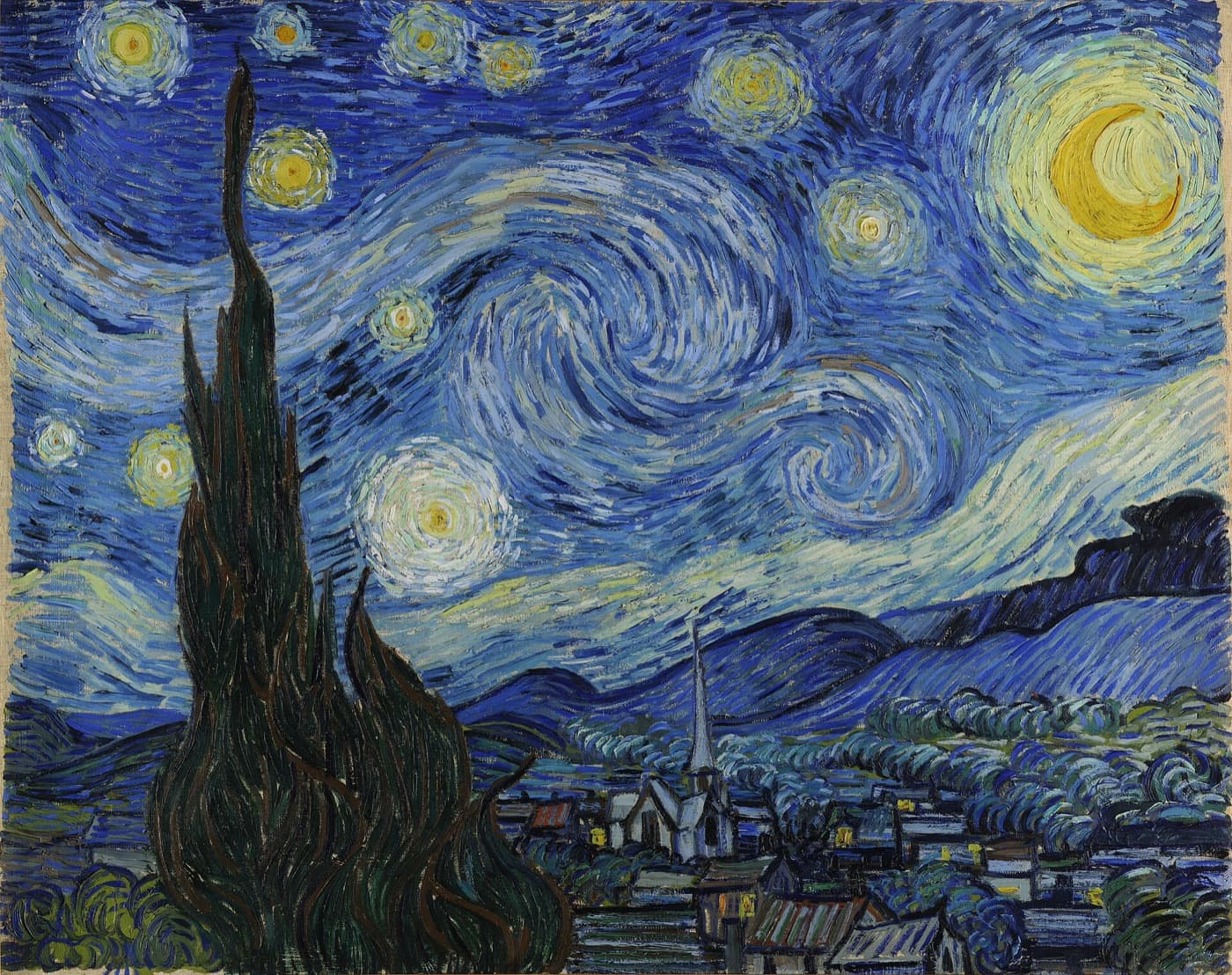
What they shared was a sense that Impressionism had stopped at the surface. Cézanne, working largely alone in Aix-en-Provence, wanted, in the words usually attributed to him, to make of it 'something solid and durable, like the art of the museums', and built pictures from blocks of colour that point straight to Cubism. Van Gogh, in Arles and Saint-Rémy, used colour and thick, directional brushwork to carry feeling. Gauguin, in Brittany and then Tahiti, flattened colour into areas held by dark outlines and loaded them with symbol. Seurat turned the broken touch into a system of dots. Around them the Nabis, Pierre Bonnard and Édouard Vuillard among them, turned the same lessons onto the domestic interior.
At a glance
- When
- 1886 to about 1905
- Where
- France
- Leading artists
- Paul Cezanne, Vincent van Gogh, Paul Gauguin, Georges Seurat
Characteristics of Post-Impressionism
- Structure
- Cézanne's constructive brushstrokes and shifting viewpoints, building form from planes of colour.
- Expressive colour
- Colour chosen for feeling rather than accuracy, as in Van Gogh's yellows and Gauguin's reds.
- Flat colour and outline
- Areas of flat colour held in dark contours, learned from stained glass and Japanese prints.
- Symbol and idea
- Subjects that mean more than they show, above all in Gauguin.
- Method
- Seurat's dots of pure colour, placed according to theory.
Post-Impressionist artists
Every artist below has a page on this site, with a short biography and what a valuation of their work turns on.
The Post-Impressionists
- Paul CezanneThe painter both Picasso and Matisse called the father of us all, working the same mountain for decades.
- Vincent van GoghPainted for ten years, sold almost nothing, and changed what a picture could be made to do.
- Paul GauguinLeft a stockbroking career and a family for Brittany, Martinique and finally Polynesia.
- Georges SeuratPainted in small, separate touches of colour, and died at thirty-one leaving a handful of large canvases.
- Paul SignacSeurat's partner in Neo-Impressionism, its theorist after Seurat died, and a sailor who painted harbours.
- Henri de Toulouse-LautrecAristocrat who moved into Montmartre and made the poster into an art form.
- Henri RousseauParis customs clerk who taught himself to paint, and painted jungles he knew from the botanical gardens.
Famous Post-Impressionist works
- Bathers at AsnièresGeorges Seurat, 1884, National Gallery, London
- Montagne Sainte-Victoire with Large PinePaul Cézanne, about 1887, The Courtauld, London
- SunflowersVincent van Gogh, 1888, National Gallery, London
- The Starry NightVincent van Gogh, 1889, Museum of Modern Art, New York
- At the Moulin RougeHenri de Toulouse-Lautrec, 1892–95, Art Institute of Chicago
- Where Do We Come From? What Are We? Where Are We Going?Paul Gauguin, 1897–98, Museum of Fine Arts, Boston
What a valuation turns on
Paintings by the four principals are almost all in museums, so what reaches the market under these names is mostly drawings, watercolours, prints and work from the circle: the Pont-Aven painters around Gauguin, the Nabis, and the many artists who painted in a Post-Impressionist manner into the 1910s and 1920s. Lithographs are the largest category, from Toulouse-Lautrec's posters and portfolios to Bonnard's and Vuillard's colour prints of the 1890s, and with these the edition, the state, the paper and the condition decide almost everything. Later restrikes and reproductions are common.
For Van Gogh, the Van Gogh Museum in Amsterdam gives opinions on works submitted to it; for Cézanne, Gauguin and Toulouse-Lautrec there are catalogues raisonnés, and for Gauguin a catalogue still being added to. A work that none of them knows needs provenance going back a long way before anyone will buy it.
Common questions
What is Post-Impressionism?
Post-Impressionism is the name for French painting from the mid-1880s to about 1905 that took Impressionism's colour and modern subjects in new directions: towards structure in Cézanne, emotion in Van Gogh, symbol in Gauguin and system in Seurat. It was never a group with a programme.
Who were the Post-Impressionist artists?
Paul Cézanne, Vincent van Gogh, Paul Gauguin and Georges Seurat are the four principals. Paul Signac, Henri de Toulouse-Lautrec, Henri Rousseau, Émile Bernard and the Nabis, among them Pierre Bonnard and Édouard Vuillard, are usually included.
Who coined the term Post-Impressionism?
The English critic and painter Roger Fry, for the exhibition Manet and the Post-Impressionists at the Grafton Galleries in London, which opened in November 1910.
What is the difference between Impressionism and Post-Impressionism?
Impressionism set out to record a moment of light and atmosphere as the eye sees it. The Post-Impressionists kept its colour but used it for something more: solid structure, expressive feeling, symbolic meaning or a scientific system.
How do I sell a Post-Impressionist work or print?
Send photographs of the front, the signature and the back, with any labels or paperwork, for a free, confidential valuation. With prints we check the edition, the state and the paper against the catalogue; with paintings and drawings, the catalogue raisonné and the provenance. We then compare a confidential private sale with auction.
