
Neoclassicism
Neoclassicism is the movement in European art from about 1760 to 1830 that revived the forms and moral seriousness of ancient Greece and Rome, led by the painter Jacques-Louis David and the sculptor Antonio Canova, in reaction against the playful Rococo.
The excavations at Herculaneum from 1738 and Pompeii from 1748 brought the ancient world back into view, and Rome became the place where artists and travellers on the Grand Tour went to study it. In 1755 the German scholar Johann Joachim Winckelmann praised the noble simplicity and quiet grandeur of Greek art, and the idea spread quickly. Anton Raphael Mengs, Pompeo Batoni and Gavin Hamilton were among the first to paint in the new spirit, and Angelica Kauffman and Benjamin West carried it to London.
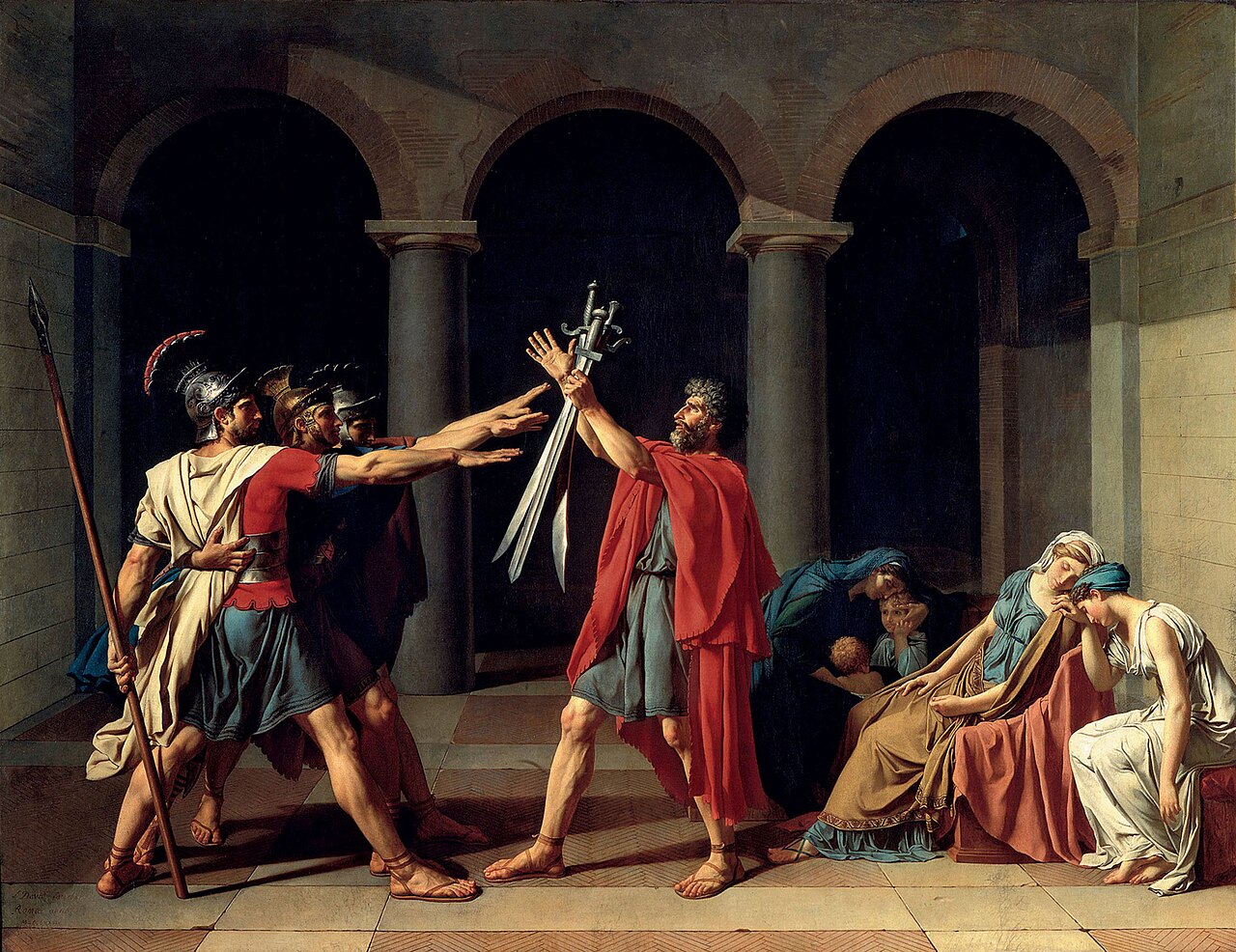
It found its most forceful form in France. Jacques-Louis David's Oath of the Horatii, shown in Paris in 1785, offered duty and sacrifice in place of Rococo charm, and the style became the visual language first of the Revolution and then of Napoleon's Empire. Antonio Canova did for marble what David did for paint. David's pupil Ingres carried the emphasis on line well into the nineteenth century, by which time Delacroix and the Romantics stood against it. In Britain it shaped the rooms of Robert Adam and the jasperware of Josiah Wedgwood.
At a glance
- When
- About 1760 to 1830
- Where
- Rome, Paris and London
- Leading artists
- Jacques-Louis David, Jean-Auguste-Dominique Ingres
Characteristics of Neoclassicism
- Classical subjects
- Stories from Greek and Roman history and myth, chosen for their moral lessons.
- Clear line
- Crisp drawing and firm outlines, valued above colour.
- Calm composition
- Frieze-like groups arranged across a shallow space.
- Smooth finish
- Brushwork and chisel marks concealed beneath a polished surface.
- Virtue and restraint
- Self-sacrifice and public duty in place of pleasure.
Neoclassical artists
Every artist below has a page on this site, with a short biography and what a valuation of their work turns on.
In France
In Rome and London
Famous Neoclassical works
- The Death of General WolfeBenjamin West, 1770, National Gallery of Canada, Ottawa
- Oath of the HoratiiJacques-Louis David, 1784, Louvre, Paris
- Psyche Revived by Cupid's KissAntonio Canova, 1787–93, Louvre, Paris
- The Death of MaratJacques-Louis David, 1793, Royal Museums of Fine Arts of Belgium, Brussels
- La Grande OdalisqueJean-Auguste-Dominique Ingres, 1814, Louvre, Paris
What a valuation turns on
Major paintings by David or Ingres rarely appear. Drawings, oil sketches and works by their pupils do, as do portraits of Grand Tour visitors. Marble copies and reductions after Canova were made in Italian workshops well into the nineteenth century, so an unsigned marble needs careful study to establish its date. Grand Tour souvenirs, such as bronzes after the antique, micromosaics and intaglios, form a market of their own.
Provenance can be excellent for works that have stayed in British country houses, and a family's records add value. Condition questions include relining and abrasion in thinly painted canvases, and repairs to marbles, which often lose fingers and noses and may have been recut or cleaned.
Common questions
What is Neoclassicism in art?
Neoclassicism is the European movement from about 1760 to 1830 that revived the art of ancient Greece and Rome, with clear line, calm composition and subjects chosen for moral seriousness.
What are the characteristics of Neoclassical art?
Classical subjects, firm outlines, shallow frieze-like space, smooth surfaces and an emphasis on duty and restraint.
Who are the most famous Neoclassical artists?
Jacques-Louis David, Jean-Auguste-Dominique Ingres and Antonio Canova, with Angelica Kauffman, Benjamin West and Anton Raphael Mengs.
What came after Neoclassicism?
Romanticism, which prized emotion, colour and the individual imagination, developed alongside it and then overtook it in the early nineteenth century.
How do I sell a Neoclassical painting, marble or Grand Tour piece?
Send photographs of the front, any signature or marks, and the back for a free, confidential valuation, with any labels or documents. We check the work against the published record, look at condition, and compare a confidential private sale with auction.