Rococo
Rococo is the light, ornamental and playful style that began in Paris around 1715 and spread across Europe in the mid-eighteenth century, in painting, architecture and decoration; its painters, Antoine Watteau, François Boucher, Jean-Honoré Fragonard and Giovanni Battista Tiepolo, traded the grandeur of the Baroque for pleasure, love and pastel colour.
The Rococo began in Paris in the years around the death of Louis XIV in 1715. Under the Regency the nobility left Versailles for town houses in Paris and wanted rooms that were intimate rather than grand: panelling carved with shells, scrolls and foliage in white, cream and gold, with mirrors, porcelain and small pictures set into the walls. The name comes from rocaille, the shell and rock work of garden grottoes, and was coined in mockery at the end of the century. Antoine Watteau gave the style its painting, the fête galante; François Boucher, the favourite painter of Madame de Pompadour, and Jean-Honoré Fragonard carried it through the reign of Louis XV; and designers such as Juste-Aurèle Meissonnier and Nicolas Pineau published the ornament that spread it across Europe.
Its greatest buildings are outside France: the palaces and pilgrimage churches of southern Germany and Austria, such as the Amalienburg at Nymphenburg and the Wieskirche in Bavaria, and the Residenz at Würzburg, where the Venetian Giovanni Battista Tiepolo painted one of the largest ceiling frescoes ever made in 1752–53. In Britain it arrived with French engravers and craftsmen: William Hogarth defined its serpentine line of beauty, the young Thomas Gainsborough learned from the engraver Hubert Gravelot, and Thomas Chippendale's Director of 1754 put Rococo furniture into English houses. From the 1760s critics such as Diderot attacked it as frivolous, Neoclassicism replaced it, and the Revolution made it a symbol of the old regime. It was revived in the nineteenth century, and much of the 'Rococo' on the market today dates from that revival.
At a glance
- When
- About 1715 to the 1770s
- Where
- Paris, then southern Germany, Venice and Britain
- Leading artists
- Antoine Watteau, François Boucher, Jean-Honoré Fragonard
Characteristics of the Rococo
- Curves and asymmetry
- C- and S-shaped scrolls, shells and foliage, rarely the same on both sides.
- Pastel colour
- Pinks, pale blues, cream and gilding, and light instead of deep shadow.
- Love and leisure
- Fêtes galantes, pastorals, flirtation and the loves of the gods.
- Intimate rooms
- Salons, boudoirs and small cabinets rather than state apartments.
- Painting as decoration
- Pictures, panelling, mirrors, porcelain and furniture designed as one.
Rococo artists
Every artist below has a page on this site, with a short biography and what a valuation of their work turns on.
In France
- Antoine WatteauInvented the fête galante, lovers, actors and music in an imagined parkland, and set the tone of the Rococo.
- François BoucherPainter to Madame de Pompadour, designer for the royal tapestry works, and the most fluent hand of the French Rococo.
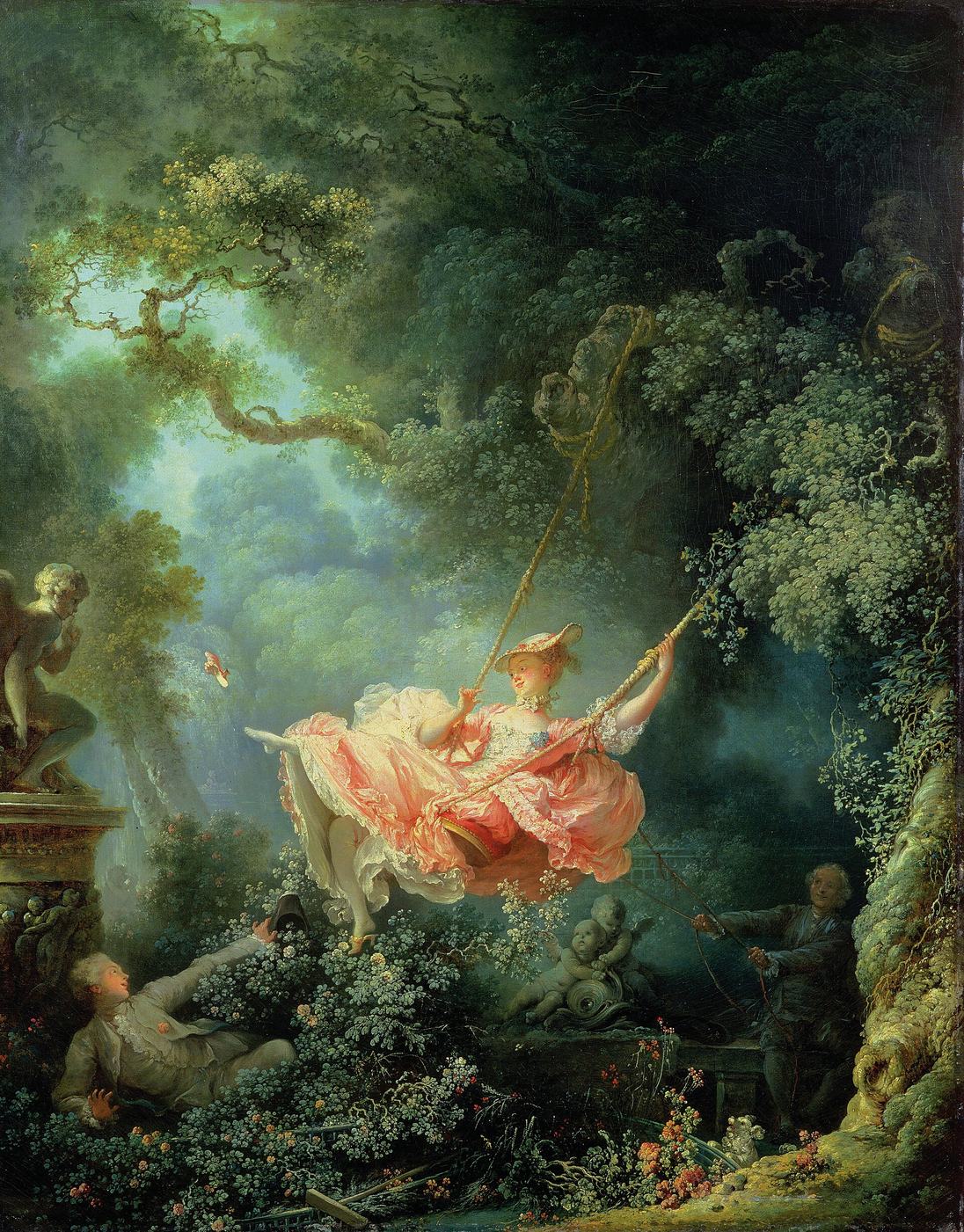
- Jean-Honoré FragonardThe Swing, the fantasy figures and some of the fastest brushwork of the eighteenth century.
Famous Rococo works
- The Pilgrimage to CytheraAntoine Watteau, 1717, Musée du Louvre, Paris
- Wieskirche, BavariaDominikus Zimmermann, 1745–54
- Staircase ceiling, Residenz, WürzburgGiovanni Battista Tiepolo, 1752–53
- Madame de PompadourFrançois Boucher, 1756, Alte Pinakothek, Munich
- The SwingJean-Honoré Fragonard, 1767, The Wallace Collection, London
What a valuation turns on
Paintings by the leading Rococo painters are rare and mostly in museums, so the active market is in drawings, oil sketches and prints. Watteau's and Boucher's chalk drawings, Fragonard's red chalk landscapes and wash drawings, Tiepolo's oil sketches and etchings, and Hogarth's engravings all come up regularly, and each has its own questions of attribution, state and condition.
The style was copied in its own century and revived in the next, so the first question about a Rococo picture or object is when it was made. Studio replicas, followers and later copies after the famous compositions are common, and much 'Rococo' furniture, porcelain and painting was made in the nineteenth-century revival, sometimes with false marks or signatures. A history that goes back to the eighteenth-century collections, and the judgement of the specialists on each artist, decide the most.
Common questions
What is Rococo art?
Rococo is the light, decorative style of the eighteenth century that began in Paris around 1715 and spread across Europe. It favoured curves and asymmetry, pastel colours and gilding, and subjects of love and leisure, in painting, interiors, furniture and porcelain alike.
What is the difference between Baroque and Rococo?
Baroque, the style of the seventeenth century, is grand, dramatic and often religious, with strong contrasts of light and shadow, made to impress on behalf of the Church and the monarchy. Rococo, which grew out of it in the eighteenth century, is lighter, smaller in scale and more playful, with pastel colours, curling ornament and private pleasures as its subjects.
Who are the most famous Rococo artists?
The painters Antoine Watteau, François Boucher, Jean-Honoré Fragonard and Giovanni Battista Tiepolo; the designers Juste-Aurèle Meissonnier and Nicolas Pineau; the architects François de Cuvilliés and Dominikus Zimmermann; and in Britain William Hogarth and the young Thomas Gainsborough.
When was the Rococo period?
From about 1715, when Louis XIV died and the French court moved back to Paris, to the 1770s, when Neoclassicism replaced it. It lasted longest in southern Germany and Austria.
How do I sell a Rococo painting or drawing?
Send photographs of the front and the back, with any labels, inscriptions or collectors' marks, for a free, confidential valuation. Whether the work is from the eighteenth century or a later copy, and who made it, usually decide the most; we check both, compare a confidential private sale with auction, and keep the paperwork in your name until you are paid.