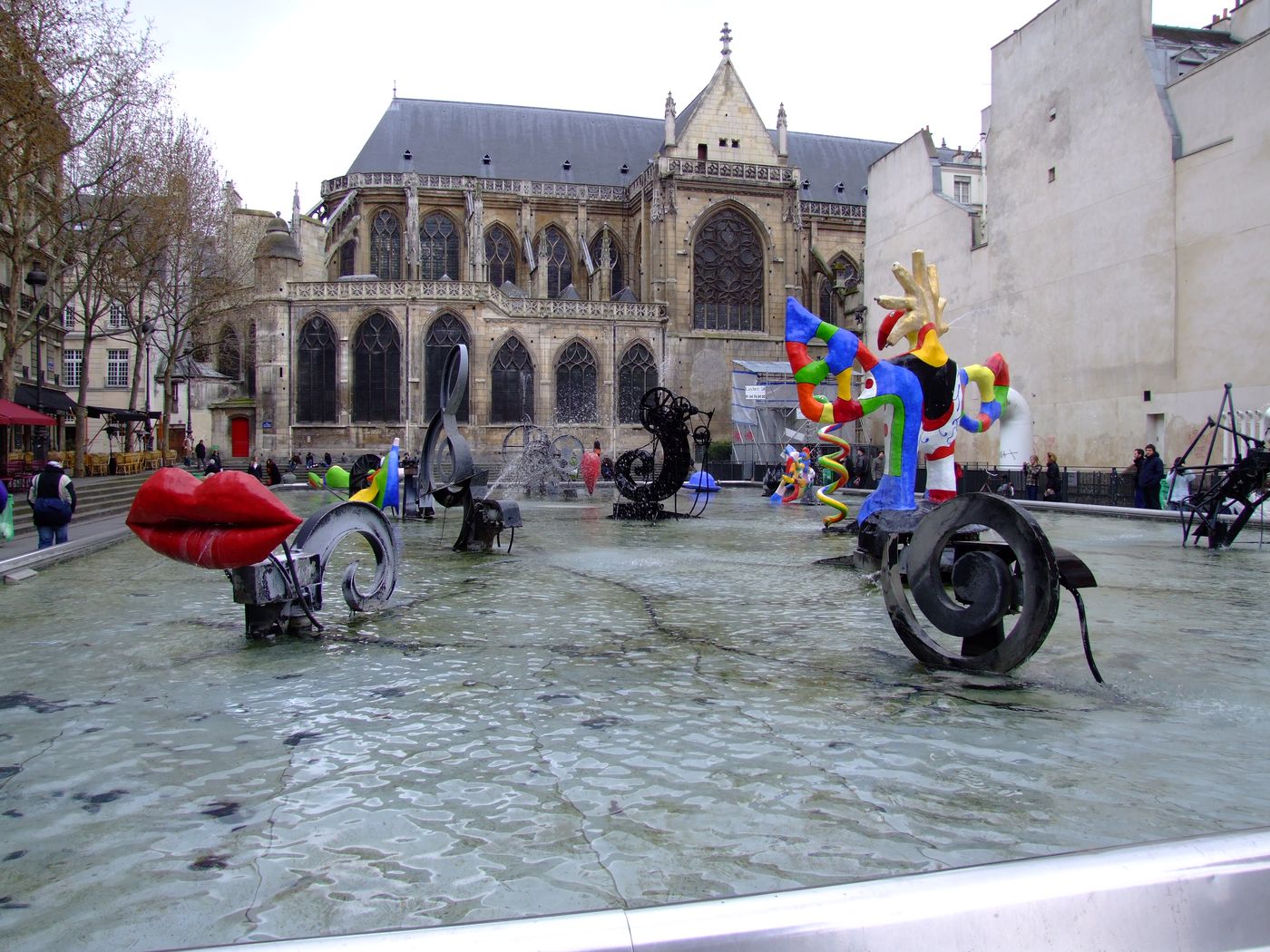
Kinetic art
Kinetic art is art that moves, or appears to move: sculpture set in motion by air, motors or the viewer, and works that change as the viewer walks past them; it took shape in the 1920s and flourished in Paris, across Europe and in Latin America in the 1950s and 1960s.
The idea is older than the name. Marcel Duchamp mounted a bicycle wheel on a stool in 1913 and made his motorised Rotary Glass Plates in 1920; Naum Gabo set a single steel rod vibrating with a motor in Kinetic Construction of 1919 to 1920; and László Moholy-Nagy built his Light-Space Modulator, a motorised sculpture of metal and glass that threw moving light and shadow, between 1922 and 1930. In Paris in 1931 the American sculptor Alexander Calder made the first sculptures moved by air, and Duchamp gave them their name: mobiles.
The movement came together in Paris in 1955, when the Galerie Denise René showed Le Mouvement, with Calder, Duchamp, Jean Tinguely, Pol Bury, Jesús Rafael Soto, Yaacov Agam and Victor Vasarely, whose manifesto for the show argued for an art of movement and optical effect. Tinguely went on to build machines that clanked, painted and destroyed themselves, as Homage to New York did in the garden of the Museum of Modern Art in 1960. The Venezuelans Soto and Carlos Cruz-Diez made it a major strand of Latin American art, and the Groupe de Recherche d'Art Visuel in Paris, with Julio Le Parc, drew the viewer into the work. Kinetic art overlapped with Op art, which makes the eye alone see movement, and the two were often shown together.
At a glance
- When
- 1920s to the 1970s, and since
- Where
- Paris, then Europe and Latin America
- Leading artists
- Alexander Calder, Jean Tinguely, Laszlo Moholy-Nagy
Characteristics of kinetic art
- Real movement
- Parts moved by air, water, motors or the viewer's touch.
- Virtual movement
- Works that seem to shift and vibrate as the viewer walks past, through layering, lines or reflection.
- Light
- Moving light and shadow used as a material in their own right.
- Chance and time
- No two moments the same: the work exists in time as well as space.
- Engineering
- Balance, motors, springs and magnets, often worked out by hand in the studio.
Kinetic artists
Every artist below has a page on this site, with a short biography and what a valuation of their work turns on.
Sculpture that moves
- Alexander CalderTrained as an engineer, and then hung sculpture from the ceiling so the air could move it.
- Jean TinguelyBuilt machines out of scrap that do nothing, badly, and sometimes destroy themselves.
- Laszlo Moholy-NagyBauhaus master who made pictures without a camera and ordered a painting over the telephone.
Famous Kinetic works
- Kinetic Construction (Standing Wave)Naum Gabo, 1919–20, Tate, London
- Rotary Glass Plates (Precision Optics)Marcel Duchamp, 1920, Yale University Art Gallery, New Haven
- Light-Space ModulatorLászló Moholy-Nagy, 1922–30, Harvard Art Museums, Cambridge, Massachusetts
- Lobster Trap and Fish TailAlexander Calder, 1939, Museum of Modern Art, New York
- Stravinsky Fountain, ParisJean Tinguely and Niki de Saint Phalle, 1983
What a valuation turns on
Kinetic works are machines as well as sculptures, so condition and function come first: whether a mobile is complete and balanced, whether a motorised piece still runs, and whether parts, motors or wiring have been replaced, and by whom. Calder's mobiles and stabiles are registered with the Calder Foundation, whose archive number is the starting point for any sale, and Tinguely's machines are recorded in his catalogue raisonné.
Smaller works, multiples and editions are common, from Calder's prints and tapestries to the editioned kinetic objects of the 1960s, and these depend on the edition, the signature and the publisher. Moving and installing a large kinetic work is specialist and costly, and it is worth knowing what that will involve before a sale.
Common questions
What is kinetic art?
Kinetic art is art that moves or appears to move: mobiles turned by air, sculptures driven by motors, and works that change as the viewer moves past them. It began in the 1910s and 1920s and was at its height in the 1950s and 1960s.
Who are the most famous kinetic artists?
Alexander Calder, Jean Tinguely, Naum Gabo, László Moholy-Nagy, Jesús Rafael Soto, Yaacov Agam, Pol Bury, Carlos Cruz-Diez and Julio Le Parc, with Marcel Duchamp among the first to make kinetic works.
Who invented the mobile?
Alexander Calder, in Paris in 1931. Marcel Duchamp named the hanging, air-moved sculptures mobiles, a French pun meaning both 'moving' and 'motive'.
What is the difference between kinetic art and Op art?
Kinetic art moves, or uses the viewer's own movement; Op art is still, and makes the eye see movement through pattern and contrast. Several artists, Vasarely and Soto among them, worked in both.
How do I sell a kinetic sculpture or a Calder?
Send photographs of the whole work, any signature or stamp and the base or fixings, with any certificates or registration numbers, for a free, confidential valuation. Registration and condition usually decide the most; we check them, compare a confidential private sale with auction, and keep the paperwork in your name until you are paid.