

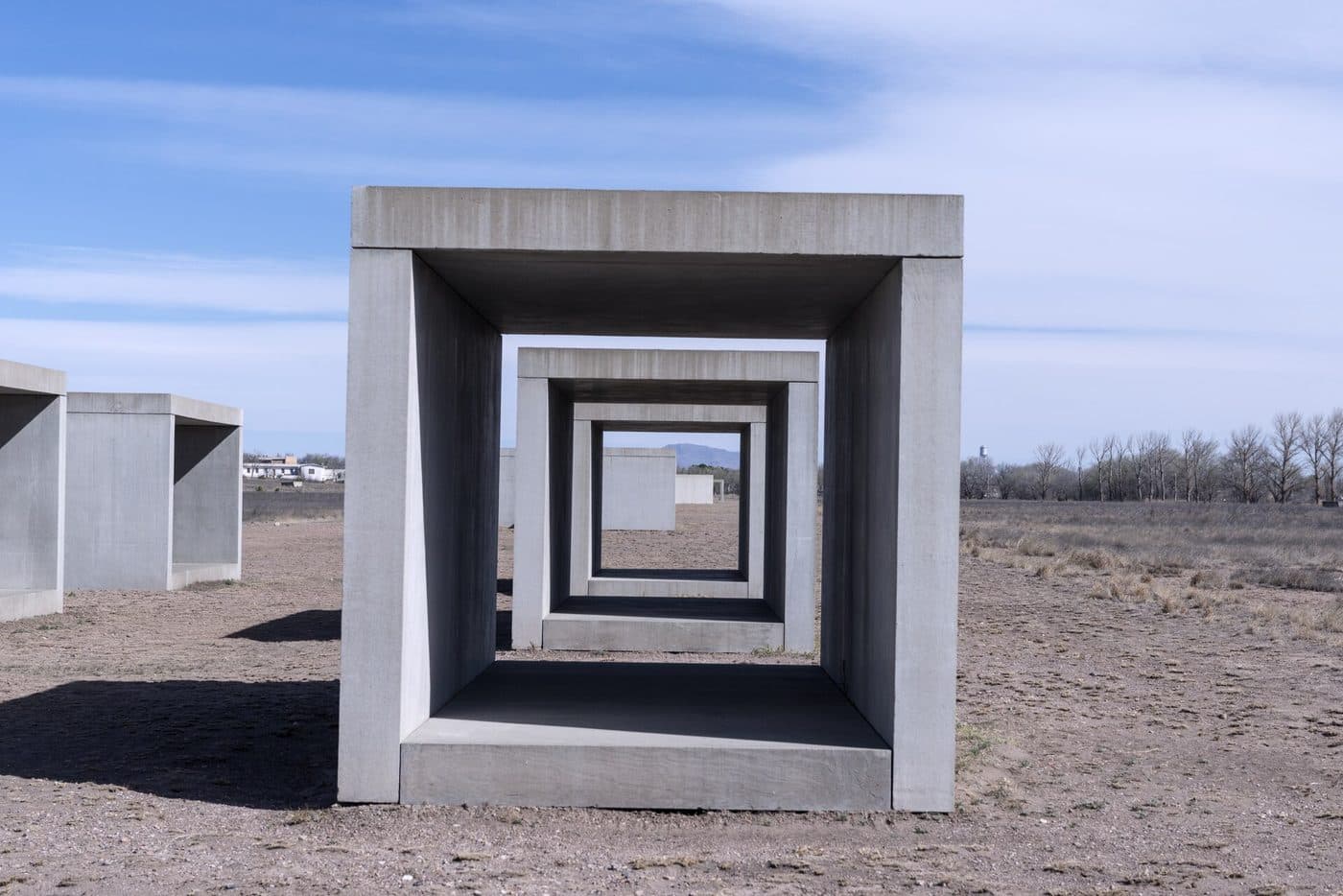
Minimalism
Minimalism, or Minimal art, was an American movement of the 1960s that reduced art to simple geometric forms, industrial materials and repetition, presenting the object as itself rather than as a picture of something else; its leading figures were Donald Judd, Dan Flavin, Carl Andre, Sol LeWitt and Robert Morris.
Frank Stella's Black Paintings of 1958 and 1959, regular bands of black enamel separated by thin lines of bare canvas, were shown at the Museum of Modern Art in 1959, and Stella's line that 'what you see is what you see' became the movement's motto. Over the next few years a group of artists in New York turned from painting to what Judd called specific objects: boxes, stacks, fluorescent tubes, floor plates and grids, often made by fabricators in steel, aluminium, plywood, Plexiglas and brick, so that nothing in them showed the artist's hand.
The name came from critics, Richard Wollheim's essay 'Minimal Art' of 1965 among them, and most of the artists rejected it; Judd thought it meaningless. The exhibition Primary Structures at the Jewish Museum in New York in 1966 brought the work to the public, and Carl Andre's Equivalent VIII, 120 firebricks bought by the Tate, caused a press furore in London in 1976. In painting, Agnes Martin's pale pencilled grids and Robert Ryman's white paintings came to be seen alongside Minimalism, though both described their work otherwise. Minimalism led directly to Conceptual art, Land art and Post-Minimalism, and Judd's permanent installations at Marfa, Texas, are its monument.
At a glance
- When
- 1960s to 1970s
- Where
- New York
- Leading artists
- Donald Judd, Dan Flavin, Sol LeWitt, Frank Stella
Characteristics of Minimalism
- Geometric form
- Cubes, grids, lines and modules.
- Industrial materials
- Steel, aluminium, Plexiglas, fluorescent light and brick, often fabricated by others.
- Seriality
- Identical units repeated in regular order.
- Literalness
- No illusion, symbol or expression: the object is what it is.
- Space and the viewer
- Work that takes in the room and the person walking around it.
Minimalist artists
Every artist below has a page on this site, with a short biography and what a valuation of their work turns on.
Minimalists
- Donald JuddRejected the word sculpture, made boxes to a specification, and rebuilt a Texas town around them.
- Dan FlavinMade art from shop-bought fluorescent tubes, turning light, colour and corners into sculpture.
- Sol LeWittWrote instructions for wall drawings and let other people execute them, for forty years.
- Frank StellaSaid what you see is what you see, then spent fifty years making it more complicated.
- Agnes MartinDrew graphite grids on square canvases in the New Mexico desert, and asked for nothing else.
- Robert RymanPainted white on white for sixty years, making the paint, the surface and the fixings the whole subject.
Around and after Minimalism
- Ellsworth KellyTook shapes from shadows, windows and bridges, and painted them flat with nothing else in the picture.
- Brice MardenWent from waxy monochrome panels to calligraphic ribbons of line, slowly, over fifty years.
- Richard SerraMade sculpture out of shipyard steel at a weight that changes the room and sometimes the street.
- Richard TuttleMakes very small, very slight things out of wire, cloth and paper, and insists on where they go.
- Lee UfanMono-ha philosopher-painter of a single brushstroke and a stone beside a steel plate.
Famous Minimalist works
- Die Fahne hoch!Frank Stella, 1959, Whitney Museum of American Art, New York
- FriendshipAgnes Martin, 1963, Museum of Modern Art, New York
- the diagonal of May 25, 1963Dan Flavin, 1963
- Equivalent VIIICarl Andre, 1966, Tate, London
- Untitled (Stack)Donald Judd, 1967, Museum of Modern Art, New York
- 15 untitled works in concreteDonald Judd, 1980–84, Chinati Foundation, Marfa, Texas
What a valuation turns on
Minimal art raises questions painting does not. Much of it was fabricated, so authenticity rests on documentation rather than on the hand: Judd's works have fabrication records, Flavin's light works are sold with a signed certificate that is part of the work, and a Flavin without its certificate is, in market terms, a set of fluorescent fittings. LeWitt's wall drawings exist as certificates and instructions, carried out by others wherever they are installed.
Condition is the other question. Polished metal, lacquer and Plexiglas show every fingerprint and scratch, and replacing a damaged part is a question of authenticity as well as of conservation. The Judd Foundation, the Flavin estate and the artists' catalogues raisonnés are the references.
Common questions
What is Minimalism in art?
Minimalism is a movement in American sculpture and painting of the 1960s that reduced art to basic geometric forms, industrial materials and repetition, so that the work refers to nothing beyond itself.
Who are the most famous Minimalist artists?
Donald Judd, Dan Flavin, Carl Andre, Sol LeWitt, Robert Morris and Frank Stella, with Agnes Martin and Robert Ryman often grouped with them in painting.
When was the Minimalist movement?
From the end of the 1950s, with Frank Stella's Black Paintings, through the 1960s, when Judd, Flavin, Andre, LeWitt and Morris made their key works. The exhibition Primary Structures in New York in 1966 brought it to a wide public.
What is the difference between Minimalism and Conceptual art?
Minimalism is about the physical object, its material, form and presence in space. Conceptual art, which grew out of it in the late 1960s, puts the idea first, and the object may be secondary or absent altogether.
How do I sell a Minimalist work?
Send photographs of the work, any certificate, and the fabrication or gallery paperwork for a free, confidential valuation. With these works the documents matter as much as the object, and we check both before comparing a confidential private sale with auction.
