
Photorealism
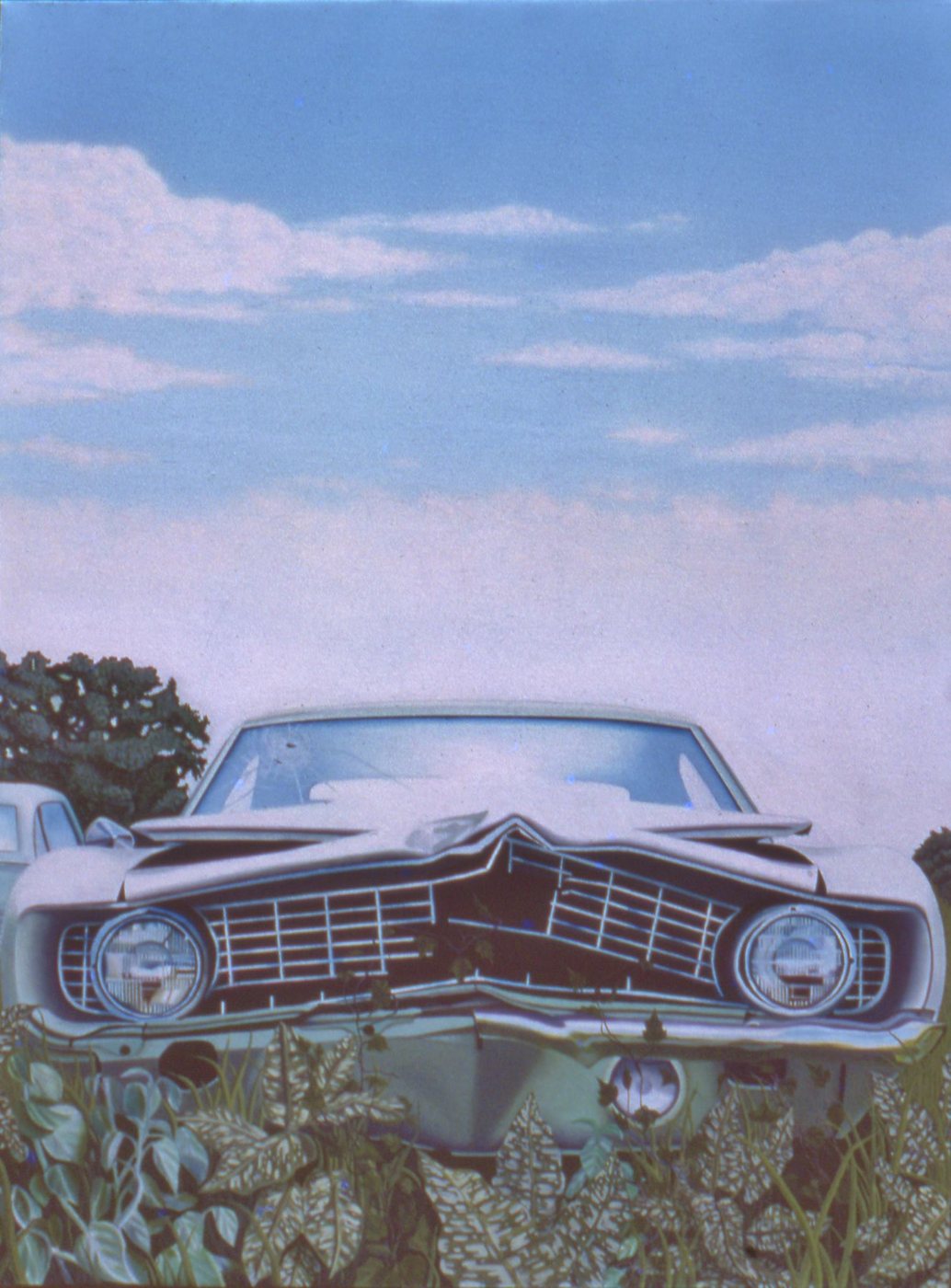
Photorealism is painting made from photographs, copied by hand so precisely that the finished canvas looks like a photograph; it began in the United States in the late 1960s with painters such as Chuck Close, Richard Estes, Ralph Goings, Robert Bechtle and Audrey Flack.
The painters arrived at it separately, in New York and California, in the second half of the 1960s. Malcolm Morley, an Englishman in New York, painted ocean liners from travel brochures from 1965; Robert Bechtle painted his family and their cars in the suburbs of the Bay Area; Richard Estes painted the shop windows, diners and phone booths of Manhattan, reflections and all; and Chuck Close began the huge heads that made his name with Big Self-Portrait in 1967. After two decades of Abstract Expressionism and Minimalism, a realist picture was a provocation, and admitting to working from photographs more so.
The dealer Louis K. Meisel coined the word Photorealism in 1969, and it appeared in print the next year in the Whitney Museum's catalogue for Twenty-two Realists. In 1972 he set out a five-point definition: the artist uses the camera to gather information, transfers it to the canvas by mechanical means such as a projector or a grid, and makes the result look photographic. The movement was given a room at documenta 5 in Kassel the same year, and in Europe it took the name hyperrealism from a 1973 exhibition in Brussels. Gerhard Richter, painting blurred pictures from newspaper photographs since 1962, and Vija Celmins, drawing the surface of the ocean from her own photographs from 1968, worked alongside it without joining it.
At a glance
- When
- Late 1960s to the 1980s, and since
- Where
- The United States, chiefly New York and California
- Leading artists
- Chuck Close
Characteristics of Photorealism
- Painted from photographs
- The camera's view copied, including its depth of field, its glare and its distortions.
- Everyday America
- Diners, cars, trucks, shop fronts, suburban houses and neon signs.
- Reflections and chrome
- Glass, polished metal and wet streets, chosen because they are the hardest to paint.
- No visible brushwork
- Smooth, impersonal surfaces, often laid down with an airbrush.
- Grid and projector
- Images transferred square by square, or projected from a slide onto the canvas.
Photorealist artists
Every artist below has a page on this site, with a short biography and what a valuation of their work turns on.
The Photorealists
Famous Photorealist works
- SS Amsterdam in Front of RotterdamMalcolm Morley, 1966
- Telephone BoothsRichard Estes, 1967, Museo Nacional Thyssen-Bornemisza, Madrid
- Big Self-PortraitChuck Close, 1967–68, Walker Art Center, Minneapolis
- '61 PontiacRobert Bechtle, 1968–69, Whitney Museum of American Art, New York
- Marilyn (Vanitas)Audrey Flack, 1977, University of Arizona Museum of Art, Tucson
What a valuation turns on
Photorealist paintings are slow to make, often taking months each, so the leading painters' output is small and their best canvases from the late 1960s and 1970s are rare and sought after. The movement's reputation has risen since the 2000s, with museum exhibitions and a new generation of hyperrealist painters.
Condition matters more than usual. The smooth, airbrushed surfaces show every scratch, dent and patch of discoloured varnish, and they are hard to retouch invisibly, so a condition report comes first. Prints are the accessible end of the market: Chuck Close and Richard Estes both made many, and their value depends on the edition, the signature and the publisher.
Common questions
What is photorealism?
Photorealism is a style of painting that copies a photograph by hand so precisely that the finished picture looks like a photograph. As a movement it began in the United States in the late 1960s, with painters such as Chuck Close, Richard Estes and Audrey Flack.
Who are the most famous photorealist artists?
Chuck Close, Richard Estes, Ralph Goings, Robert Bechtle, Audrey Flack, Malcolm Morley, Don Eddy, Charles Bell, Tom Blackwell, Richard McLean, Ben Schonzeit and John Salt, with the sculptors Duane Hanson and John De Andrea.
Who coined the term photorealism?
The New York dealer Louis K. Meisel, in 1969. The word first appeared in print in 1970, in the Whitney Museum's catalogue for its exhibition Twenty-two Realists, and Meisel later set out a five-point definition of the movement.
What is the difference between photorealism and hyperrealism?
The words are often used for the same thing. Strictly, photorealism is the American movement of the late 1960s and 1970s, which copied photographs as exactly as possible; hyperrealism, a name taken from a 1973 exhibition in Brussels, came to mean later painting and sculpture that goes beyond the photograph, with more detail and more emotion.
How do I sell a photorealist painting?
Send photographs of the front, the signature and the back, with any labels, certificates or invoices, for a free, confidential valuation. Condition and the date of the work usually decide the most; we check them, compare a confidential private sale with auction, and keep the paperwork in your name until you are paid.