Social Realism
Social realism is a tendency in art, strongest from the 1920s to the 1950s, that depicts working people and social injustice in a direct, recognisable style, in the work of Käthe Kollwitz, Diego Rivera, Dorothea Lange and Britain's Kitchen Sink painters.
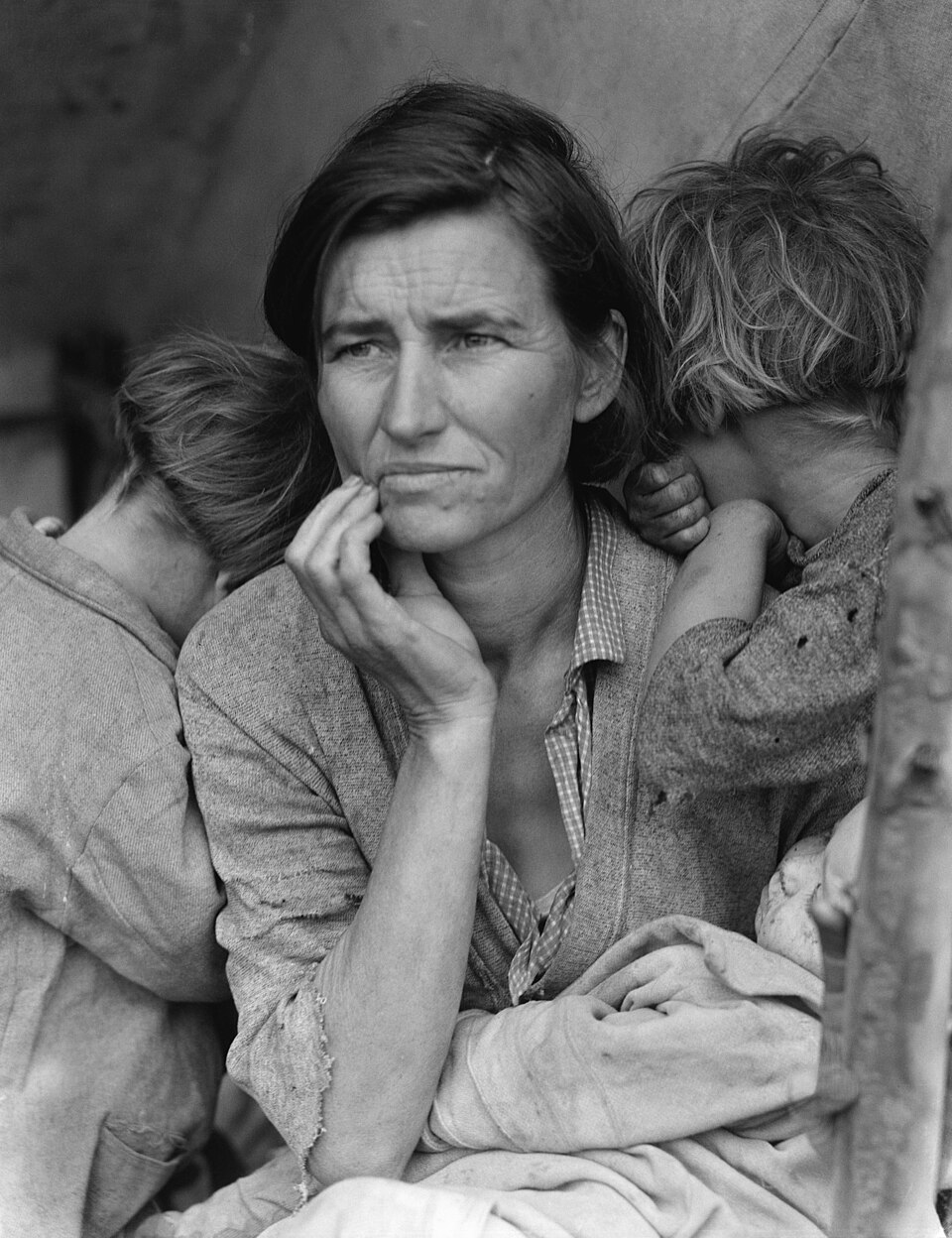
Artists had pictured the poor before, among them Gustave Courbet and Jean-François Millet, but social realism as a tendency took shape in the twentieth century. In Germany, Käthe Kollwitz made prints of hunger and grief. After the Mexican Revolution, Diego Rivera, José Clemente Orozco and David Alfaro Siqueiros painted murals of workers and history. The Great Depression brought the idea to the United States, where the Federal Art Project employed artists and Farm Security Administration photographers, including Dorothea Lange and Walker Evans, documented rural poverty. Ben Shahn painted the trial of Sacco and Vanzetti.
It should not be confused with Socialist Realism, the official style imposed by the Soviet Union from the 1930s to glorify the state. Social realists were usually independent and critical. In Britain the critic David Sylvester coined the term Kitchen Sink in 1954 for painters such as John Bratby, who showed cramped domestic interiors. L. S. Lowry's mill towns are often discussed alongside them, and in the 1980s Scottish painters including Ken Currie and Peter Howson gave the tradition a new force, with images of labour and its loss in Glasgow.
At a glance
- When
- Mainly the 1920s to the 1950s
- Where
- The United States, Mexico, Germany and Britain
- Leading artists
- Käthe Kollwitz, Diego Rivera
Characteristics of social realism
- Working lives
- Factories, fields, kitchens and dole queues as the main subjects.
- Political sympathy
- An open concern with injustice, poverty and labour.
- Recognisable style
- Figurative work designed to be read and understood by all.
- Public forms
- Murals, prints, posters and photographs that reach wide audiences.
- Plain materials
- Sombre tones and thick paint, with no attempt to flatter the subject.
Social Realist artists
Every artist below has a page on this site, with a short biography and what a valuation of their work turns on.
In Europe and the Americas
Photographers
In Britain
- L. S. LowryAmong the most forged British artists there is, and the drawings are where it happens.
- John BratbyKitchen Sink painter of bins, cornflake packets and cluttered rooms, laid on an inch thick.
- Ken CurrieGlasgow painter of heroic workers, then of damaged bodies and the stark Three Oncologists.
- Peter HowsonNew Glasgow Boy who went to Bosnia as a war artist and painted what it did to him.
Famous Social Realist works
- A Weavers' RevoltKäthe Kollwitz, 1893–97
- The Passion of Sacco and VanzettiBen Shahn, 1931–32, Whitney Museum of American Art, New York
- Detroit Industry MuralsDiego Rivera, 1932–33, Detroit Institute of Arts
- Migrant MotherDorothea Lange, 1936, Library of Congress, Washington
- Still Life with Chip FrierJohn Bratby, 1954, Tate, London
What a valuation turns on
Much of this work was made to be seen widely, so prints and photographs form a large part of the market. Kollwitz's etchings and lithographs vary greatly by state and impression, and later printings are common. Photographs by Lange and Evans depend on when they were printed, and because Farm Security Administration negatives are in the public domain, modern prints are widespread and have little value by comparison.
British painters from Lowry to Bratby have a strong following at home, and subject, date and scale are central to their value. Thickly painted Kitchen Sink canvases should be checked for cracking and surface dirt. For murals and large commissions, what appears on the market is typically drawings and studies, which need a documented connection to the finished work.
Common questions
What is social realism in art?
Social realism is art that depicts working people and social injustice in a direct, recognisable style. It was strongest from the 1920s to the 1950s.
What is the difference between social realism and Socialist Realism?
Social realism is an independent, often critical tendency. Socialist Realism was the official style of the Soviet Union, intended to glorify the state and its workers.
Who are the most famous social realist artists?
Käthe Kollwitz, Diego Rivera, Ben Shahn, Dorothea Lange and Walker Evans, with the Kitchen Sink painters in Britain.
What is the Kitchen Sink school?
A group of British realist painters of the 1950s, including John Bratby, who showed ordinary domestic life. The critic David Sylvester gave them the name in 1954.
How do I sell a social realist painting, print or photograph?
Send photographs of the front, any signature or marks, and the back for a free, confidential valuation, with any labels or documents. We check the work against the published record, look at condition, and compare a confidential private sale with auction.