

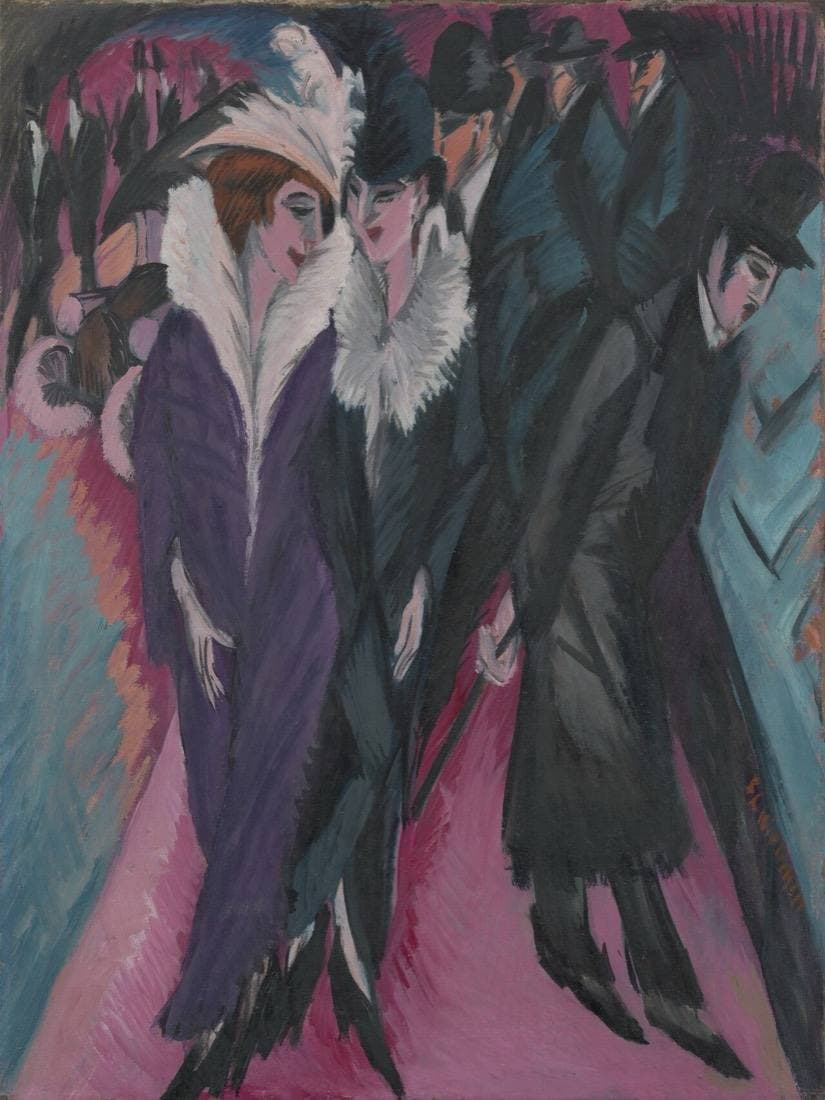
Expressionism
Expressionism was a movement, mostly German and Austrian, in which artists distorted form and heightened colour to convey emotion and inner experience rather than outward appearance; it began with the Die Brücke group in Dresden in 1905.
Four architecture students founded Die Brücke, The Bridge, in Dresden in June 1905: Ernst Ludwig Kirchner, Erich Heckel, Karl Schmidt-Rottluff and Fritz Bleyl. Max Pechstein, Otto Mueller and, for a short time, Emil Nolde joined them. They worked communally, painted nudes outdoors at the Moritzburg lakes, revived the woodcut as a raw and direct medium, and after moving to Berlin around 1911 turned to the city itself: streets, cabarets and the crowds of Potsdamer Platz. The group broke up in 1913.
In Munich, Wassily Kandinsky and Franz Marc organised the first Blaue Reiter, Blue Rider, exhibition in December 1911 and published the almanac of that name in 1912. Where Die Brücke was raw and urban, the Blaue Reiter was spiritual: Kandinsky moved towards complete abstraction, Marc painted animals in symbolic colour, and August Macke, Gabriele Münter, Alexej von Jawlensky and Paul Klee were part of the circle. The First World War broke both groups up. In Vienna, Egon Schiele and Oskar Kokoschka were making anguished, psychological portraits of their own, and after the war Max Beckmann carried Expressionism into something harder. In 1937 the Nazi regime confiscated thousands of Expressionist works from German museums and paraded many of them in the Degenerate Art exhibition in Munich.
At a glance
- When
- 1905 to the 1920s
- Where
- Dresden, Berlin, Munich and Vienna
- Leading artists
- Ernst Ludwig Kirchner, Erich Heckel, Karl Schmidt-Rottluff, Max Pechstein
Characteristics of Expressionism
- Distortion
- Bodies, faces and spaces bent and exaggerated for emotional effect.
- Clashing colour
- Acid greens, pinks and blues, used for feeling rather than description.
- The woodcut
- Revived by Die Brücke: gouged, angular and often printed by hand.
- Anxiety and the city
- Alienation, sexuality and the crowd in the modern metropolis.
- Borrowed forms
- Sculpture from Africa and Oceania, seen in the Dresden ethnographic museum.
- Towards abstraction
- Kandinsky's belief that colour and line could express the spiritual directly.
Expressionist artists
Every artist below has a page on this site, with a short biography and what a valuation of their work turns on.
Die Brücke, Dresden and Berlin
- Ernst Ludwig KirchnerFounded Die Brucke, painted Berlin's streets on the edge of war, and never recovered from it.
- Erich HeckelDie Brucke founder, and one of the great woodcutters of German Expressionism.
- Karl Schmidt-RottluffDie Brucke founder whose woodcuts hit harder than anyone else's in the group.
- Max PechsteinThe Brücke painter the public took to first, expelled by the group and later declared degenerate by the state.
- Otto MuellerPainted thin nudes in reed beds in distemper on rough hessian, and nothing else much.
- Emil NoldeGerman Expressionist of burning skies and watercolour flowers, with a biography that has been reassessed.
Der Blaue Reiter, Munich
- Wassily KandinskyGave up a law professorship at thirty and painted his way out of the recognisable world.
- Franz MarcPainted horses and deer in blue and yellow because he trusted animals more than people, and died at Verdun.
- August MackePainted shop windows, parks and one Tunisian spring in flat bright colour, and was dead by twenty-seven.
- Gabriele MünterPainted Murnau in heavy outline and flat colour, then hid the Blaue Reiter in her cellar for the duration.
- Alexej von JawlenskyRussian officer turned Munich Expressionist, who painted the same head for thirty years.
- Paul KleeTook a line for a walk, taught at the Bauhaus, and made nearly ten thousand works.
Vienna and beyond
- Edvard MunchPainted The Scream four times, and printed the rest of his life's anxieties in editions.
- Egon SchieleDrew the body without flattery for ten years and was dead at twenty-eight.
- Oskar KokoschkaViennese expressionist who painted his sitters as though he could see through them.
- Max BeckmannWent to the First World War as a medical orderly and painted Germany's next thirty years from the inside.
- Chaim SoutinePainted carcasses, bellboys and landscapes that appear to be sliding off the canvas.
Famous Expressionist works
- Blue Horse IFranz Marc, 1911, Lenbachhaus, Munich
- Self-Portrait with PhysalisEgon Schiele, 1912, Leopold Museum, Vienna
- Street, BerlinErnst Ludwig Kirchner, 1913, Museum of Modern Art, New York
- Composition VIIWassily Kandinsky, 1913, Tretyakov Gallery, Moscow
- The Bride of the WindOskar Kokoschka, 1913–14, Kunstmuseum Basel
- DepartureMax Beckmann, 1932–35, Museum of Modern Art, New York
What a valuation turns on
German Expressionism has a deep international market, and prints are the larger part of it. Kirchner, Heckel, Schmidt-Rottluff, Nolde and Pechstein printed many of their woodcuts, etchings and lithographs themselves, in small and often unnumbered runs, so an impression printed by the artist differs greatly from a later printing from the same block. The catalogues raisonnés of the prints (Dube for Kirchner and Heckel, Schiefler for Nolde) are where identification starts.
Provenance before 1945 is the other question. Expressionist works were confiscated from museums in 1937 and taken from Jewish collectors, and a gap in the record between 1933 and 1945 has to be researched before a work can be sold. Nolde's watercolours, of which there are many, are reviewed by the Nolde Foundation at Seebüll.
Common questions
What is Expressionism?
Expressionism is art that distorts form and exaggerates colour to express emotion and inner experience rather than to show how things look. As a movement it was centred in Germany and Austria from 1905 to the 1920s.
What is German Expressionism?
The work of two groups above all: Die Brücke, founded in Dresden in 1905 by Kirchner, Heckel, Schmidt-Rottluff and Bleyl, and Der Blaue Reiter, formed in Munich in 1911 around Kandinsky and Marc. The term also covers Expressionist film, theatre and architecture of the 1910s and 1920s.
Who were the main Expressionist artists?
Ernst Ludwig Kirchner, Erich Heckel, Karl Schmidt-Rottluff, Max Pechstein, Emil Nolde, Wassily Kandinsky, Franz Marc, August Macke, Gabriele Münter, Egon Schiele, Oskar Kokoschka and Max Beckmann, with Edvard Munch as the great forerunner.
What is the difference between Die Brücke and Der Blaue Reiter?
Die Brücke, in Dresden and Berlin, was raw, urban and figurative, known for its woodcuts and street scenes. Der Blaue Reiter, in Munich, was spiritual and moved towards abstraction, in Kandinsky's work above all.
How do I sell an Expressionist woodcut or painting?
Send photographs of the front, the back and any signature, stamps or labels for a free, confidential valuation. For prints we check the catalogue number and the printing; for every work, the provenance between 1933 and 1945. We then compare a confidential private sale with auction.
