Constructivism
Constructivism was a Russian movement that emerged around 1915 and took shape after the 1917 Revolution, in which artists such as Vladimir Tatlin, Alexander Rodchenko and El Lissitzky rejected traditional fine art in favour of constructions, graphic design and photography serving a new society.
Shortly before the First World War, Vladimir Tatlin saw Picasso's constructions in Paris and went back to Russia to make counter-reliefs from metal, wood and wire, using real materials in real space. After the Revolution, artists were offered a new purpose. Tatlin designed a colossal spiralling Monument to the Third International. In 1921 Alexander Rodchenko showed three canvases of pure red, yellow and blue and declared the end of painting, and the First Working Group of Constructivists was formed in Moscow, with Rodchenko, Varvara Stepanova and the theorist Aleksei Gan.
They turned to the poster, the book, the theatre, photography, textiles and furniture. Liubov Popova designed sets and fabrics, and Lissitzky, who had worked with Malevich at Vitebsk, took the ideas to Germany. Naum Gabo and Antoine Pevsner went their own way, arguing in their Realistic Manifesto of 1920 for an art free from political use, and left Russia. In the West Constructivism influenced the Bauhaus, where László Moholy-Nagy taught, and in London it shaped the 1937 publication Circle, edited by Gabo, Ben Nicholson and Leslie Martin. In the Soviet Union, the official doctrine of Socialist Realism brought it to an end in the early 1930s.
At a glance
- When
- About 1915 to 1932
- Where
- Moscow, then Berlin and the West
- Leading artists
- Vladimir Tatlin, Alexander Rodchenko, El Lissitzky, Liubov Popova
Characteristics of Constructivism
- Industrial materials
- Metal, glass, plastic and wire used for their own qualities.
- Geometric form
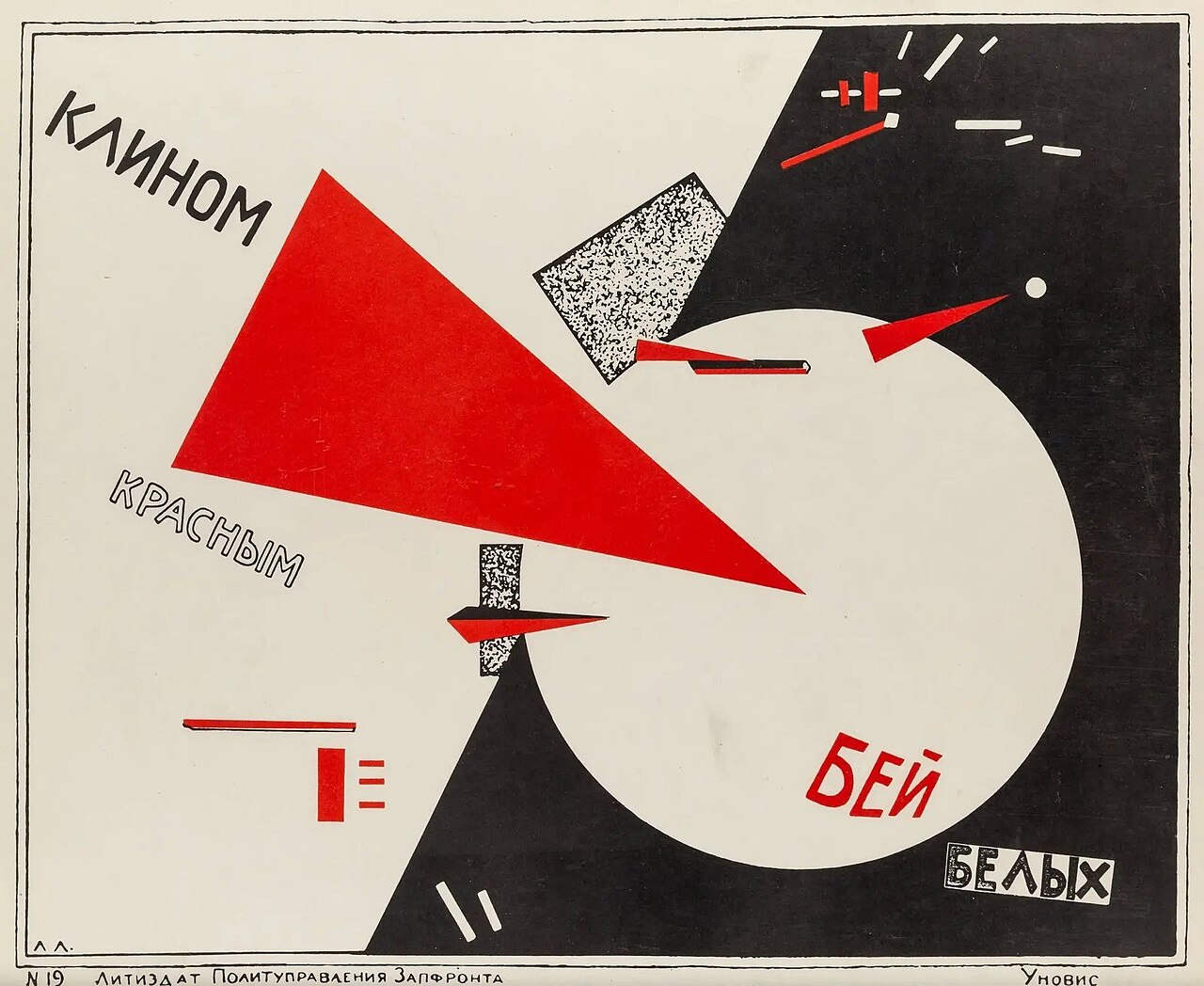
- Circles, diagonals and intersecting planes.
- Art with a purpose
- A rejection of art for its own sake in favour of useful work.
- Bold graphics
- Red and black, strong diagonals and photomontage.
- Construction
- Objects built up in space rather than carved or modelled.
Constructivist artists
Every artist below has a page on this site, with a short biography and what a valuation of their work turns on.
In Russia
- Vladimir TatlinRussian artist whose counter-reliefs and tower for the Third International founded Constructivism.
- Alexander RodchenkoRussian painter, designer and photographer, and a leading member of the Constructivists.
- El LissitzkyRussian artist and designer of the Proun works and of Beat the Whites with the Red Wedge.
- Liubov PopovaRussian painter and designer of the avant-garde, known for her Painterly Architectonics and textile designs.
- Naum GaboRussian-born sculptor of transparent constructions, author of the Realistic Manifesto, who worked in St Ives.
Those it reached
- Kazimir MalevichInvented Suprematism, painted the Black Square, and took painting to pure abstraction in 1915.
- Laszlo Moholy-NagyBauhaus master who made pictures without a camera and ordered a painting over the telephone.
- Ben NicholsonCarved white reliefs in the 1930s and spent fifty years arranging jugs, hills and rectangles.
- Barbara HepworthPut the hole through the middle of the sculpture, and made St Ives a centre of European modernism.
Famous Constructivist works
- Head No. 2Naum Gabo, 1916, enlarged 1964, Tate, London
- Beat the Whites with the Red WedgeEl Lissitzky, 1919
- Monument to the Third International (model)Vladimir Tatlin, 1919–20
- Pure Red Colour, Pure Yellow Colour, Pure Blue ColourAlexander Rodchenko, 1921
- Set for The Magnanimous CuckoldLiubov Popova, 1922
- Books! (poster)Alexander Rodchenko, 1924
What a valuation turns on
The Russian avant-garde has been more heavily faked than almost any other field of modern art, and many paintings on the market have no reliable history. A clear line of ownership from before the 1970s, independent technical analysis of pigments and support, and scholarly opinion are all needed before a painting can be valued. Works that have been in known Western collections since the 1920s carry the most confidence.
Posters, books and photographs are a more accessible part of the field, and each has its own questions: for posters, whether the sheet has been lined or restored; for photographs, whether a print was made in the artist's lifetime or later from the negative. Constructions in early plastics, particularly Gabo's, can yellow and crack, and need specialist assessment.
Common questions
What is Constructivism in art?
Constructivism was a Russian movement of the 1910s and 1920s that rejected traditional fine art in favour of constructions, graphic design and photography meant to serve society.
Who founded Constructivism?
Vladimir Tatlin's counter-reliefs of 1914 and 1915 are usually seen as the beginning. The First Working Group of Constructivists, with Rodchenko and Stepanova, took on the name in Moscow in 1921.
What is the difference between Constructivism and Suprematism?
Kazimir Malevich's Suprematism sought a pure spiritual abstraction. The Constructivists wanted art to be material and useful, and built it from real substances.
Why did Constructivism end?
Soviet policy turned against the avant-garde around 1932, and Socialist Realism became the required style. Its ideas lived on in the West, at the Bauhaus and beyond.
How do I sell a Russian avant-garde work or poster?
Send photographs of the front, any signature or marks, and the back for a free, confidential valuation, with any labels or documents. We check the work against the published record, look at condition, and compare a confidential private sale with auction.