
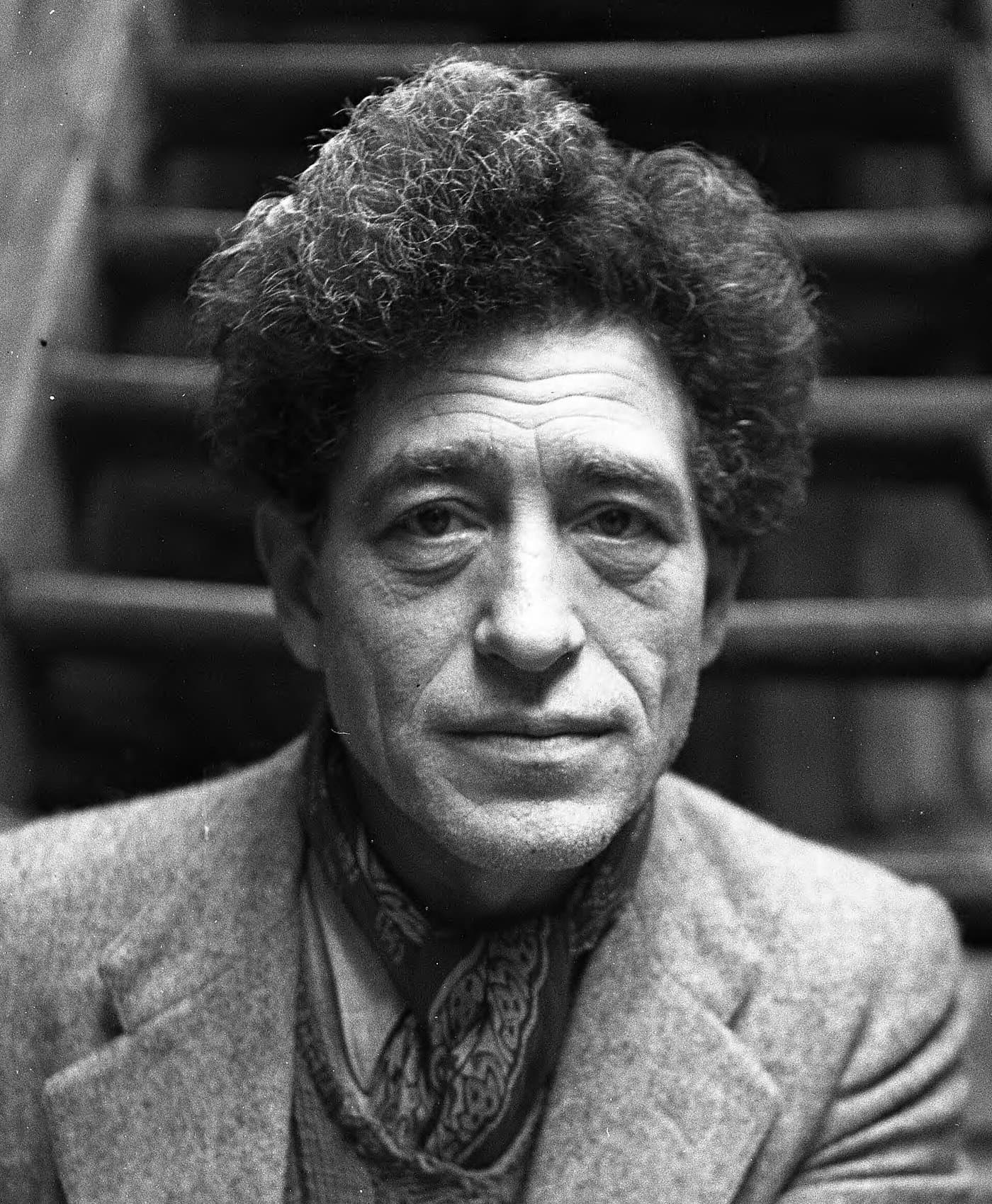
Alberto Giacometti valuation
Pared the human figure down until there was almost nothing left, and kept going.
Alberto Giacometti was born in the Swiss Val Bregaglia in 1901, son of the painter Giovanni, and came to Paris in 1922.
What a work by Alberto Giacometti is worth
Send photographs and whatever paperwork came with it. The first question is what the work actually is — edition or unique, when, and in what condition — because everything else follows from the answer. A valuation is free, made online from the photographs you send, and it commits you to nothing. We act for sellers across the United Kingdom, Europe and the United States.
Write to info@whitebankfineart.co.uk, or start below.
Bio
Alberto Giacometti was born in the Swiss Val Bregaglia in 1901, son of the painter Giovanni, and came to Paris in 1922. He made Surrealist objects through the early 1930s — The Palace at 4 a.m., Suspended Ball — and was expelled from the movement in 1935 for returning to work from a model. The war years in Geneva produced figures so small they fitted in matchboxes; afterwards, in the Rue Hippolyte-Maindron studio he occupied for forty years, they became the attenuated standing women and walking men that are the best-known sculptures of the century. He died in 1966.
This is a market defined by its authentication apparatus. The Fondation Giacometti in Paris maintains the Alberto Giacometti Database and the catalogue raisonne, and its opinion is decisive; the field has been troubled by one of the largest forgery operations ever prosecuted, involving hundreds of fake bronzes, and unregistered casts should be treated with great caution. Cast number, foundry, lifetime versus posthumous casting and patina all bear directly on value. The paintings and the dense grey drawings are a significant part of the output and are far less often faked.
At a glance
- Born
- 10 October 1901, Borgonovo
- Died
- 11 January 1966, Chur
- Movement
- Surrealism
More on Wikipedia.
The lithographs, and Paris sans fin
Giacometti made prints in woodcut, engraving, etching and aquatint, and above all in lithography from 1949. From 1951 the Galerie Maeght, his Paris dealer, published his lithographs separately. The largest project was Paris sans fin, 150 lithographs of the city, its streets and cafés and his own studio, drawn for the publisher Tériade from the late 1950s and published in 1969, three years after his death, in an edition of 270 copies.
Herbert Lust's catalogue of the prints, first published in 1970 and revised in 1991, is the usual reference and records about four hundred. Because Paris sans fin came out after his death, its lithographs do not carry his pencil signature, and single sheets from broken-up copies of the book are common. A signed and numbered impression of a separately published lithograph is a different object, and the catalogue number tells the two apart.
Bourdelle, the Chase Manhattan figures and Venice
Giacometti was the eldest of four children, and his brothers Diego and Bruno became an artist and an architect. After the École des Beaux-Arts in Geneva he went to Paris in 1922 to study under Antoine Bourdelle, and from 1926 he worked at 46 rue Hippolyte-Maindron, with Miró, Ernst, Picasso and Balthus among his circle. Between 1938 and 1944 none of his sculptures stood more than seven centimetres high.
In 1958 he was asked for a monumental sculpture for the plaza of the Chase Manhattan Bank building in New York. The project produced his largest figures, Grande femme debout I to IV, of 1960, but he was unhappy with their relation to the site and abandoned it. He won the grand prize for sculpture at the Venice Biennale in 1962, designed the tree for a Paris production of Waiting for Godot in 1961, and appeared with L'Homme qui marche I on the Swiss 100-franc note. Annette Giacometti began the listing of authenticated works that the Fondation, created in 2003, continues; it holds about 5,000 of them.
Best auction results
- L'Homme au doigt $141.3m
- Bronze, 1947 · New York · May 2015
- Publicly reported
- Including fees. The highest price for a sculpture at auction.
- L'Homme qui marche I £65m
- Bronze, 1960 · London · February 2010
- Publicly reported
- Grande tête mince $53.3m
- Bronze bust, 1955 · New York · May 2010
- Publicly reported
Results as reported at the time of sale, inclusive of buyer's premium. They are a record of what specific works achieved on specific days, not a guide to what any other work is worth.
Whitebank Fine Art is an art advisory and gallery, not an auction house, and is not affiliated with any auction house or with the artist, their estate or their representatives. This page describes the range we advise on. Nothing here is investment advice.