

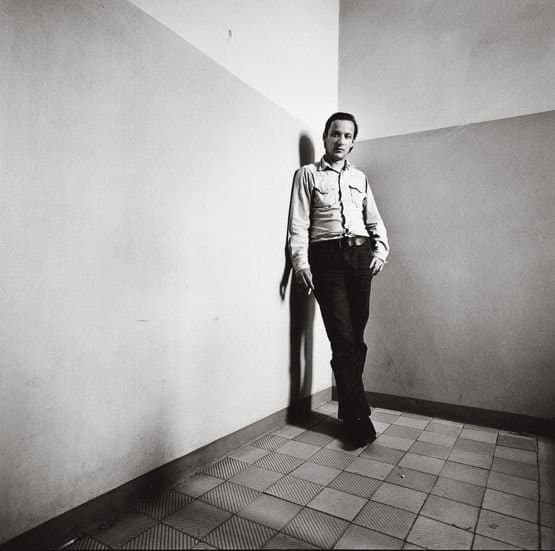
Blinky Palermo valuation
Took the name of an American boxing promoter, sewed pictures out of shop-bought cloth, and died at thirty-three.
Blinky Palermo was born Peter Schwarze in Leipzig in 1943 and raised as Peter Heisterkamp after adoption.
What a work by Blinky Palermo is worth
Send photographs and whatever paperwork came with it. The first question is what the work actually is — edition or unique, when, and in what condition — because everything else follows from the answer. A valuation is free, made online from the photographs you send, and it commits you to nothing. We act for sellers across the United Kingdom, Europe and the United States.
Write to info@whitebankfineart.co.uk, or start below.
Bio
Blinky Palermo was born Peter Schwarze in Leipzig in 1943 and raised as Peter Heisterkamp after adoption. At the Düsseldorf academy he studied under Joseph Beuys alongside Richter, Polke and Knoebel, and acquired from a fellow student the nickname of Frank ‘Blinky’ Palermo, an American boxing promoter he was said to resemble. The work is small in quantity and various in kind: the Stoffbilder, made by buying lengths of commercial fabric, cutting them into bands and sewing them together over a stretcher so that no colour is ever mixed or applied; painted objects; drawings; wall drawings and wall paintings made for one particular room; and finally the metal pictures, among them To the People of New York City. He died on holiday in the Maldives in 1977, aged thirty-three, of causes never satisfactorily established.
A career of little more than a decade means supply is finite and the paperwork usually deep, with provenance running back through a small circle of German galleries and collectors. The cloth pictures are the signature body and their weakness is plain: dyed commercial fabric fades in light and stains permanently, and neither can be put right afterwards. Works on paper, prints and multiples make up the accessible end. The wall works cannot be owned as objects at all — what changes hands is the certificate and the instruction for making them.
At a glance
- Born
- 2 June 1943, Leipzig
- Died
- 18 February 1977, Vihamanaafushi
- Movement
- Abstract art
More on Wikipedia.
Goller, the studio in Mönchengladbach and New York
Palermo studied with Bruno Goller and Joseph Beuys at the Kunstakademie in Düsseldorf and took the name in 1964. Between late 1966 and 1972 he made about 65 Stoffbilder. In 1969 he shared a studio in Mönchengladbach with Imi Knoebel and Ulrich Rückriem, and in 1970 he and Gerhard Richter submitted designs for the sports buildings of the Munich Olympics.
From 1968 he made more than 20 murals and wall drawings for particular places, including Edinburgh and Brussels, recorded in sketches and photographs. He moved to New York in December 1973. His first solo show was at Galerie Friedrich & Dahlem in Munich in 1966, and he took part in documenta in 1972 and 1977 and the Venice Biennale in 1976. His twin brother, Michael Heisterkamp, is his sole heir and holds the copyright.
Totems, tape and the Metallbilder
Palermo looked to Malevich, Barnett Newman and Ellsworth Kelly. In the mid-1960s he left the rectangular canvas for circles, triangles, crosses and tall strips: Untitled (Totem) of 1964 is a seven-foot length of wood painted orange and crossed by five short canvas-wrapped bars. He painted on aluminium, steel, wood, paper and Formica, often making lines with tape instead of paint. For the Stoffbilder he took fabric from department stores and had others do the stitching. The 1970 Olympic proposal with Richter set windows in 27 colours, each used fifty times in a random order.
The Metallbilder of 1972 follow a fixed formula: usually four panels set well apart, each carrying one main colour with bands of another at top and bottom. To the People of New York City, made in Düsseldorf after New York, runs to 15 parts and 39 aluminium panels in cadmium red, cadmium yellow and black, and Dia showed it in 1987. Dia and Bard College gave him his first American retrospective in 2010, which travelled to LACMA and the Hirshhorn.
Best auction results
- Rot/Gelb $4.5m
- Fabric painting, 1968 · New York · May 2017
- Publicly reported
- His auction record until 2023.
Results as reported at the time of sale, inclusive of buyer's premium. They are a record of what specific works achieved on specific days, not a guide to what any other work is worth.
Whitebank Fine Art is an art advisory and gallery, not an auction house, and is not affiliated with any auction house or with the artist, their estate or their representatives. This page describes the range we advise on. Nothing here is investment advice.
