

Eduardo Paolozzi valuation
Made the first Pop collage in 1947, then spent decades welding machines that look like men.
Eduardo Paolozzi was born in Leith in 1924 to Italian parents, was interned as an enemy alien at sixteen while his father, grandfather and uncle drowned when the ship deporting them was torpedoed.
What a work by Eduardo Paolozzi is worth
Send photographs and whatever paperwork came with it. The first question is what the work actually is — edition or unique, when, and in what condition — because everything else follows from the answer. A valuation is free, made online from the photographs you send, and it commits you to nothing. We act for sellers across the United Kingdom, Europe and the United States.
Write to info@whitebankfineart.co.uk, or start below.
Bio
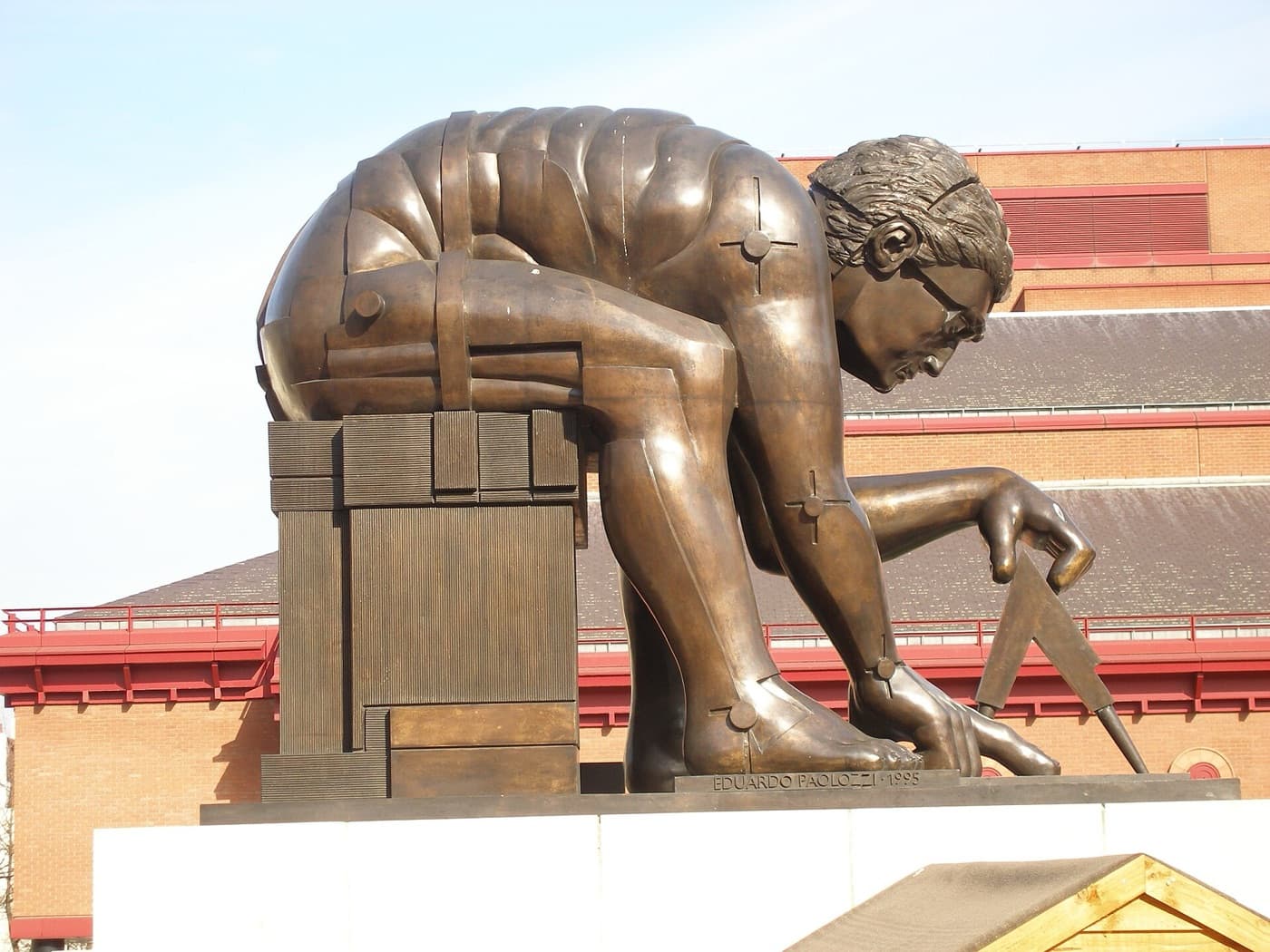
Eduardo Paolozzi was born in Leith in 1924 to Italian parents, was interned as an enemy alien at sixteen while his father, grandfather and uncle drowned when the ship deporting them was torpedoed. He studied at the Slade, and in 1952 showed the Independent Group a collage scrapbook made from American magazines — including I was a Rich Man's Plaything of 1947, with the word POP coming out of a gun, generally taken as the first Pop image. The sculpture that followed cast machine parts into figures; the later work includes the Tottenham Court Road mosaics and the Newton outside the British Library. He died in 2005.
The bronzes are editioned and require identification by cast number and foundry; the early 1950s and 1960s figures are the most sought. Paolozzi was also an outstanding and extremely prolific printmaker, and the screenprint portfolios of the 1960s — As Is When, Universal Electronic Vacuum, Moonstrips Empire News — are major works, valued as complete portfolios well above loose sheets. Collages are unique and are the historically important part of the output. Prints are colour-critical and fade.
At a glance
- Born
- 7 March 1924, Leith
- Died
- 22 April 2005, London
- Movements
- Pop art, Contemporary art
More on Wikipedia.
Bunk!, the mosaics and the print catalogue
The Bunk! collages of the late 1940s and early 1950s were reissued in 1972 as a portfolio of forty-five screenprints and lithographs, some with collage, printed by Advanced Graphics and published by Snail Chemicals in London. Most copies are unsigned, and single sheets are often sold separately; they are prints after the collages, a different thing from the collages themselves.
Rosemary Miles's The Complete Prints of Eduardo Paolozzi, published by the Victoria and Albert Museum in 1977, covers the prints to that date, and Miles numbers are used to identify them. The Tottenham Court Road mosaics, commissioned in 1979, were restored during the station's rebuilding, and the sections removed in the works were given to the University of Edinburgh in 2015.
Hammer Prints, Editions Alecto and Red Rose Speedway
Paolozzi's parents came from Viticuso in Lazio and ran an ice-cream shop in Leith, and he spent his childhood summers with his grandparents near Monte Cassino. After Edinburgh College of Art, a spell at Saint Martin's and the Slade, he lived in Paris from 1947 to 1949 and came to know Giacometti, Arp, Brâncuși, Braque and Léger. Back in England he and Nigel Henderson set up Hammer Prints, making wallpapers, textiles and ceramics, and in 1956 he played a deaf-mute in Lorenza Mazzetti's Free Cinema film Together.
The 1960s portfolios came out in fixed editions: As Is When, twelve screenprints on Wittgenstein, in an edition of 65 from Editions Alecto in 1965; Moonstrips Empire News, a hundred prints in an acrylic box, eight of them signed, in an edition of 500 in 1967; Universal Electronic Vacuum, ten prints he published himself in an edition of 75 the same year; and General Dynamic F.U.N., fifty sheets boxed in five versions, in an edition of 350 in 1970. Several of the man-machine images come from the popular science books of Fritz Kahn. He designed the sleeve of Paul McCartney's Red Rose Speedway in 1973, was knighted in 1989, and in 1994 gave the Scottish National Gallery of Modern Art a large body of work and the contents of his studio, which the Dean Gallery recreated from 1999.
Whitebank Fine Art is an art advisory and gallery, not an auction house, and is not affiliated with any auction house or with the artist, their estate or their representatives. This page describes the range we advise on. Nothing here is investment advice.
