

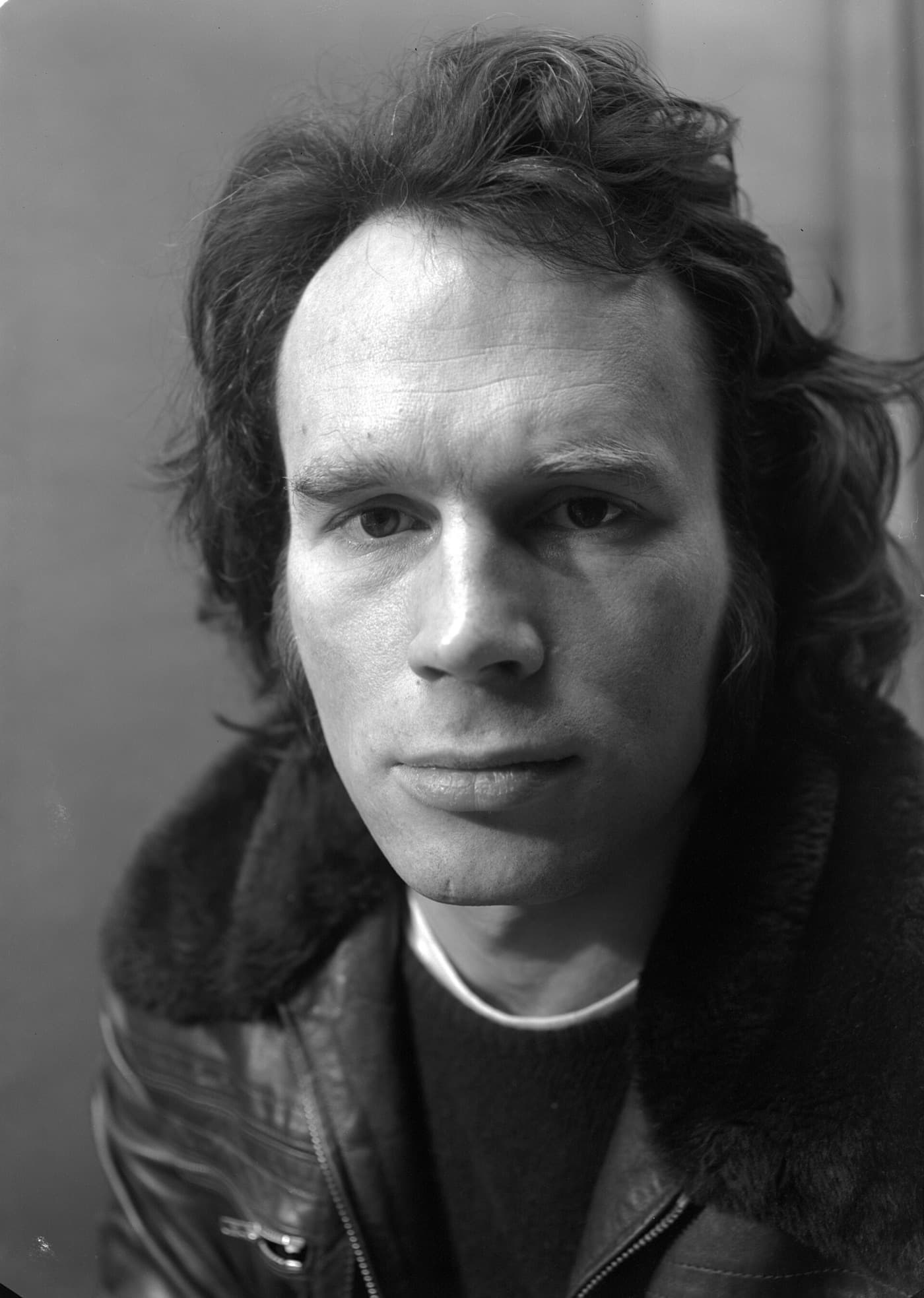
Brice Marden valuation
Went from waxy monochrome panels to calligraphic ribbons of line, slowly, over fifty years.
Brice Marden was born at Bronxville in New York in 1938 and trained at Boston University and Yale.
What a work by Brice Marden is worth
Send photographs and whatever paperwork came with it. The first question is what the work actually is — edition or unique, when, and in what condition — because everything else follows from the answer. A valuation is free, made online from the photographs you send, and it commits you to nothing. We act for sellers across the United Kingdom, Europe and the United States.
Write to info@whitebankfineart.co.uk, or start below.
Bio
Brice Marden was born at Bronxville in New York in 1938 and trained at Boston University and Yale. The work of the 1960s and 1970s is monochrome: single rectangular panels, and later panels joined in twos and threes, painted in oil mixed with beeswax and worked with a knife to a matte, dense, slightly waxy surface in muted greys, greens and flesh tones. From the mid-1980s, after seeing Chinese calligraphy and travelling in Asia, the practice changed entirely into looping ribbons of line drawn with long-handled brushes over stained grounds, the Cold Mountain paintings among them. He died in 2023.
The two phases are entirely different objects and are the first thing a valuation distinguishes. The wax-and-oil monochromes are the technical problem: the surface is soft, holds fingerprints, marks with contact, blooms in heat, and cannot be cleaned or retouched invisibly, so condition reports on these need to be read closely. The later paintings are oil on linen and behave conventionally. There is a substantial print output — etchings and lithographs in editions — and a large body of drawings in ink and graphite. Signature and date are usually on the reverse.
At a glance
- Born
- 15 October 1938, Bronxville
- Died
- 9 August 2023, Tivoli
- Movement
- Minimalism
More on Wikipedia.
Bykert, Hydra and the Basel windows
Marden was Robert Rauschenberg's assistant in 1966, the year of his first solo show at the Bykert Gallery in New York, which included the first of the oil-and-beeswax paintings. From 1971 he and his wife Helen went every year to the Greek island of Hydra, where between 1981 and 1987 he made 31 paintings on marble. From 1978 to 1985 he worked on designs for windows for the apse of Basel Minster.
His first museum exhibition was a retrospective at the Guggenheim in New York in 1975. He died in August 2023, aged 84. For a painting, the title, the date and a provenance that goes back to his galleries are what identify it; for a print, the edition and the publisher's documentation.
Yale, the Jewish Museum and Cold Mountain
Marden took his BFA at Boston University in 1961 and his MFA at Yale in 1963, taught by Esteban Vicente, Alex Katz, Jack Tworkov and Philip Pearlstein, with Richard Serra, Chuck Close, Vija Celmins and Nancy Graves among his fellow students. He was a guard at the Jewish Museum in New York during its Jasper Johns retrospective of 1964, and that winter made his first single-panel monochrome. At Chiron Press, where he worked as an assistant, he made the lithograph Gulf for the New York 10-69 portfolio.
A journey through Thailand, Sri Lanka and India in 1983 and the exhibition Masters of Japanese Calligraphy, 8th to 19th Century, in 1984 led to the Shell Drawings of 1985 to 1987 and then to the Cold Mountain paintings of 1989 to 1991, named after the eighth-century Chinese hermit poet Han Shan. At nine by twelve feet they were the largest he had made. The Propitious Garden of Plane Image, begun in 2000, reaches 24 feet in its longest panels. He showed with Matthew Marks Gallery for more than twenty years, and with Gagosian from 2017.
Best auction results
- Complements $30.9m
- Diptych, 2004 to 2007 · New York · 10 July 2020
- Publicly reported
- One of three diptychs in the series The Propitious Garden of Plane Image.
Results as reported at the time of sale, inclusive of buyer's premium. They are a record of what specific works achieved on specific days, not a guide to what any other work is worth.
Whitebank Fine Art is an art advisory and gallery, not an auction house, and is not affiliated with any auction house or with the artist, their estate or their representatives. This page describes the range we advise on. Nothing here is investment advice.
