

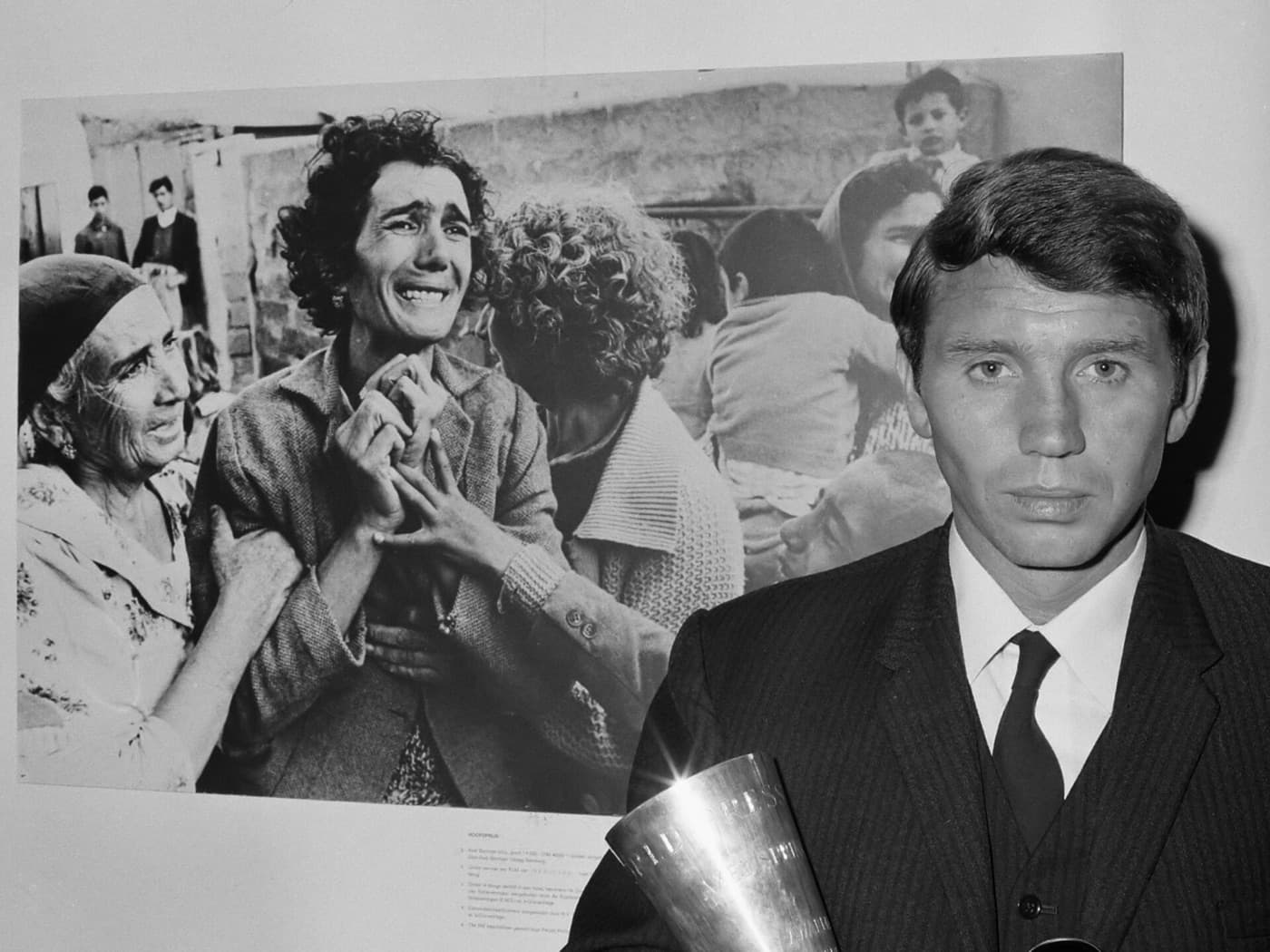
Don McCullin valuation
Photographed Vietnam, Biafra and Cyprus, and then went home to photograph the Somerset winter.
Don McCullin was born in Finsbury Park in 1935 and left school at fifteen with nothing; a photograph of a local gang, taken with a camera bought while doing National Service, was published by the Observer in 1959 and started the career.
What a work by Don McCullin is worth
Send photographs and whatever paperwork came with it. The first question is what the work actually is — edition or unique, when, and in what condition — because everything else follows from the answer. A valuation is free, made online from the photographs you send, and it commits you to nothing. We act for sellers across the United Kingdom, Europe and the United States.
Write to info@whitebankfineart.co.uk, or start below.
Bio
Don McCullin was born in Finsbury Park in 1935 and left school at fifteen with nothing; a photograph of a local gang, taken with a camera bought while doing National Service, was published by the Observer in 1959 and started the career. Over the following twenty years he covered Cyprus, the Congo, Biafra, Vietnam, Cambodia, Northern Ireland and Beirut, largely for the Sunday Times Magazine, and the shell-shocked marine and the starving Biafran mother are among the defining photographs of the period. Denied accreditation for the Falklands, he turned to English landscape, still life and the Somerset Levels in winter. He was knighted in 2017.
McCullin prints his own work in his own darkroom and has done so throughout, which is unusual and central to the value: a print made by him is the object collected, and the printing is deliberately dark and heavy. Print date matters as much as negative date, and later prints of famous images are common and are not vintage. Editions vary between images and some early prints were not editioned at all. Signature is normally in pencil on the verso or the mount, and gallery documentation is the usual reference.
His own prints and other prints
Because McCullin prints his own photographs, the first question with any print is whether he made it. Prints signed by him and made in his darkroom, whether recent or decades old, are the collected object. Prints that passed through newspaper and agency archives sometimes surface with press stamps on the back; they were made for reproduction, often by someone else, and are valued as press prints rather than as his.
His books are the other common category, from the early titles of the 1970s to the autobiography Unreasonable Behaviour, and signed copies are collected. Posters for his exhibitions, including the large retrospectives at Tate Britain and elsewhere, are reproductions and should not be confused with a photographic print however they are framed.
The Guvnors, Blowup and the Mad Day Out
McCullin was born in St Pancras and spent part of the war evacuated to a farm in Somerset. He won a scholarship to the Hammersmith School of Arts and Crafts but left school at fifteen for a catering job on the railways. Called up to the RAF in 1953, he was posted to the Suez Canal as a photographer's assistant, failed the written paper to become an RAF photographer and spent his service in the darkroom; he bought his first camera, a Rolleicord, for £30 in Nairobi. The Observer published his 1958 picture of The Guvnors, a local gang posed in a bombed-out building.
He took the photographs of Maryon Park used in Antonioni's Blowup in 1966, and on 28 July 1968 spent the day photographing the Beatles around London, the session known as the Mad Day Out, which gave the gatefold picture on their Red and Blue compilations. The same year his Nikon F stopped a bullet meant for him. His books include The Palestinians, with Jonathan Dimbleby, in 1980, and Shaped by War, published with his 2010 retrospective at the Imperial War Museum North. Photo London named him its Master of Photography for 2016, and he has said Alfred Stieglitz was a key influence.
Whitebank Fine Art is an art advisory and gallery, not an auction house, and is not affiliated with any auction house or with the artist, their estate or their representatives. This page describes the range we advise on. Nothing here is investment advice.
