Edmund de Waal valuation
British artist and potter of porcelain installations in vitrines, and author of The Hare with Amber Eyes.
Edmund de Waal was born in Nottingham in 1964.
What a work by Edmund de Waal is worth
Send photographs and whatever paperwork came with it. The first question is what the work actually is — edition or unique, when, and in what condition — because everything else follows from the answer. A valuation is free, made online from the photographs you send, and it commits you to nothing. We act for sellers across the United Kingdom, Europe and the United States.
Write to info@whitebankfineart.co.uk, or start below.
Bio
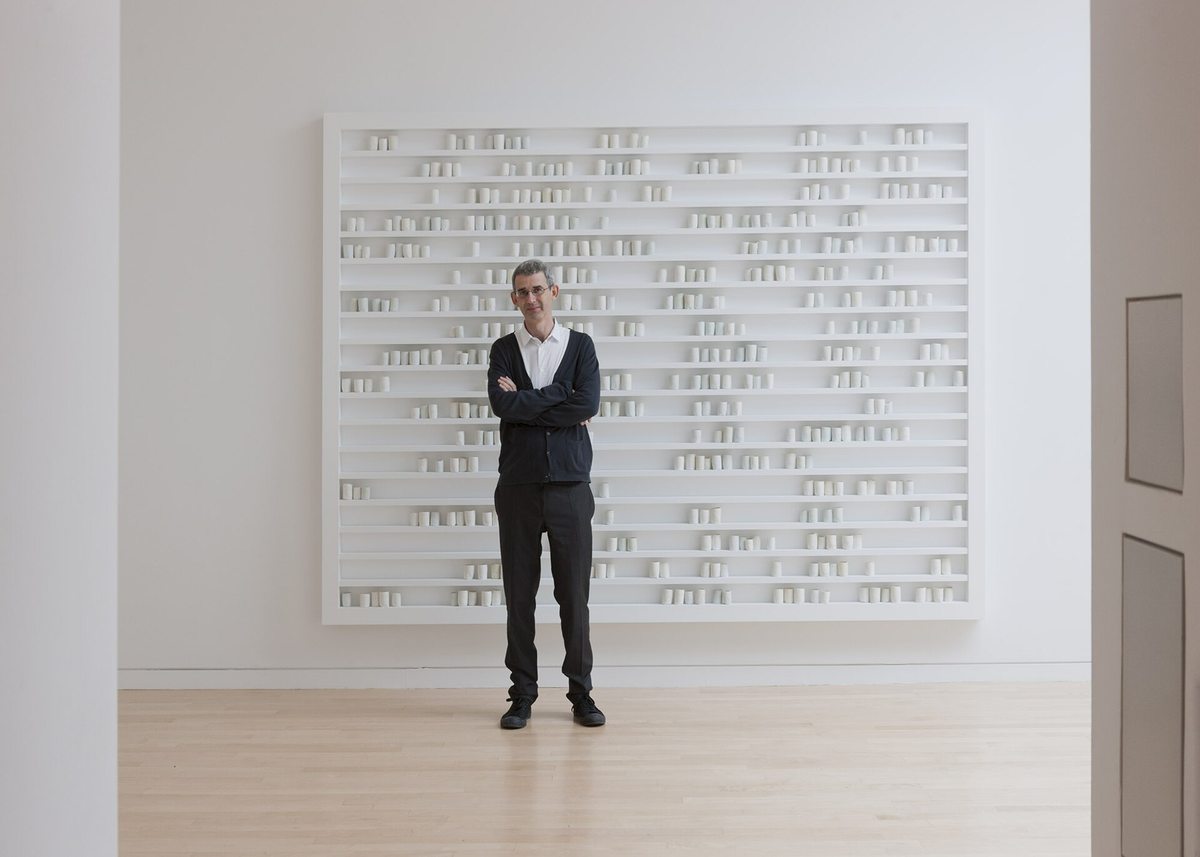
Edmund de Waal was born in Nottingham in 1964. His interest in ceramics began at the age of five, when his father took an evening class at the Lincoln School of Art, and it has remained at the centre of his work. Since 2000 he has moved away from single vessels for domestic use towards groups of vessels and objects, and then to wall-mounted and freestanding vitrines filled with thrown porcelain, often made in response to collections, archives or the history of a particular place. He is also a writer: The Hare with Amber Eyes, a history of his family, the Ephrussi, won the Costa Book Award for Biography and the Ondaatje Prize in 2011, and The White Road, on the history of porcelain, followed in 2015. He lives and works in London.
His works are mostly groups of vessels in a vitrine or on a shelf and are sold as a whole, so every piece should be present and the vitrine undamaged. Porcelain chips and cracks easily, and any restoration should be declared; a gallery invoice and the date of the work should go with it.
At a glance
- Born
- 1964, Nottingham
The Hare with Amber Eyes
The Hare with Amber Eyes, published in 2010, tells the story of de Waal's family, the Ephrussi, a Jewish banking dynasty centred on Odessa, Vienna and Paris, through a collection of 264 Japanese netsuke, the miniature ivory and wood sculptures used as toggles on kimonos. Charles Ephrussi bought them in Paris in the 1870s. When the Nazis confiscated the family's property in 1938, Anna, a maid at the Palais Ephrussi in Vienna, hid the netsuke in a mattress. They came down through the family to de Waal from his great-uncle Ignace Ephrussi.
The book won the Costa Book Award for Biography, the Ondaatje Prize and, in 2015, the Windham-Campbell Prize for non-fiction. In 2021 it was given away in Vienna as a free book, in a print run of 100,000, and the Jewish Museum in New York held an exhibition on it in 2021 and 2022. The White Road, his history of porcelain, followed in 2015.
Edmund de Waal ceramics and porcelain
De Waal was taught pottery at school in Canterbury by Geoffrey Whiting, a student of Bernard Leach, and at 17 began a two-year apprenticeship with him, making hundreds of earthenware and stoneware pots. After reading English at Cambridge he set up a pottery in Herefordshire making functional stoneware in the Leach tradition. In 1988 he moved to Sheffield and began working in porcelain, and a scholarship then took him to Japan, where he studied at the Mejiro ceramics studio and researched his 1998 monograph on Leach.
He settled in London in 1993 and began making porcelain vessels in a celadon glaze, with pinched and pushed-in sides, first shown at Egg in London in 1995. Since 2000 he has moved to groups of vessels and then to vitrines, later adding metals, gilding, porcelain shards and sheets of porcelain embossed with handwriting. Early Edmund de Waal pottery, the domestic stoneware and small porcelain jars, is a very different object from a wall-mounted vitrine, so the date and form of a piece are the first things to establish.
Edmund de Waal installations and exhibitions
His New York exhibition Atemwende, at Gagosian in 2013, took its title from a poetry collection by Paul Celan and was followed by the BBC's Imagine. He has made major installations for Chatsworth, Kettle's Yard, Tate Britain, the Fitzwilliam Museum, Southwark Cathedral, the Victoria and Albert Museum and the Kunsthistorisches Museum in Vienna, and A Local History (2012) places three vitrines beneath the pavement at the University of Cambridge.
In 2015 he curated White in the Royal Academy's library and print room, and in 2016 he curated Kneaded Knowledge with Ai Weiwei. Later projects include Elective Affinities at the Frick Collection in 2019, psalm in Venice in 2019, Library of Exile at the British Museum in 2020 and This Living Hand at Henry Moore Studios & Gardens in 2021. He also designed Wayne McGregor's ballet Yugen for the Royal Ballet.
Whitebank Fine Art is an art advisory and gallery, not an auction house, and is not affiliated with any auction house or with the artist, their estate or their representatives. This page describes the range we advise on. Nothing here is investment advice.