

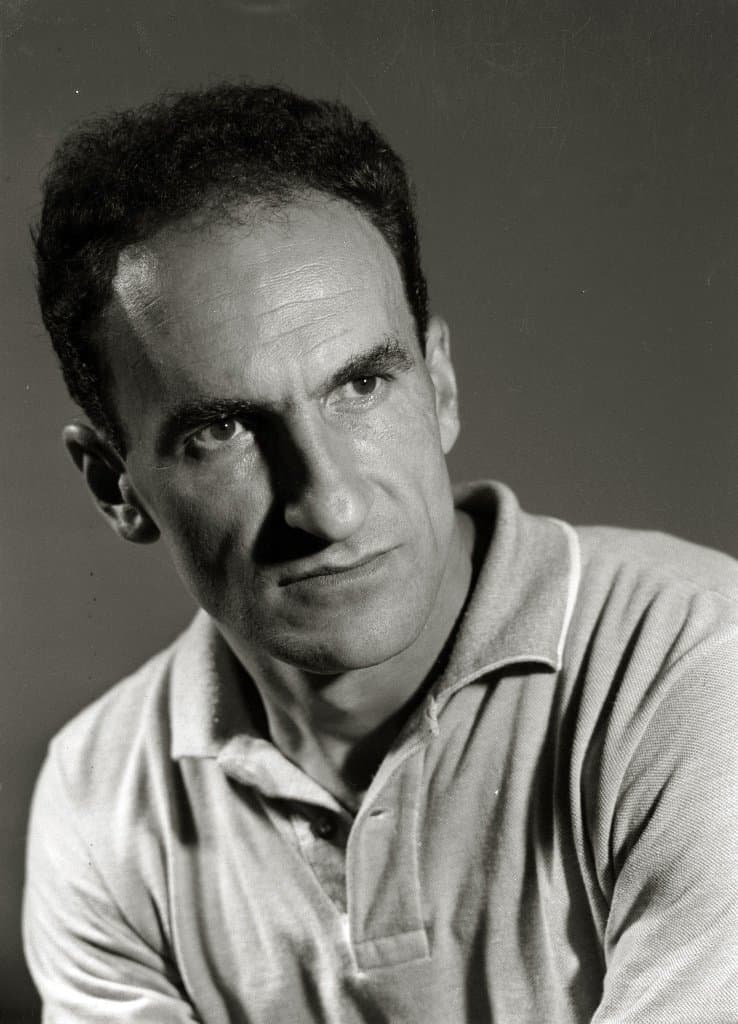
Eduardo Chillida valuation
Basque sculptor of forged iron and carved stone, working on the space rather than the mass.
Eduardo Chillida was born in San Sebastian in 1924 and kept goal for Real Sociedad before a knee injury ended it and architecture, then sculpture, took over.
What a work by Eduardo Chillida is worth
Send photographs and whatever paperwork came with it. The first question is what the work actually is — edition or unique, when, and in what condition — because everything else follows from the answer. A valuation is free, made online from the photographs you send, and it commits you to nothing. We act for sellers across the United Kingdom, Europe and the United States.
Write to info@whitebankfineart.co.uk, or start below.
Bio
Eduardo Chillida was born in San Sebastian in 1924 and kept goal for Real Sociedad before a knee injury ended it and architecture, then sculpture, took over. He worked with a village blacksmith on his return from Paris in 1951 and forged iron became the central material, joined later by steel, granite, alabaster and fired clay. The recurring subject is not the mass but what the mass encloses: arms of metal reaching around a void, the comb forms of the Peine del Viento anchored into the rocks at San Sebastian, the great excavated chamber inside Tindaya. He also made a very large body of works on paper. He died in 2002.
The forged and cast works exist both as unique pieces and as numbered editions, and the two are not distinguishable without the documentation, which makes establishing which you have the first step rather than a formality. Surface is the other issue: the iron and steel are meant to oxidise in a controlled way, and cleaning or lacquering a patina is not reversible. The gravitaciones — cut and layered paper suspended in space — and the etchings and lithographs are numerous. Museo Chillida Leku holds the archive.
At a glance
- Born
- 10 January 1924, San Sebastián
- Died
- 19 August 2002, San Sebastián
- Movement
- Abstract art
More on Wikipedia.
Arantzazu, the Comb of the Wind and Chillida Leku
Chillida's first solo exhibition was at the Clan Gallery in Madrid in 1954, the year he made the four doors for the basilica at Arantzazu, and he showed at the Venice Biennale in 1958, 1988 and 1990. The Comb of the Wind, made with the architect Luis Peña Ganchegui, is fixed to the rocks at the end of La Concha bay in San Sebastián, and other public works stand in Barcelona, Berlin, Paris, Frankfurt and outside the Meyerson Symphony Center in Dallas.
In the early 1980s he and his wife bought a sixteenth-century farmhouse at Hernani, near San Sebastián, which became Chillida Leku, an open-air museum of his sculpture. It closed in 2011 and reopened in 2019 with the backing of Hauser & Wirth. He received the Praemium Imperiale for sculpture in 1991.
The Hotel Biarritz, Paris and Anvil of Dreams
Chillida's mother was the soprano Carmen Juantegui, and he grew up near the Hotel Biarritz in San Sebastián, which his grandparents owned. The knee injury needed five operations. He studied architecture at the University of Madrid from 1943 to 1946, gave it up for art in 1947, and the next year moved to Paris, where he set up his first studio, worked in plaster and clay and studied archaic figures in the Louvre. He married Pilar Belzunce in 1950 and lived for a time at Villaines-sous-Bois, outside Paris, before going back to the Basque Country, where he soon set up a forge in his own studio.
From 1954 to 1966 he worked on the series Anvil of Dreams, in which metal forms rise from a wooden base, the first time he used wood, and he began carving alabaster in 1965. In the early 1960s he met the philosopher Martin Heidegger, and they found they were working with space in the same way. He called himself a realist sculptor and disliked the label abstract. De Musica, the Dallas piece, is two pillars whose branches reach out without touching, and another of his sculptures is inside the World Bank headquarters in Washington. Tasende Gallery represented him in the United States from the mid-1980s, and Hauser & Wirth has represented the estate since 2018.
Whitebank Fine Art is an art advisory and gallery, not an auction house, and is not affiliated with any auction house or with the artist, their estate or their representatives. This page describes the range we advise on. Nothing here is investment advice.
