
Henri Cartier-Bresson valuation
Trained as a painter, carried a Leica for forty years, and gave photography the idea of the decisive moment.
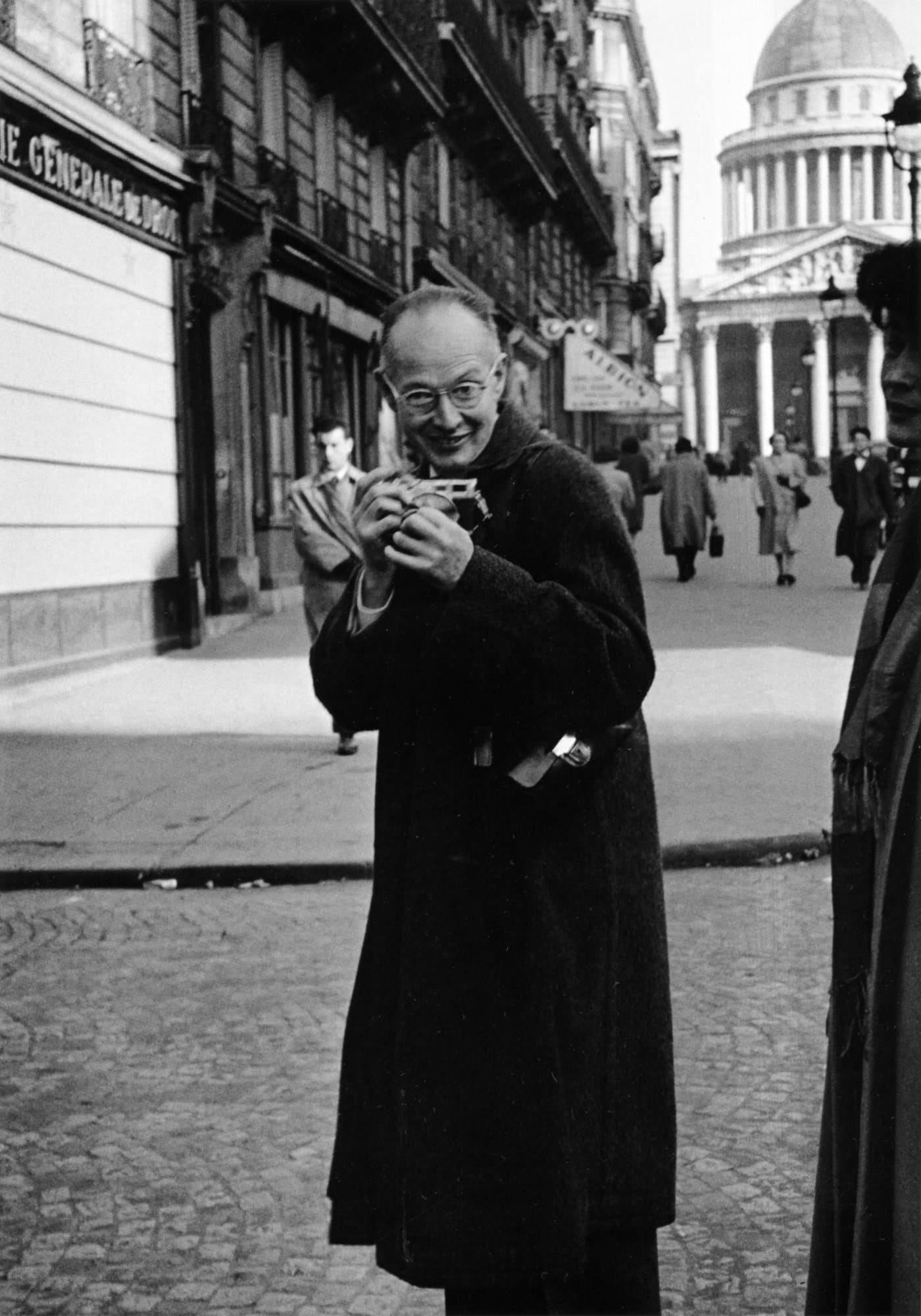
Henri Cartier-Bresson was born at Chanteloup-en-Brie in 1908 into a family of textile manufacturers, studied painting under Andre Lhote, and took up the Leica in 1932.
What a work by Henri Cartier-Bresson is worth
Send photographs and whatever paperwork came with it. The first question is what the work actually is — edition or unique, when, and in what condition — because everything else follows from the answer. A valuation is free, made online from the photographs you send, and it commits you to nothing. We act for sellers across the United Kingdom, Europe and the United States.
Write to info@whitebankfineart.co.uk, or start below.
Bio
Henri Cartier-Bresson was born at Chanteloup-en-Brie in 1908 into a family of textile manufacturers, studied painting under Andre Lhote, and took up the Leica in 1932. Taken prisoner in 1940, he escaped on his third attempt in 1943. In 1947 he co-founded the Magnum agency with Robert Capa, George Rodger and David Seymour, and spent the next quarter-century on assignment — the funeral of Gandhi, the last days of the Kuomintang in China, the Soviet Union after Stalin. His 1952 book Images a la Sauvette, published in English as The Decisive Moment with a cover by Matisse, gave his approach its name. He turned back to drawing in the 1970s and died in 2004.
He did not print his own negatives, so the questions are when a print was made and for what purpose. Prints made at the time for magazines, agencies and exhibitions, often with agency or photographer's stamps on the verso, are the scarce category. Far more common are the later exhibition prints of the 1970s to the 1990s, many of them signed in ink, and a later print and a vintage print from the same negative are different objects. He insisted on printing the full negative uncropped, often with a thin black border, and a cropped print raises questions. The Fondation Henri Cartier-Bresson in Paris, which he set up with Martine Franck and which opened in 2003, holds the archive.
At a glance
- Born
- 22 August 1908, Chanteloup-en-Brie
- Died
- 3 August 2004, Montjustin
- Movement
- Humanistic Photography
More on Wikipedia.
Africa, the Julien Levy Gallery and Jean Renoir
After a spell in the Ivory Coast in 1930 and 1931, Cartier-Bresson bought in Marseille the Leica with a 50mm lens that he used for years. In 1935 he went to New York to exhibit at the Julien Levy Gallery with Walker Evans and Manuel Álvarez Bravo. Back in France he worked for Jean Renoir, acting in Partie de campagne in 1936 and serving as second assistant on La Règle du jeu in 1939.
At the end of the war he made Le Retour, a documentary about returning prisoners and displaced people, which led to a retrospective at the Museum of Modern Art in 1947 that then toured the United States. He married the Javanese dancer Ratna Mohini in 1937, and after their divorce married the Magnum photographer Martine Franck in 1970.
Munkácsi, the coronation and the drawings
Cartier-Bresson said a 1930 photograph by Martin Munkácsi, of three boys running into the surf of Lake Tanganyika, made him give up painting for photography. He painted the shiny parts of his Leica black, never used flash, and composed in the viewfinder instead of the darkroom. His first published photojournalism, for the French weekly Regards in 1937, covered the coronation of George VI and showed the crowds in the London streets without a single picture of the king, credited simply to Cartier. From 1937 to 1939 he worked for the evening paper Ce soir.
He photographed Marilyn Monroe, Clark Gable and Montgomery Clift at the Mapes Hotel in Reno during the press preview of The Misfits, and spent about twenty days in Sardinia for Vogue in 1962. In 1966 he stepped down as a principal of Magnum, which still distributes his pictures, and in 1975 he held his first exhibition of drawings, at the Carlton Gallery in New York. The Fondation moved from Montparnasse to the Marais in 2018.
Whitebank Fine Art is an art advisory and gallery, not an auction house, and is not affiliated with any auction house or with the artist, their estate or their representatives. This page describes the range we advise on. Nothing here is investment advice.