
M. C. Escher valuation
Staircases that return to their own beginning, drawn with a printmaker's patience rather than a mathematician's.
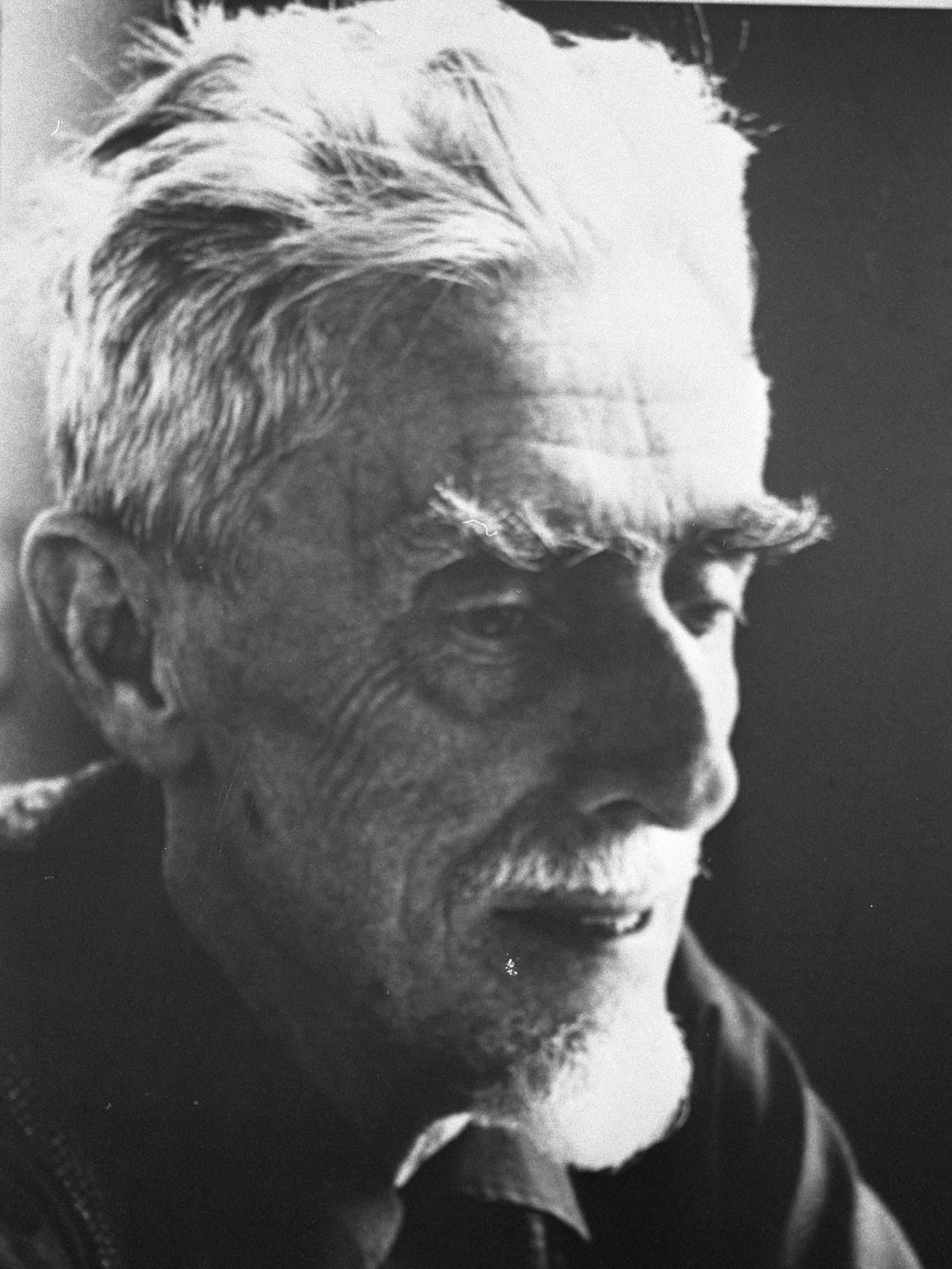
Maurits Cornelis Escher was born at Leeuwarden in 1898, trained in graphic art at Haarlem, and spent formative years in Italy drawing landscape and architecture before political conditions drove him north in 1935.
What a work by M. C. Escher is worth
Send photographs and whatever paperwork came with it. The first question is what the work actually is — edition or unique, when, and in what condition — because everything else follows from the answer. A valuation is free, made online from the photographs you send, and it commits you to nothing. We act for sellers across the United Kingdom, Europe and the United States.
Write to info@whitebankfineart.co.uk, or start below.
Bio
Maurits Cornelis Escher was born at Leeuwarden in 1898, trained in graphic art at Haarlem, and spent formative years in Italy drawing landscape and architecture before political conditions drove him north in 1935. A second visit to the Alhambra in 1936 and its tiled walls set him on the work he is known for: regular divisions of the plane in which fish become birds, and the impossible constructions — Relativity, Ascending and Descending, Waterfall, Drawing Hands. He had no mathematical training and always said so, corresponding with Penrose and Coxeter as an interested amateur. He died in 1972.
This is entirely a print market, and technique is the first thing to establish: Escher worked in woodcut, wood engraving, lithography and mezzotint, and the mezzotints in particular are scarce. Most of his prints are not numbered in the modern sense, so identification depends on the Bool catalogue number, the signature and inscription in pencil, and the paper. Posthumous restrikes and a great many photomechanical reproductions circulate and are frequently offered as originals. Condition is decisive — foxing, light-staining and trimmed margins are common in sheets that have hung for decades.
Mesquita, Rome and Baarn
Escher learned drawing and woodcut at the Haarlem School of Architecture and Decorative Arts from 1919 to 1922, where his teacher was Samuel Jessurun de Mesquita. He lived in Rome from 1923 to 1935, married Jetta Umiker in 1924, and travelled through the Abruzzi, Calabria, Corsica, Sicily and the Amalfi coast; the landscapes and townscapes of those journeys are the prints of his Italian years.
After Rome he lived in Switzerland and then at Uccle, near Brussels, and from 1941 at Baarn in the Netherlands. His last print, Snakes, a woodcut printed from three blocks, was finished in July 1969. His work became widely known after Martin Gardner wrote about it in Scientific American in 1966, and he died in March 1972.
The Alhambra sketches, the stamps and the collections
Escher's first visit to the Alhambra came in 1922, on a journey that took him from Florence, Siena and Ravello to Madrid, Toledo and Granada. On the second, in 1936, he spent days at a time drawing its tile patterns, and it was his last long study trip: after 1937 he worked from the studio. His watercolour Study of Regular Division of the Plane with Reptiles, of 1939, became the lithograph Reptiles of 1943, and in 1958 he set out his method in the book Regular Division of the Plane. He kept prints by Piranesi on his studio walls.
He designed Dutch postage stamps in 1935 and 1949, was made a Knight of the Order of Orange-Nassau in 1955, and in 1970 moved to the Rosa Spier Huis, an artists' home in Laren. He was seventy before he had a retrospective, and Britain's first major Escher exhibition opened only in 2015, at the Scottish National Gallery of Modern Art, before moving to Dulwich Picture Gallery. The main collections of his originals are at the Escher Museum in The Hague, part of the Kunstmuseum there, and at the National Gallery of Art in Washington and the National Gallery of Canada. The M.C. Escher Company controls the copyright.
Whitebank Fine Art is an art advisory and gallery, not an auction house, and is not affiliated with any auction house or with the artist, their estate or their representatives. This page describes the range we advise on. Nothing here is investment advice.