
Mark Tobey valuation
Invented white writing after studying calligraphy in a Zen monastery, and spent his last years in Basel.
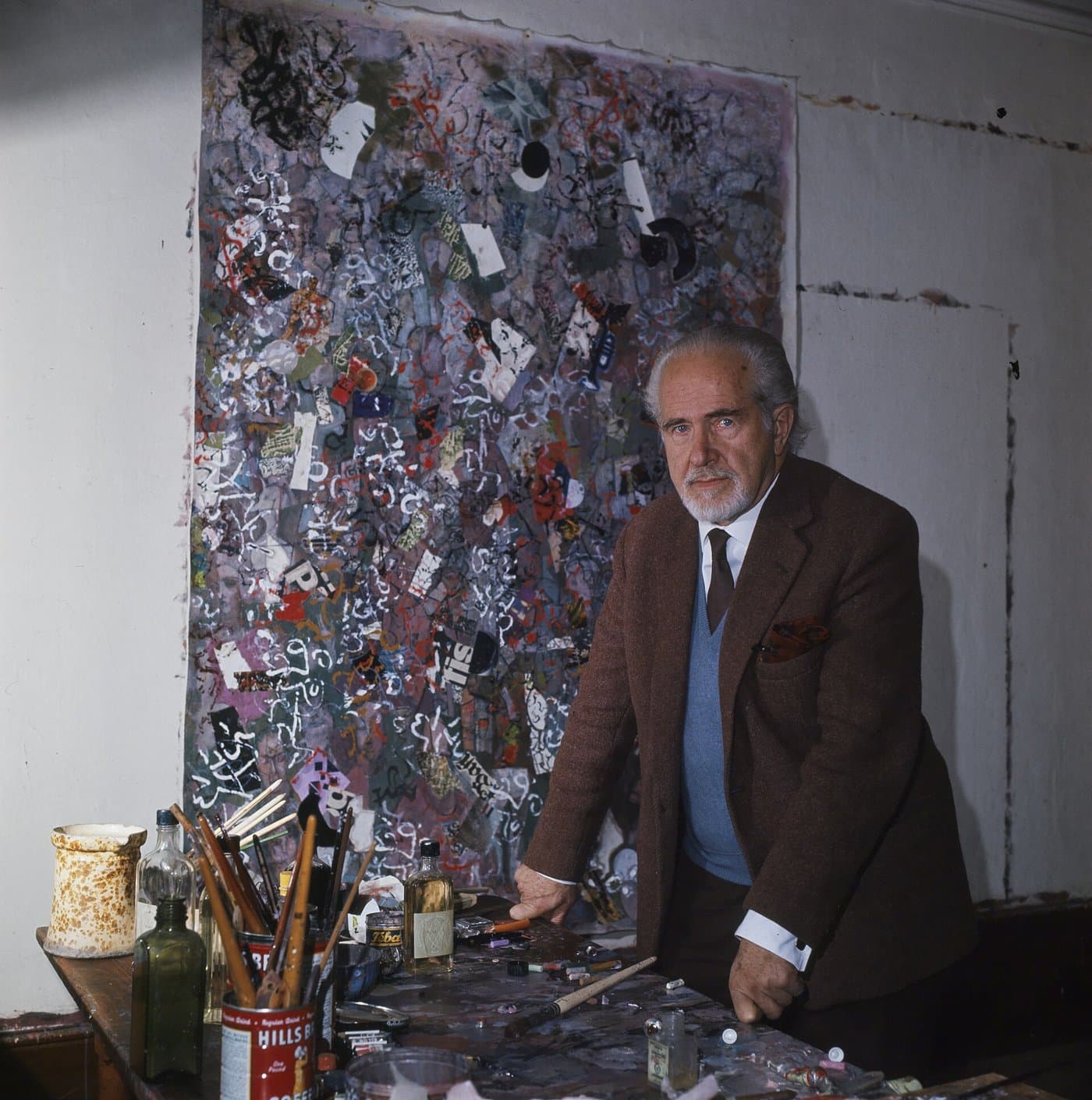
Mark Tobey was born in Wisconsin in 1890, converted to the Baha'i faith in 1918, and spent a month in a Zen monastery in Kyoto in 1934 studying calligraphy and meditation.
What a work by Mark Tobey is worth
Send photographs and whatever paperwork came with it. The first question is what the work actually is — edition or unique, when, and in what condition — because everything else follows from the answer. A valuation is free, made online from the photographs you send, and it commits you to nothing. We act for sellers across the United Kingdom, Europe and the United States.
Write to info@whitebankfineart.co.uk, or start below.
Bio
Mark Tobey was born in Wisconsin in 1890, converted to the Baha'i faith in 1918, and spent a month in a Zen monastery in Kyoto in 1934 studying calligraphy and meditation. What came out of it was white writing: all-over surfaces of small, pale, calligraphic strokes covering the entire picture with no centre and no hierarchy, arrived at years before Pollock's drip paintings and often cited in arguments about who got there first. He taught at Dartington Hall in England, worked in Seattle, won the painting prize at the Venice Biennale in 1958, and died in Basel in 1976.
Tobey worked small and mostly on paper in tempera, gouache and ink rather than on canvas, and that is the shape of the market: the works are intimate, the surfaces are matt and unvarnished, and light damage, foxing and mount-burn are the principal condition faults. The white writing works of the 1940s and 1950s lead. The market is spread between the United States, Switzerland and Japan. There is a print output in lithograph and etching from the 1960s and 1970s, published in modest editions.
At a glance
- Born
- 11 December 1890, Centerville
- Died
- 24 April 1976, Basel
- Movements
- Abstract Expressionism, Northwest School
More on Wikipedia.
Seattle, Dartington and the Northwest School
Tobey settled in Seattle in 1921 and taught on and off at the Cornish School. In 1929 a solo exhibition at Romany Marie's café gallery in New York caught the eye of Alfred H. Barr Jr., who chose pictures from it for the Museum of Modern Art the next year. The white writing began at night in his studio at Dartington Hall, and the first of it was shown in New York at the Willard Gallery.
His first solo show at the Seattle Art Museum was in 1935. Life magazine's 1953 article Mystic Painters of the Northwest named him, Guy Anderson, Kenneth Callahan and Morris Graves as the founders of the Northwest School. The Whitney showed him in 1951, and in the early 1960s he moved to Basel with his companion Pehr Hallsten.
Knoedler, the Willard Gallery and the Venice prize
Before Seattle he worked in New York as a fashion illustrator for McCall's and had his first one-man show at Knoedler in 1917. His Willard Gallery show of 1944 was a success, and Marian Willard commissioned Sidney Janis to write an essay separating Tobey's white writing, consciously directed, from the automatic writing of the Surrealists; Threading Light, of 1942, was in it. Jackson Pollock went to his Willard shows, and the question of who reached the all-over picture first has never been settled.
In 1958 he became the second American, after Whistler, to win the International Grand Prize at the Venice Biennale, and in 1961 the first American painter to show at the Pavillon de Marsan at the Louvre. MoMA gave him a solo show in 1962 and the Stedelijk in 1966, and the Smithsonian held a retrospective in 1974. A retrospective of the mature work, organised by the Addison Gallery and sponsored by the Peggy Guggenheim Collection, opened in Venice in 2017.
Whitebank Fine Art is an art advisory and gallery, not an auction house, and is not affiliated with any auction house or with the artist, their estate or their representatives. This page describes the range we advise on. Nothing here is investment advice.