

Maurice de Vlaminck valuation
Racing cyclist and violinist who painted with paint straight from the tube and never took a lesson.
Maurice de Vlaminck was born in Paris in 1876, earned his living as a racing cyclist and a violinist, and was proud of never having set foot in the Louvre for instruction.
What a work by Maurice de Vlaminck is worth
Send photographs and whatever paperwork came with it. The first question is what the work actually is — edition or unique, when, and in what condition — because everything else follows from the answer. A valuation is free, made online from the photographs you send, and it commits you to nothing. We act for sellers across the United Kingdom, Europe and the United States.
Write to info@whitebankfineart.co.uk, or start below.
Bio
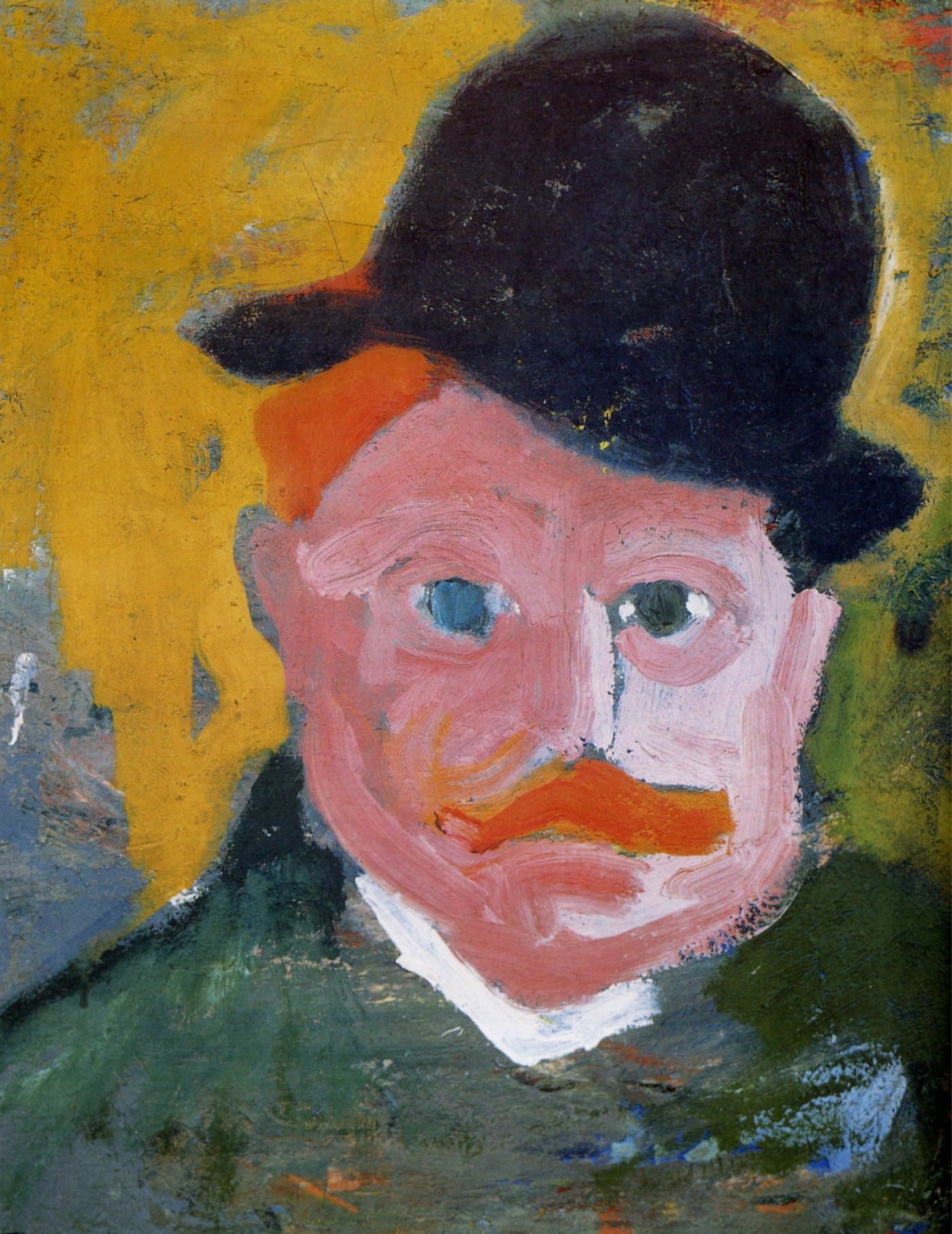
Maurice de Vlaminck was born in Paris in 1876, earned his living as a racing cyclist and a violinist, and was proud of never having set foot in the Louvre for instruction. He shared a studio at Chatou with Derain, saw the Van Gogh retrospective of 1901, and painted the most violent of all the Fauve pictures — pure vermilion and cobalt squeezed straight from the tube. He was among the first Europeans to collect African masks. After 1908 he moved towards Cezanne and then to the dark, heavy, snow-laden village landscapes that occupied the rest of his career. He died in 1958.
The Fauve years of 1904 to 1907 are a small group and are far ahead of everything else; the later landscapes are a very large field and are valued quite differently. Vlaminck is heavily forged, particularly in the later manner, which is easier to imitate, and expert opinion is normally required. His participation in the Nazi-organised artists' tour of Germany in 1941 is part of the record. He also made woodcuts and lithographs, and produced ceramics and illustrated books.
At a glance
- Born
- 4 April 1876, Paris
- Died
- 11 October 1958, Rueil-la-Gadelière
- Movements
- Fauvism, Cubism
More on Wikipedia.
Chatou, the Salon d'Automne and Rueil-la-Gadelière
Vlaminck met Derain by chance on a train in 1900, and the two then shared a studio at Chatou. He showed with Matisse, Derain and others at the Salon d'Automne of 1905, where the critic Louis Vauxcelles called them fauves, wild beasts, and Ambroise Vollard bought the contents of his studio the following year. In 1911 he painted the Thames in London, and in 1913 he worked with Derain at Marseille and Martigues.
He settled at Rueil-la-Gadelière, south-west of Paris, after the First World War, and died there in October 1958. He also wrote poetry, novels and memoirs. For a Fauve painting especially, an exhibition history and a provenance going back to his early dealers carry great weight.
Rue Pierre Lescot, Sur le zinc and the Chatou bridge
Vlaminck was born on the rue Pierre Lescot in Paris. His father, who was Flemish, taught the violin, and his mother, from Lorraine, taught the piano. He began painting in his late teens, studied in 1893 with a painter named Henri Rigalon on the Île de Chatou, and married Suzanne Berly in 1894. The studio he took with Derain in 1900, the Maison Levanneur, now houses the Cneai. In 1902 and 1903 he wrote several mildly pornographic novels, illustrated by Derain, and he painted by day and earned his living at night giving violin lessons and playing in bands.
Sur le zinc and L'Homme à la pipe, both of 1900, are among his first important paintings; the critic Souren Melikian called the drinker in Sur le zinc "the impersonal cartoon of a type". Sous bois followed in 1904, and from 1905 he broke the motif into dabs and streaks of colour in pictures such as Le Pont de Chatou, Les Ramasseurs de pommes de terre and Le Verger. He married his second wife, Berthe Combes, with whom he had two daughters, and from 1925 he travelled throughout France while painting mostly along the Seine. In June 1942 he published an attack on Picasso and Cubism in the periodical Comoedia.
Whitebank Fine Art is an art advisory and gallery, not an auction house, and is not affiliated with any auction house or with the artist, their estate or their representatives. This page describes the range we advise on. Nothing here is investment advice.
