

Fauvism
Fauvism was the first avant-garde movement of the twentieth century: a short burst of painting in pure, unnatural colour led by Henri Matisse and André Derain, named at the Salon d'Automne in Paris in 1905 and over by about 1908.
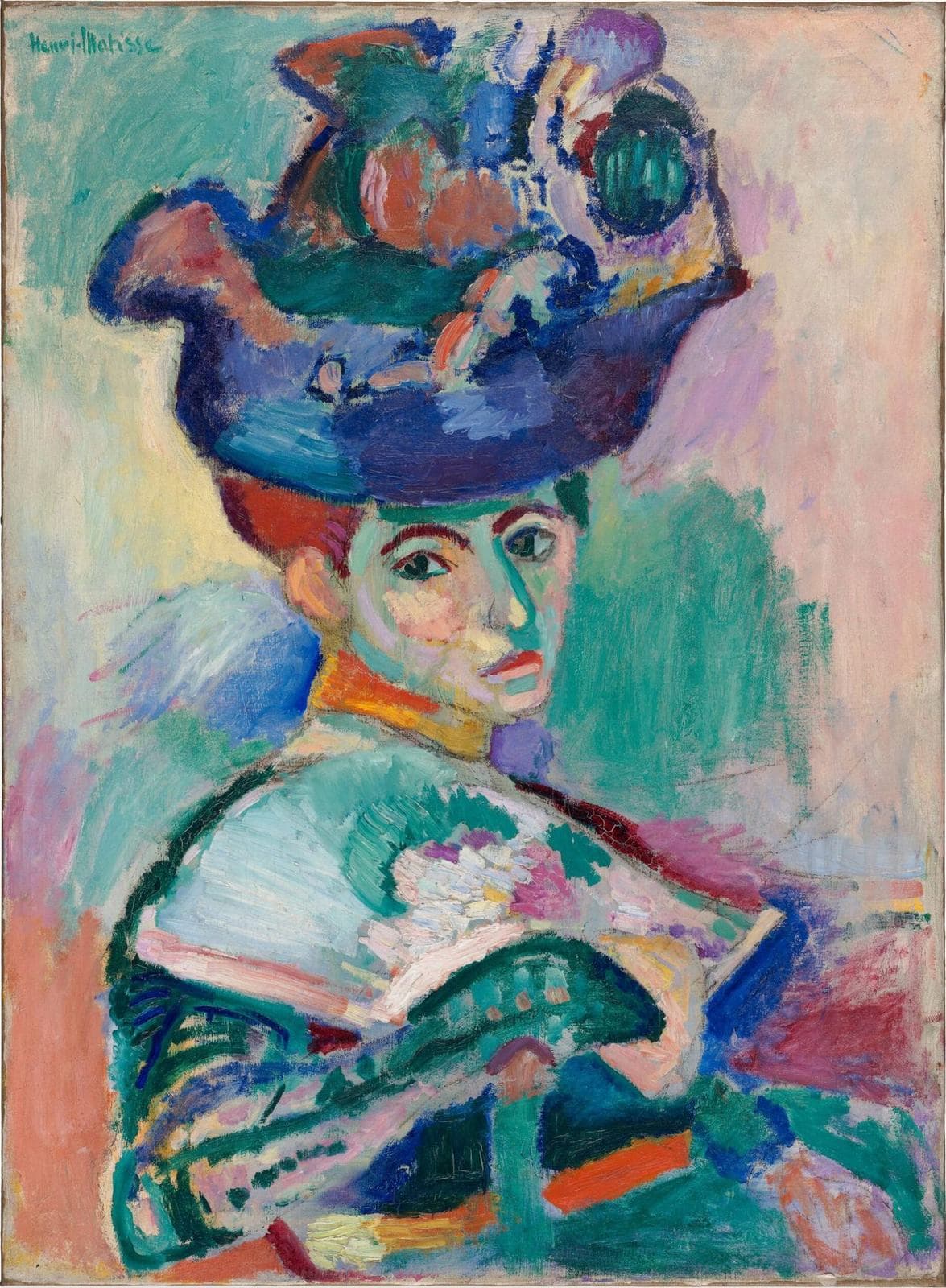
In the summer of 1905 Matisse and Derain painted together at Collioure, a fishing port near the Spanish border, in colours that had little to do with what they saw: pink seas, green faces, orange trees. When they showed the results at the Salon d'Automne that October, hung in one room with Maurice de Vlaminck, Albert Marquet, Henri Manguin and others, the critic Louis Vauxcelles noticed a conventional sculpture in the middle of it and called it 'Donatello among the wild beasts', les fauves. Matisse's Woman with a Hat, a portrait of his wife in slashes of green, violet and orange, caused the greatest stir, and was bought by the Steins.
The Fauves had no manifesto. They took colour from Van Gogh and Gauguin and the free touch from Signac's later manner, and used colour for its own sake, to build space and express feeling rather than to describe. Vlaminck and Derain worked side by side at Chatou, outside Paris; Raoul Dufy and Georges Braque, both from Le Havre, joined in 1906, and in Paris the Scottish painter John Duncan Fergusson took up the same colour and carried it home. It lasted barely three years: by 1908 Braque had turned to Cézanne and Cubism, Derain to a more classical manner, and Matisse went on alone with what Fauvism had started.
At a glance
- When
- 1905 to 1908
- Where
- Paris, Collioure and Chatou
- Leading artists
- Henri Matisse, Andre Derain, Maurice de Vlaminck, Raoul Dufy
Characteristics of Fauvism
- Pure, arbitrary colour
- Colour straight from the tube, chosen for intensity rather than to match nature.
- Colour as structure
- Space built from contrasts of warm and cool rather than from perspective or modelling.
- Bold, visible brushwork
- Broad, quick strokes, sometimes with bare canvas left between them.
- Simplified form
- Flattened shapes and strong outlines, after Gauguin.
- Ordinary subjects
- Landscapes, harbours, interiors and portraits: the radicalism is all in the colour.
Fauve artists
Every artist below has a page on this site, with a short biography and what a valuation of their work turns on.
The Fauves
- Henri MatisseTrained for the law, discovered painting in a sickbed, and ended cutting colour with scissors.
- Andre DerainPainted Collioure with Matisse in one summer and invented Fauvism, then spent forty years retreating from it.
- Maurice de VlaminckRacing cyclist and violinist who painted with paint straight from the tube and never took a lesson.
- Raoul DufyRegattas, racecourses and the Promenade des Anglais, drawn in ink and flooded with colour.
- Albert MarquetFauve for a season, then fifty years of quiet grey harbours seen from an upstairs window.
- Kees van DongenFauve colour applied to the women of Parisian society, who queued for it.
- Georges BraqueInvented Cubism alongside Picasso, then spent forty years quietly not being him.
Famous Fauve works
- Woman with a HatHenri Matisse, 1905, San Francisco Museum of Modern Art
- Open Window, CollioureHenri Matisse, 1905, National Gallery of Art, Washington
- Restaurant de la Machine at BougivalMaurice de Vlaminck, about 1905, Musée d'Orsay, Paris
- Le Bonheur de vivreHenri Matisse, 1905–06, Barnes Foundation, Philadelphia
- The Pool of LondonAndré Derain, 1906, Tate, London
What a valuation turns on
Fauve paintings are scarce: the movement was short and the best were bought early. What comes up more often is work from either side of it: Derain's and Vlaminck's later landscapes, Dufy's watercolours and gouaches of regattas, racecourses and the Riviera, Marquet's harbours, Van Dongen's portraits, and Matisse's prints and drawings. Date matters here more than with almost any other movement, because a Fauve picture of 1905 to 1907 and a work by the same hand twenty years later are different propositions.
Vlaminck painted a great deal and was much faked, and so was Dufy. For Matisse, the Archives Henri Matisse give opinions; for Dufy, Derain, Vlaminck, Marquet and Van Dongen there are catalogues raisonnés or committees, and a work none of them knows will be difficult to sell.
Common questions
What is Fauvism?
Fauvism was a short-lived movement in French painting, from 1905 to about 1908, which used pure, intense, unnatural colour and bold brushwork to express feeling rather than describe appearances. Henri Matisse and André Derain led it.
Why is it called Fauvism?
The critic Louis Vauxcelles, reviewing the Salon d'Automne of 1905, saw a conventional sculpture in a room of these paintings and called it 'Donatello among the wild beasts'. Fauves is French for wild beasts.
Who were the Fauve artists?
Henri Matisse, André Derain and Maurice de Vlaminck, with Albert Marquet, Henri Manguin, Charles Camoin, Kees van Dongen, Raoul Dufy, Othon Friesz and, briefly, Georges Braque.
What are the characteristics of Fauvism?
Pure colour straight from the tube, used for intensity rather than accuracy; space built from colour contrasts instead of perspective; broad, visible brushstrokes; simplified, flattened forms; and everyday subjects such as landscapes, harbours and portraits.
How do I sell a Fauve painting or a Dufy watercolour?
Send photographs of the front, the signature and the back, with any labels or certificates, for a free, confidential valuation. We check the work against the catalogue raisonné or committee for the artist, establish its date, and compare a confidential private sale with auction.
