

Otto Mueller valuation
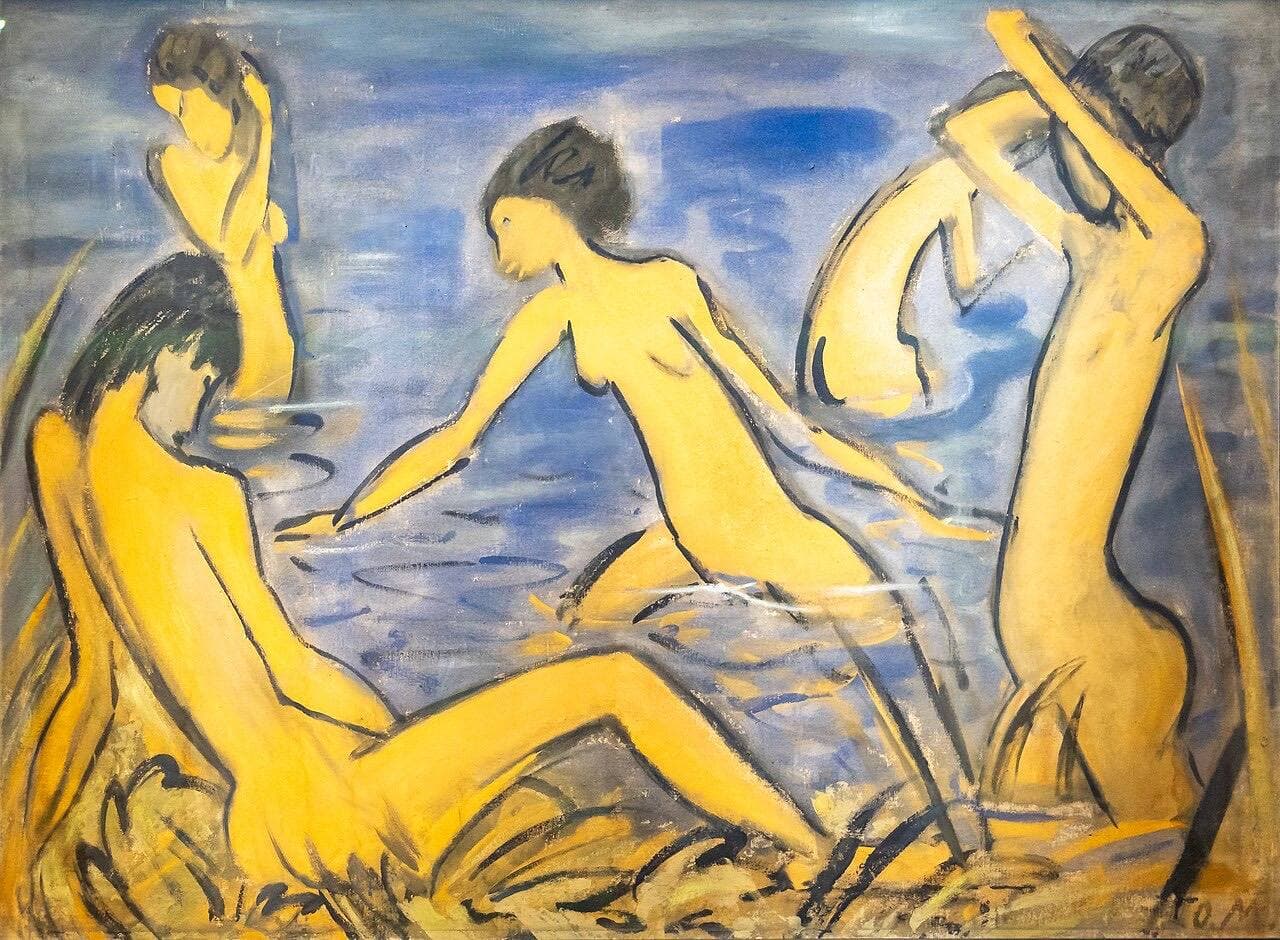
Painted thin nudes in reed beds in distemper on rough hessian, and nothing else much.
Otto Mueller was born in Silesia in 1874, trained in Dresden, and joined Die Brucke in 1910, staying with it to the end.
What a work by Otto Mueller is worth
Send photographs and whatever paperwork came with it. The first question is what the work actually is — edition or unique, when, and in what condition — because everything else follows from the answer. A valuation is free, made online from the photographs you send, and it commits you to nothing. We act for sellers across the United Kingdom, Europe and the United States.
Write to info@whitebankfineart.co.uk, or start below.
Bio
Otto Mueller was born in Silesia in 1874, trained in Dresden, and joined Die Brucke in 1910, staying with it to the end. His subject barely varied: slender, angular nudes standing in water, among reeds or under trees, and in the 1920s the Roma and Sinti communities he travelled among in the Balkans. The technique is unusual and immediately recognisable — matt distemper on coarse hessian or burlap, absorbent, chalky and completely without gloss. He taught at Breslau from 1919 and died of lung disease in 1930; the Nazis subsequently confiscated more than three hundred of his works.
The distemper technique is the central condition problem in this market. The paint is water-soluble, powdery and extremely vulnerable: it cannot be cleaned, it flakes, and it is damaged permanently by moisture, so surface condition is decisive and heavily restored examples are common. Provenance between 1933 and 1945 is unavoidable given the scale of confiscation. The lithographs, particularly the Zigeunermappe portfolio of 1927, are the most significant graphic work. The market is principally German, and forgeries of the reed-bed nudes exist in quantity.
At a glance
- Born
- 16 October 1874, Lubawka
- Died
- 24 September 1930, Wrocław
- Movement
- Expressionism
More on Wikipedia.
Görlitz, Dresden and Breslau
Mueller trained in lithography in Görlitz and Breslau from 1890 to 1892, then studied at the Dresden academy and briefly in Munich, where Franz von Stuck told him he had no talent; he destroyed much of his early work. He settled in Berlin in 1908, joined Die Brücke in 1910 and in 1911 travelled and worked with Kirchner. In the First World War he served as a soldier in France and Russia.
At the Breslau academy his pupils included Johnny Friedlaender and Isidor Aschheim. In 1937 the Nazis seized 357 of his works from German museums, others were taken from Jewish collectors such as the Littmann family, and several turned up in the Gurlitt hoard, so wartime provenance needs checking for any painting.
Whitebank Fine Art is an art advisory and gallery, not an auction house, and is not affiliated with any auction house or with the artist, their estate or their representatives. This page describes the range we advise on. Nothing here is investment advice.
