

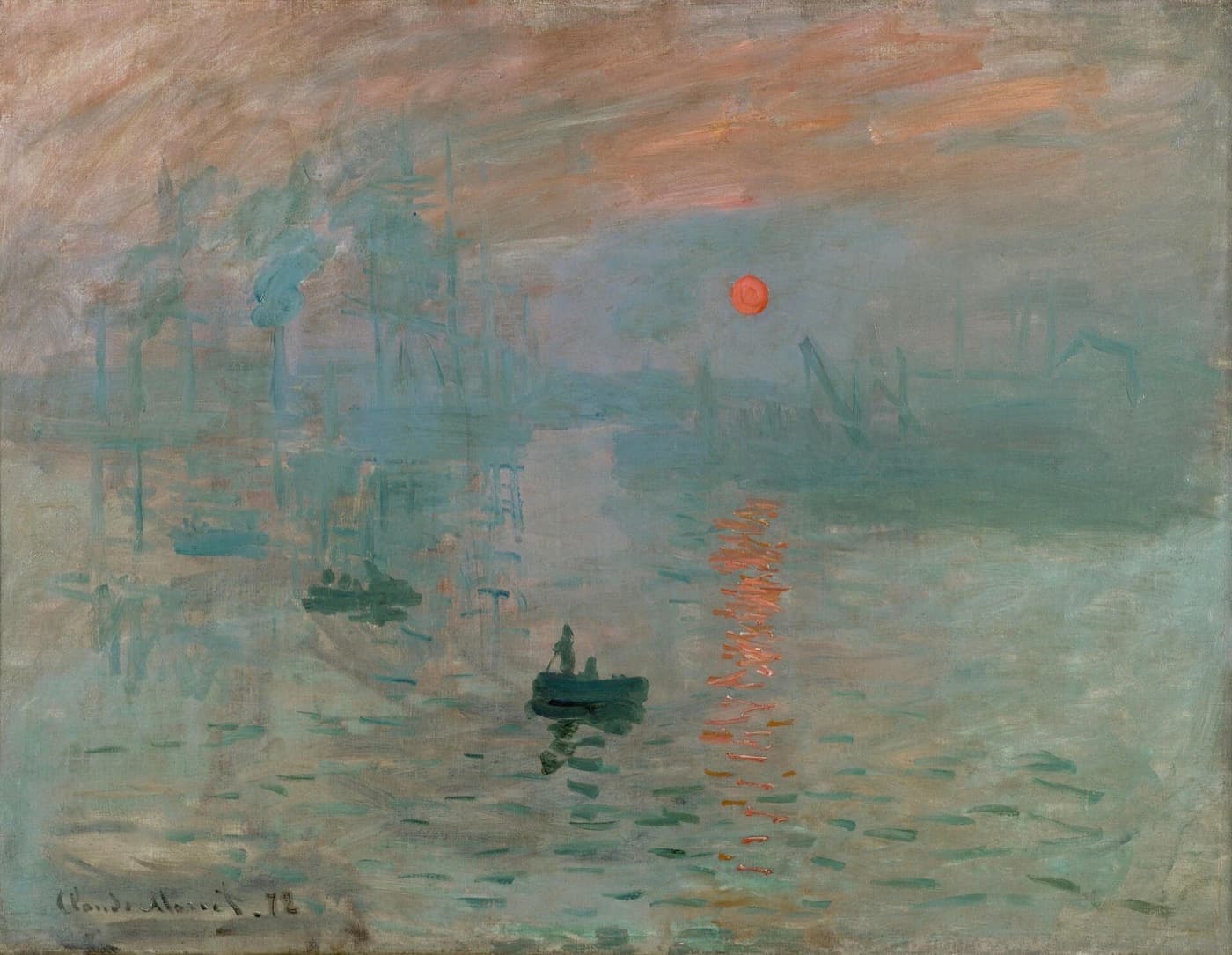
Impressionism
Impressionism was a movement of painters in Paris, led by Claude Monet, who from the late 1860s painted modern life and landscape out of doors, in quick, broken strokes of unmixed colour, to catch the passing effects of light.
The name began as an insult. In April 1874 a group of artists who had been turned away by the official Salon, or had given up on it, showed together in the photographer Nadar's former studio on the Boulevard des Capucines. Among Monet's entries was a view of the harbour at Le Havre in morning haze, Impression, Sunrise, and the critic Louis Leroy headed his mocking review 'The Exhibition of the Impressionists'. The artists took the word for themselves and held eight exhibitions between 1874 and 1886.
What held them together was method more than manner. They painted outdoors, en plein air, with the new paints sold in tin tubes; they laid colour down in separate touches instead of blending it, and let shadows go blue and violet rather than brown. Their subjects were the ones around them: the boulevards and railway stations of Haussmann's Paris, cafés and dance halls, regattas on the Seine at Argenteuil, gardens and riverbanks. By the 1880s the group was drifting apart, and its last exhibition, in 1886, included Seurat, whose method pointed somewhere else entirely.
At a glance
- When
- 1860s to 1886
- Where
- Paris and northern France
- Leading artists
- Claude Monet, Pierre-Auguste Renoir, Edgar Degas, Camille Pissarro
Characteristics of Impressionism
- Broken colour
- Short, separate strokes of unmixed colour, left for the eye to blend at a distance.
- Light and its changes
- The same motif painted at different hours and seasons, as in Monet's series of haystacks, poplars and Rouen Cathedral.
- Painting outdoors
- Landscapes begun, and often finished, in front of the motif and at speed, rather than worked up in the studio.
- Modern life
- Railway stations, boulevards, cafés, ballet rehearsals and suburban leisure in place of history, myth and religion.
- Coloured shadows
- Little black and no brown: shade is painted in blues and violets.
- Unexpected viewpoints
- Cropped, off-centre compositions, partly learned from photography and Japanese prints.
Impressionist artists
Every artist below has a page on this site, with a short biography and what a valuation of their work turns on.
The Impressionists
- Claude MonetPainted the same haystack, facade and lily pond over and over to catch what the light was doing.
- Pierre-Auguste RenoirPainted porcelain as a boy, then dappled light on skin for the rest of a very long career.
- Edgar DegasDrew dancers, laundresses and racehorses from angles nobody had thought to use.
- Camille PissarroThe only painter in all eight Impressionist exhibitions, and the teacher the others went to.
- Alfred SisleyThe Impressionist most faithful to landscape, painting the Seine and the Loing for thirty years.
- Berthe MorisotFounding Impressionist who painted women, children and gardens with a fast, feathery brush.
- Mary CassattAmerican who exhibited with the Impressionists in Paris and painted women's private lives, above all mothers and children.
- Gustave CaillebottePainted Paris's new boulevards, its rowers and floor scrapers, and paid for the Impressionists he exhibited with.
Before them, and beyond France
- Eugène BoudinPainter of Normandy beaches and big skies, who persuaded the teenage Monet to paint outdoors.
- Édouard ManetPainted modern Paris against the Salon's grain, and made Le Déjeuner sur l'herbe and Olympia the start of modern art.
- Max LiebermannBrought Impressionism to Germany, led the Berlin Secession, and was driven out of his own academy.
- Walter SickertPainted music halls, Camden Town bedrooms and Venice, and taught British painting to look at modern life.
Famous Impressionist works
- Impression, SunriseClaude Monet, 1872, Musée Marmottan Monet, Paris
- The CradleBerthe Morisot, 1872, Musée d'Orsay, Paris
- The Dance ClassEdgar Degas, 1874, Metropolitan Museum of Art, New York
- Bal du moulin de la GalettePierre-Auguste Renoir, 1876, Musée d'Orsay, Paris
- Paris Street; Rainy DayGustave Caillebotte, 1877, Art Institute of Chicago
- The Boulevard Montmartre at NightCamille Pissarro, 1897, National Gallery, London
What a valuation turns on
Most Impressionist paintings of the first rank are in museums, and what comes to market is more often a work on paper, an oil sketch, a pastel, a print, or a painting by one of the many artists who worked in the Impressionist manner in France, Britain and America after 1886. The questions are the same for all of them: is the work in the artist's catalogue raisonné, what does its provenance show, and has it been relined, cleaned or restored? For each of the principal Impressionists there is a catalogue raisonné, and for several a committee or institute that will give an opinion on a work not yet in it.
Wording matters. A work 'in the manner of' or 'after' Monet is, by those words, not by Monet, and an old label or invoice can carry a lot of weight either way. A signature is not proof on its own: the thousands of works sold from Degas's studio in 1918 and 1919 carry a red stamped 'Degas', which is the mark of those sales, not of the artist signing. Photographs of the front, the back and any labels are where a valuation starts.
Common questions
What is Impressionism?
Impressionism was a movement of painters in Paris from the late 1860s who painted modern life and landscape out of doors, in quick, broken strokes of unmixed colour, to record the passing effects of light. The name comes from Claude Monet's Impression, Sunrise, shown at the group's first exhibition in 1874.
Who were the main Impressionist painters?
Claude Monet, Pierre-Auguste Renoir, Edgar Degas, Camille Pissarro, Alfred Sisley, Berthe Morisot, Mary Cassatt and Gustave Caillebotte were the core of the group that exhibited together between 1874 and 1886. Édouard Manet, often grouped with them, never showed in their exhibitions.
When was the Impressionist movement?
The painters met in Paris in the 1860s, held their first group exhibition in April 1874 and their eighth and last in 1886. Several of them, Monet above all, went on painting in the same way well into the twentieth century.
What is the difference between Impressionism and Post-Impressionism?
Impressionism records what the eye sees in a moment. Post-Impressionism is a name given in 1910 to the artists who came after it and took its colour in other directions: Cézanne towards structure, Van Gogh and Gauguin towards emotion and symbol, Seurat towards a system.
How do I sell an Impressionist painting?
Send photographs of the front, the signature and the back, with any labels, invoices or letters, for a free, confidential valuation. Whether the work is in the artist's catalogue raisonné is usually the first question. We check it, compare a confidential private sale with auction, and keep the paperwork in your name until you are paid.
